
I kept seeing the Solana conversation revolve around TPS and speed, but the more interesting story right now is happening underneath the network.
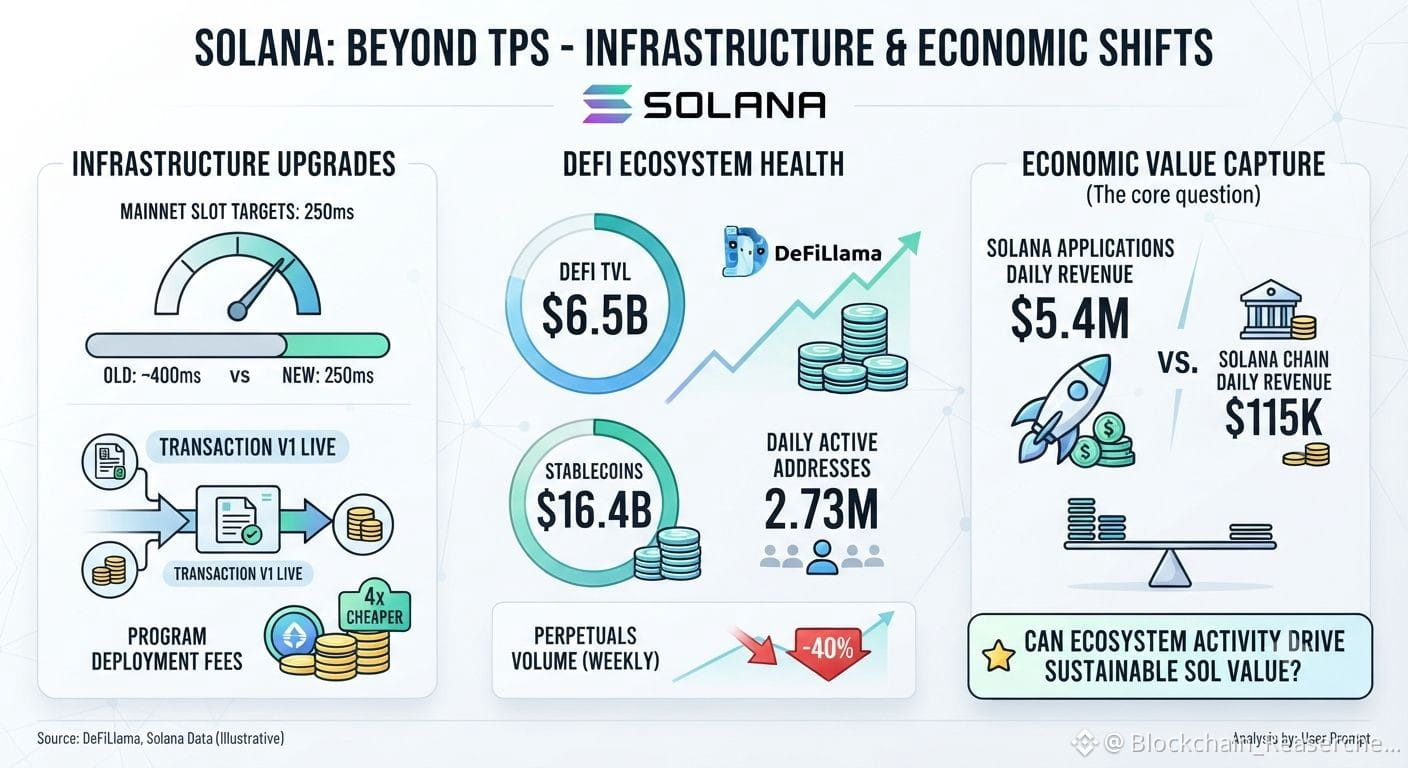
Solana has just pushed mainnet slot targets down to 250ms, while Transaction V1 is now live and makes some program deployments up to 4× cheaper in transaction fees. That is a real infrastructure change, not just another roadmap bullet.
But here’s the part I find more interesting.
DeFiLlama currently shows roughly $6.5B in DeFi TVL, $16.4B in stablecoins, and 2.73M active addresses over 24 hours. Yet perpetuals volume is down almost 40% over the week. At the same time, Solana applications are generating about $5.4M in daily revenue, versus roughly $115K for the chain itself.
That combination matters.
It suggests Solana’s ecosystem can keep attracting liquidity and users even while one of the most speculative parts of the market cools down.
And it exposes an important distinction: network usage is not the same thing as token value capture.
The chain can process transactions, applications can earn millions, stablecoin liquidity can expand—and SOL itself still has to capture enough of that economic activity to justify its valuation.
That’s the question I’d watch more closely than another headline about TPS:
Can Solana turn growing application-level activity into stronger, sustainable economic value for the SOL asset itself?
#Solana
Solana has just pushed mainnet slot targets down to 250ms, while Transaction V1 is now live and makes some program deployments up to 4× cheaper in transaction fees. That is a real infrastructure change, not just another roadmap bullet.
But here’s the part I find more interesting.
DeFiLlama currently shows roughly $6.5B in DeFi TVL, $16.4B in stablecoins, and 2.73M active addresses over 24 hours. Yet perpetuals volume is down almost 40% over the week. At the same time, Solana applications are generating about $5.4M in daily revenue, versus roughly $115K for the chain itself.
That combination matters.
It suggests Solana’s ecosystem can keep attracting liquidity and users even while one of the most speculative parts of the market cools down.
And it exposes an important distinction: network usage is not the same thing as token value capture.
The chain can process transactions, applications can earn millions, stablecoin liquidity can expand—and SOL itself still has to capture enough of that economic activity to justify its valuation.
That’s the question I’d watch more closely than another headline about TPS:
Can Solana turn growing application-level activity into stronger, sustainable economic value for the SOL asset itself?
#Solana