
#polymarketbankfailurebetsdrawfdicconcern
🚨 Polymarket’s Bank-Failure Bets Are Drawing FDIC Attention
Prediction markets are increasingly moving into areas that regulators normally watch closely.
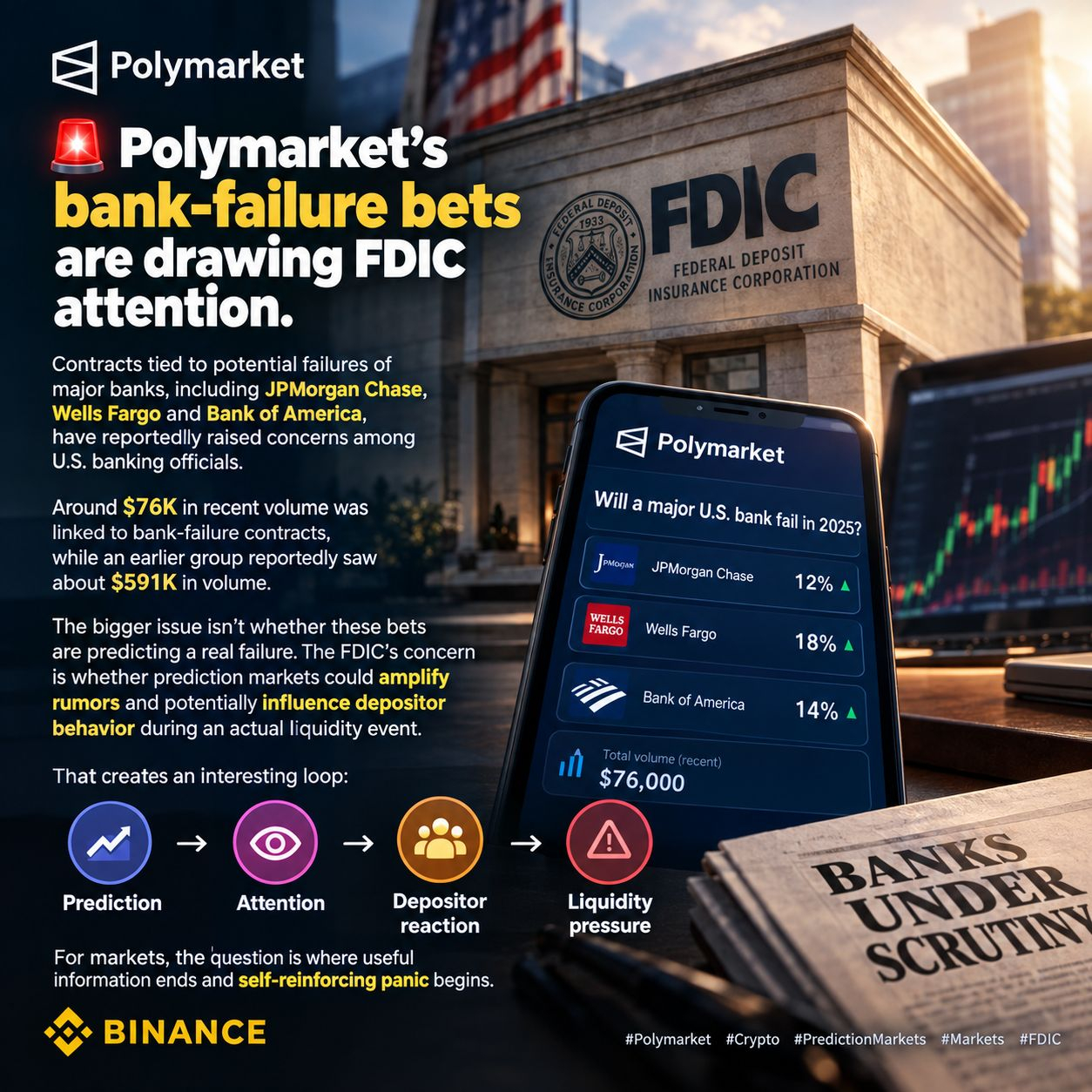
Polymarket contracts tied to potential failures of major banks — including JPMorgan Chase, Wells Fargo and Bank of America — have reportedly drawn scrutiny from US banking officials, according to Bloomberg.
The contracts are still relatively small compared with the broader prediction-market ecosystem. Recent wagers tied to banks failing by the end of 2026 had around $76,000 in total volume, while an earlier group of bank-failure contracts generated about $591,000.
But the size of the market isn't the only issue.
🏦 Why is the FDIC paying attention?
The Federal Deposit Insurance Corporation reportedly discussed whether these contracts could create risks if they became larger and more influential.
The concern is not simply that traders are betting on whether a bank will fail.
It's what could happen after the prediction gets attention.
A prediction market can turn a possibility into a highly visible headline. If enough people see a market suggesting that a bank could fail, that information could potentially influence how depositors behave.
That creates a feedback loop worth watching:
Prediction → attention → depositor reaction → liquidity pressure
Bloomberg reported that FDIC officials specifically considered whether these contracts could eventually contribute to a real-world bank run. The agency also discussed whether its existing ethics rules were sufficient to prevent employees with access to confidential information from trading on such markets.
📊 But a prediction isn't proof of a bank problem
This distinction matters.
The existence of a market where traders can bet on a bank failure doesn't mean the bank is actually approaching failure.
In fact, research from the Federal Reserve Bank of Richmond published in 2026 notes that bank failures are generally preceded by weak fundamentals such as poor loan performance, low capital or declining earnings. Depositor runs can accelerate a crisis, but the research says they are rarely the fundamental root cause.
So traders shouldn't automatically interpret prediction-market activity as a fundamental signal.
It's another piece of information — and one that needs context.
🔄 The interesting part: markets can influence what they measure
This is where prediction markets become particularly interesting.
Normally, markets are expected to reflect information.
But when the underlying event involves human behavior, the market itself can potentially become part of the information environment.
Imagine a scenario:
A prediction market shows increased trading around a potential bank failure.
↓
The market receives attention on social media.
↓
More people become aware of the possibility.
↓
Some depositors become concerned and move money.
↓
The bank experiences additional liquidity pressure.
The original prediction hasn't necessarily been correct.
Yet the attention surrounding it could potentially affect the outcome.
That's the regulatory concern worth watching.
🌐 Why this matters for crypto
Crypto traders are already familiar with prediction markets becoming a real-time source of market sentiment.
Polymarket covers everything from crypto and finance to politics, sports and technology. The expansion into financial-system events creates a different question:
Where does information discovery end and market influence begin?
For crypto, this matters because prediction markets increasingly sit at the intersection of trading, information and social media.
A market can move quickly when a headline breaks. But the headline can also change what traders believe, which can change their behavior.
That's why volume alone shouldn't be treated as confirmation.
👀 What traders should watch
For markets, the important signals are likely to be:
Changes in prediction-market volume
Whether major financial news confirms the underlying narrative
Bank deposit and liquidity data
Credit-market stress
Official statements from regulators
Whether social-media discussion begins accelerating
Whether actual bank fundamentals are changing
The FDIC's reported concerns don't establish that any of the named banks are facing imminent failure.
The more interesting question is whether prediction markets can remain information tools without becoming catalysts for the events they're measuring.
My take
Prediction markets are designed to aggregate information.
But when the event being predicted is a potential bank failure, the information itself can influence behavior.
That's the loop traders should keep an eye on:
Prediction → attention → reaction → liquidity.
The line between predicting a market event and influencing it could become increasingly important as prediction markets expand into financial-system risks.
#Polymarket #Crypto #PredictionMarkets #Markets #FDIC #Banking #Trading