#polymarketbankfailurebetsdrawfdicconcern
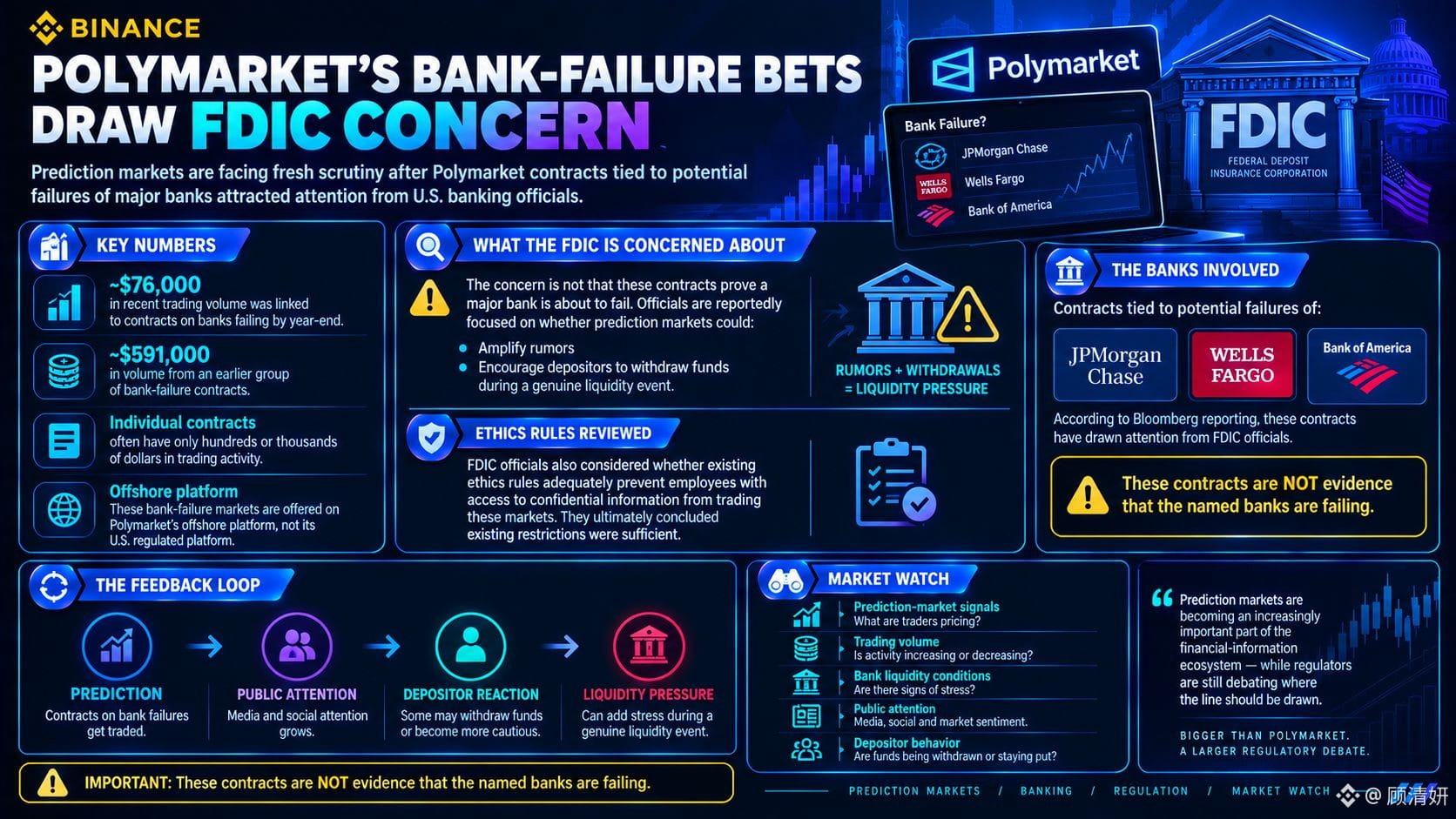
🚨 POLYMARKET’S BANK-FAILURE BETS DRAW FDIC CONCERN
Prediction markets are facing fresh scrutiny after Polymarket contracts tied to potential failures of major banks attracted attention from U.S. banking officials.
According to Bloomberg reporting, contracts involving banks such as JPMorgan Chase, Wells Fargo and Bank of America have raised concerns at the Federal Deposit Insurance Corporation (FDIC).
🔎 KEY NUMBERS
• Around $76,000 in recent trading volume was linked to contracts on banks failing by year-end
• An earlier group of bank-failure contracts reportedly generated about $591,000 in volume
WHY THE FDIC IS WATCHING
Officials are reportedly focused on the possibility that larger prediction markets could amplify rumors or encourage depositors to withdraw funds, potentially creating additional pressure on a bank during a genuine liquidity event.
FDIC officials also considered whether existing ethics rules adequately prevent employees with access to confidential information from trading these markets. They ultimately concluded that existing restrictions were sufficient.
🌐 WHY IT MATTERS FOR MARKETS
Prediction markets are increasingly being used to price probabilities around real-world events.
But bank-failure contracts create a unique feedback loop:
Prediction → Public attention → Depositor reaction → Liquidity pressure
That makes the regulatory debate bigger than Polymarket itself.
For crypto traders, the broader takeaway is that prediction markets are becoming an increasingly important part of the financial-information ecosystem — while regulators are still debating where the line should be drawn.
⚠️ Important: These contracts are not evidence that the named banks are failing. Trading volume remains relatively small compared with traditional financial markets.
Could prediction markets become useful early-warning indicators — or create the very panic they are trying to measure?
$KMNO $2Z $MARSCOIN
🚨 POLYMARKET’S BANK-FAILURE BETS DRAW FDIC CONCERN
Prediction markets are facing fresh scrutiny after Polymarket contracts tied to potential failures of major banks attracted attention from U.S. banking officials.
According to Bloomberg reporting, contracts involving banks such as JPMorgan Chase, Wells Fargo and Bank of America have raised concerns at the Federal Deposit Insurance Corporation (FDIC).
🔎 KEY NUMBERS
• Around $76,000 in recent trading volume was linked to contracts on banks failing by year-end
• An earlier group of bank-failure contracts reportedly generated about $591,000 in volume
WHY THE FDIC IS WATCHING
Officials are reportedly focused on the possibility that larger prediction markets could amplify rumors or encourage depositors to withdraw funds, potentially creating additional pressure on a bank during a genuine liquidity event.
FDIC officials also considered whether existing ethics rules adequately prevent employees with access to confidential information from trading these markets. They ultimately concluded that existing restrictions were sufficient.
🌐 WHY IT MATTERS FOR MARKETS
Prediction markets are increasingly being used to price probabilities around real-world events.
But bank-failure contracts create a unique feedback loop:
Prediction → Public attention → Depositor reaction → Liquidity pressure
That makes the regulatory debate bigger than Polymarket itself.
For crypto traders, the broader takeaway is that prediction markets are becoming an increasingly important part of the financial-information ecosystem — while regulators are still debating where the line should be drawn.
⚠️ Important: These contracts are not evidence that the named banks are failing. Trading volume remains relatively small compared with traditional financial markets.
Could prediction markets become useful early-warning indicators — or create the very panic they are trying to measure?
$KMNO $2Z $MARSCOIN