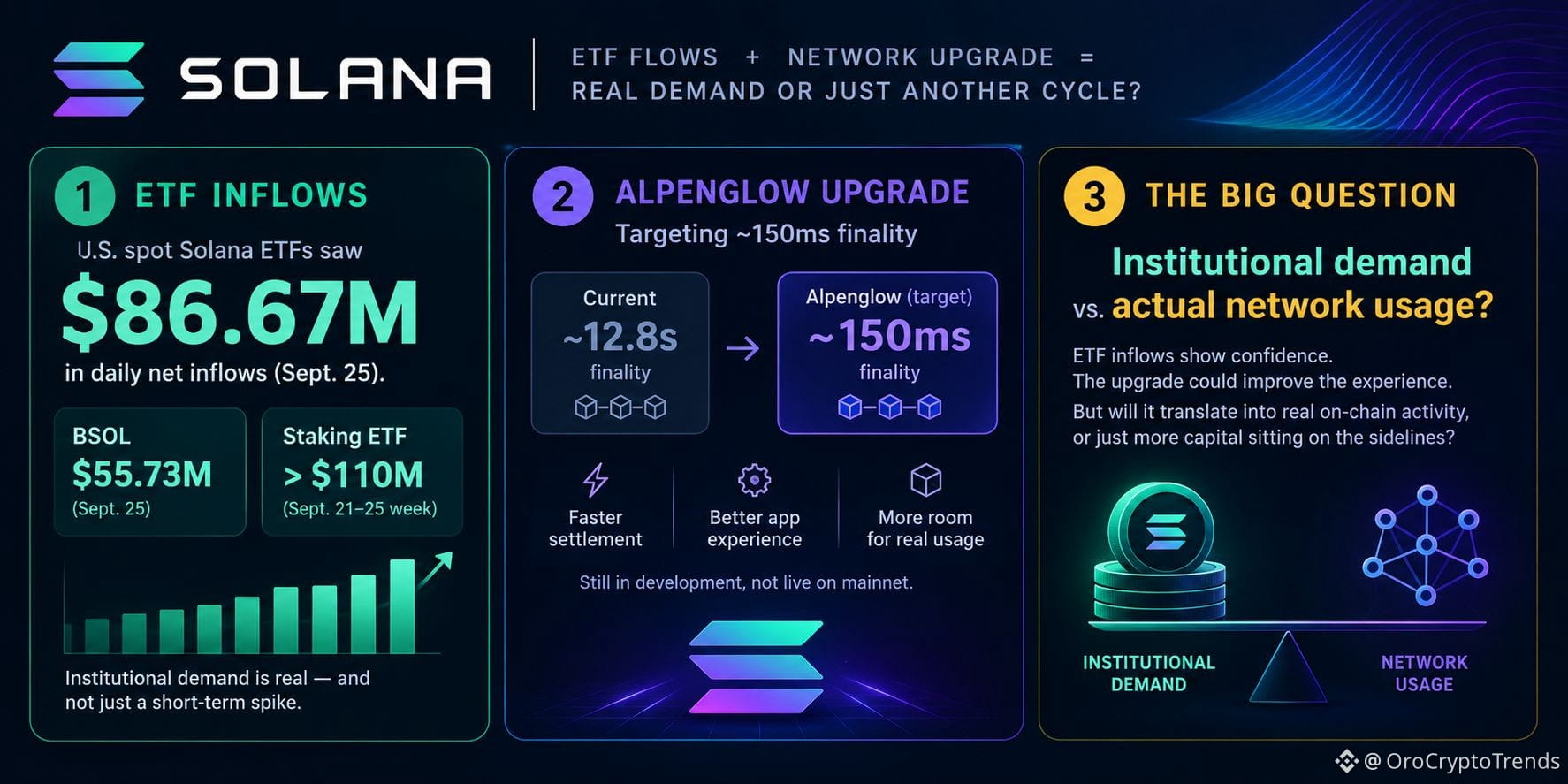

$SOL $86.67M flowed into U.S. spot Solana ETFs in one day. That’s the part everyone is going to notice.
But honestly, I think the more interesting question is what happens underneath that headline.
BSOL alone pulled in $55.73M on Sept. 25, and Bitwise says the staking ETF brought in more than $110M across the Sept. 21–25 trading week. That’s not just a random SOL trading spike. There is clearly real demand for regulated exposure to SOL, including exposure that generates staking rewards.
And then there’s the infrastructure side.
Alpenglow is targeting roughly 150ms finality, down from about 12.8 seconds under the current consensus design. That could matter much more than another short-term chart breakout if it actually improves the experience for financial applications and high-frequency settlement. But it’s still an upgrade in development, not a finished mainnet reality.
So I’m not reading the ETF flows as “SOL goes up.”
I’m reading them as a test.
Can institutional demand keep growing while the network turns better infrastructure into actual usage?
That’s the part I’m watching.
Still trying to figure out what this actually changes.
But honestly, I think the more interesting question is what happens underneath that headline.
BSOL alone pulled in $55.73M on Sept. 25, and Bitwise says the staking ETF brought in more than $110M across the Sept. 21–25 trading week. That’s not just a random SOL trading spike. There is clearly real demand for regulated exposure to SOL, including exposure that generates staking rewards.
And then there’s the infrastructure side.
Alpenglow is targeting roughly 150ms finality, down from about 12.8 seconds under the current consensus design. That could matter much more than another short-term chart breakout if it actually improves the experience for financial applications and high-frequency settlement. But it’s still an upgrade in development, not a finished mainnet reality.
So I’m not reading the ETF flows as “SOL goes up.”
I’m reading them as a test.
Can institutional demand keep growing while the network turns better infrastructure into actual usage?
That’s the part I’m watching.
Still trying to figure out what this actually changes.