
✅️🤝✅️


Publier

EmaLili
·
--
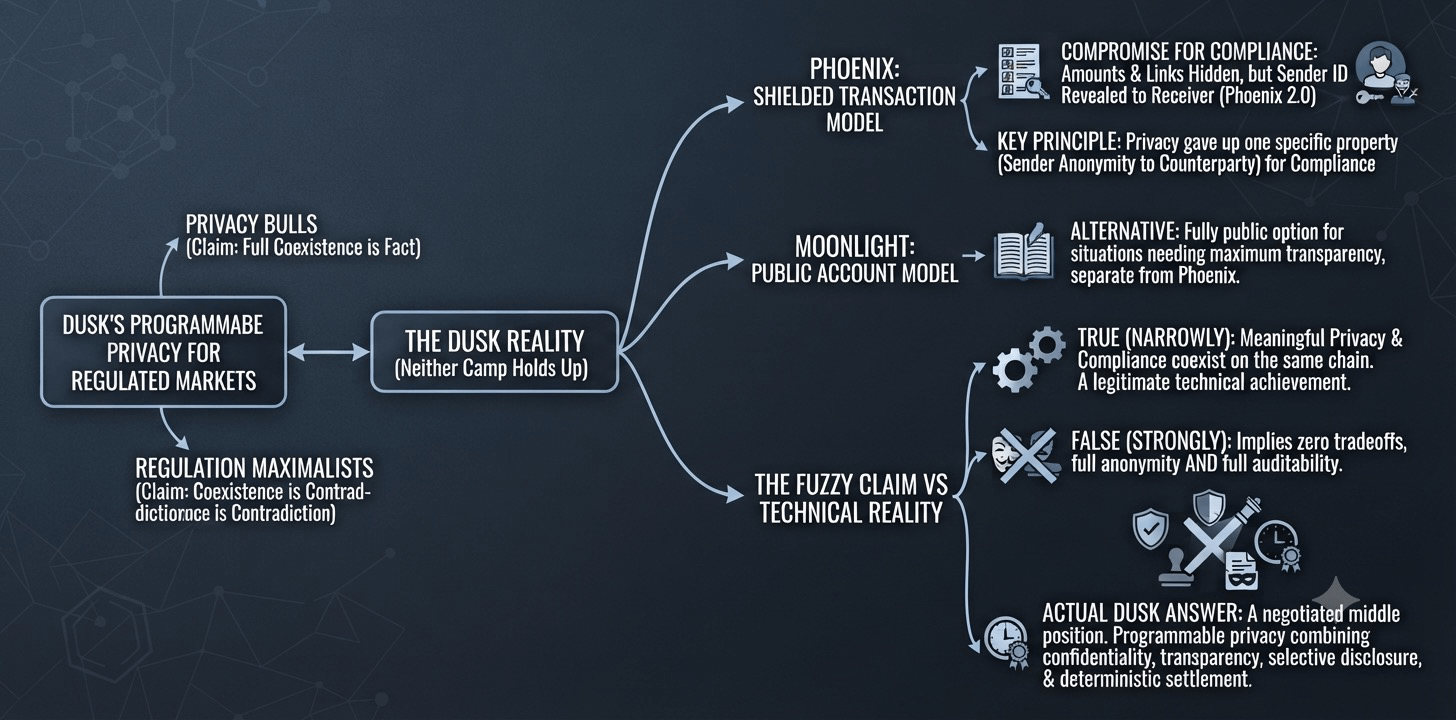
"Privacy and regulatory compliance can fully coexist on-chain." I hear this framed as settled fact by people bullish on privacy tech and as an obvious contradiction by people who think regulators will always demand full transparency eventually. Neither version holds up cleanly once you look at what Dusk actually built to test the claim. Both camps tend to argue from conviction rather than from what Dusk's documentation specifies, a narrower claim than either side wants it to be.
Phoenix, Dusk's shielded transaction model, achieves its version of compliant privacy through a specific compromise: transaction amounts and links stay hidden from the public, but Phoenix 2.0 was updated so the sender's identity is revealed to the receiver, precisely to satisfy exchange and regulatory requirements. That's not full privacy coexisting untouched alongside full compliance. It's privacy that gave up one specific property, sender anonymity toward the counterparty, in exchange for staying compliant. Moonlight, the fully public account model sitting next to Phoenix, exists as a separate, non-private option entirely for situations where even that compromise isn't enough.
The fuzzy claim is true in a narrow sense: Dusk has genuinely built infrastructure where meaningful privacy and meaningful compliance operate on the same chain, and that's a legitimate technical achievement most projects haven't matched. It's false in the stronger sense some people mean, implying zero tradeoffs, full anonymity plus full auditability at once. Dusk's actual answer is neither pure privacy nor pure transparency, but a negotiated middle position chosen deliberately. Anyone reading "coexist" as "without compromise" is reading more certainty into the claim than Dusk's architecture delivers. What Dusk actually offers is programmable privacy for regulated markets, combining confidentiality with transparency, selective disclosure and deterministic settlement, useful without being the maximalist version of the claim people keep repeating.
#dusk $DUSK @Dusk
Phoenix, Dusk's shielded transaction model, achieves its version of compliant privacy through a specific compromise: transaction amounts and links stay hidden from the public, but Phoenix 2.0 was updated so the sender's identity is revealed to the receiver, precisely to satisfy exchange and regulatory requirements. That's not full privacy coexisting untouched alongside full compliance. It's privacy that gave up one specific property, sender anonymity toward the counterparty, in exchange for staying compliant. Moonlight, the fully public account model sitting next to Phoenix, exists as a separate, non-private option entirely for situations where even that compromise isn't enough.
The fuzzy claim is true in a narrow sense: Dusk has genuinely built infrastructure where meaningful privacy and meaningful compliance operate on the same chain, and that's a legitimate technical achievement most projects haven't matched. It's false in the stronger sense some people mean, implying zero tradeoffs, full anonymity plus full auditability at once. Dusk's actual answer is neither pure privacy nor pure transparency, but a negotiated middle position chosen deliberately. Anyone reading "coexist" as "without compromise" is reading more certainty into the claim than Dusk's architecture delivers. What Dusk actually offers is programmable privacy for regulated markets, combining confidentiality with transparency, selective disclosure and deterministic settlement, useful without being the maximalist version of the claim people keep repeating.
#dusk $DUSK @Dusk
Avertissement : ce contenu inclut des opinions de tiers. Il ne constitue pas un conseil. Binance Ai peut être utilisée, sans garantie de résultat. Consultez les CG.