

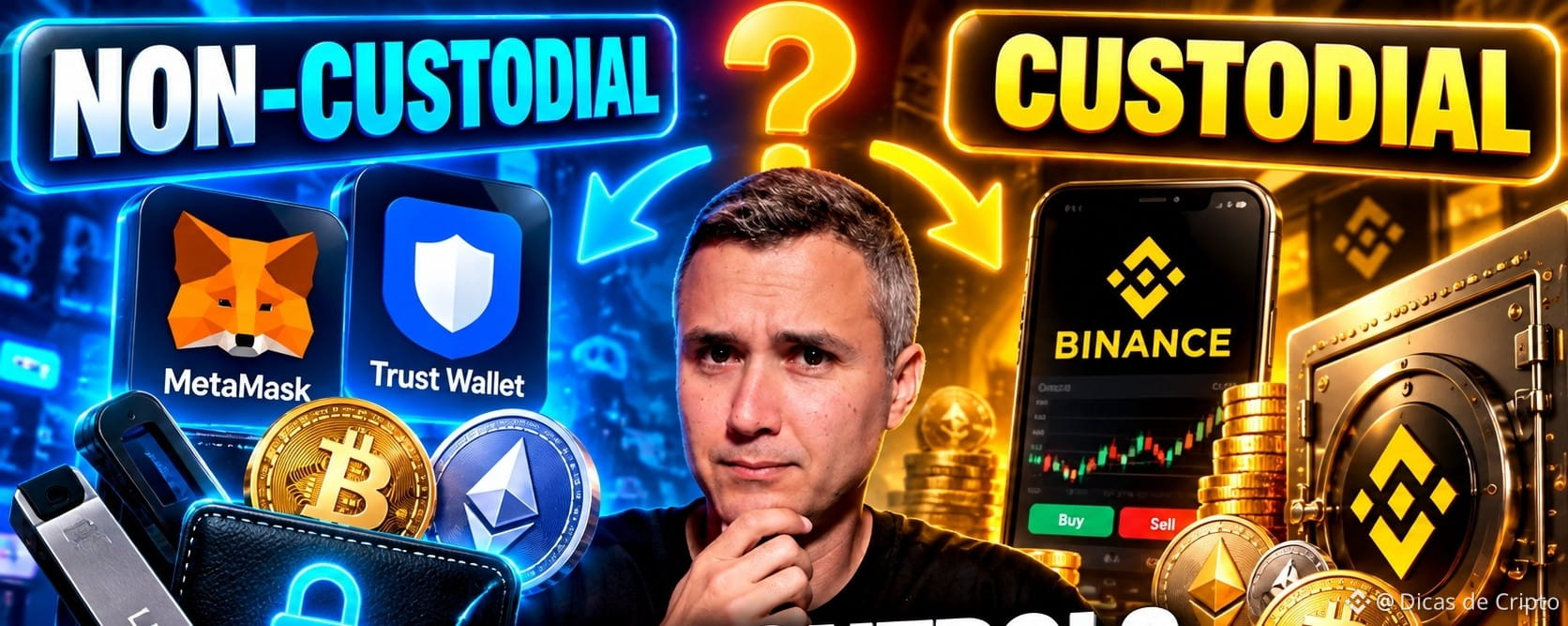


Custodial vs. Non-Custodial Wallets: Which One Should You Choose? (MetaMask, Trust Wallet or Binance) 🛡️
When you first enter the cryptocurrency market, it’s common to come across names like MetaMask and Trust Wallet, along with technical terms that can feel like a completely different language.
One of the first questions you’ll probably ask is:
Where should I store my crypto safely?
To answer that, you need to understand the fundamental difference between a Custodial Wallet and a Non-Custodial Wallet.
Choosing the wrong option can be costly, so let’s take a look at how each one works and which option may be more suitable for your needs.
🏦 What Is a Custodial Wallet? (Example: Binance)
The word “custody” basically means safekeeping.
With a custodial wallet, a third-party company holds and manages your crypto on your behalf, working in a way that is somewhat similar to a traditional bank.
For example, when you keep your crypto in your Binance account, Binance provides the custody infrastructure for your funds and manages the private-key side of the assets.
✅ Advantages:
Easy account recovery: If you forget your password, you can use the account recovery process to regain access.
Convenient for trading: Your funds are already available for buying, selling, or exchanging without needing to move them on-chain and pay network fees for every internal transaction.
Beginner-friendly: Centralized exchanges generally offer simple and intuitive interfaces.
❌ Disadvantages:
The famous crypto saying applies here:
“Not your keys, not your coins.”
You are trusting the platform to safeguard your assets and provide access to them.
🦊 What Is a Non-Custodial Wallet? (Example: MetaMask and Trust Wallet)
With a non-custodial wallet, you are your own bank.
A non-custodial, or self-custody, wallet gives you full control over your assets through your private keys or Secret Recovery Phrase (seed phrase), usually consisting of 12 or 24 words.
Apps such as MetaMask and Trust Wallet, as well as hardware wallets like Ledger and Trezor, don't hold your crypto in the traditional sense. Instead, they provide the tools you need to manage your assets and interact directly with blockchain networks.
✅ Advantages:
Full control: You control your wallet and its private keys rather than relying on a centralized exchange to hold them for you.
Web3 access: Non-custodial wallets are commonly used to interact with decentralized applications (dApps), DeFi protocols, NFT marketplaces, blockchain games, and other Web3 services.
Greater self-custody: You don't need to rely on a centralized platform to access your on-chain assets.
❌ Disadvantages:
No password recovery from a central provider: If you permanently lose your Secret Recovery Phrase or private keys, you may lose access to your funds.
You are responsible for security: If someone obtains your seed phrase, they may be able to control the assets in your wallet.
More responsibility: With self-custody, you are responsible for securely backing up your recovery phrase and protecting it from theft, phishing, and other threats.
⚖️ Custodial vs. Non-Custodial: Which One Should You Choose?
There isn't one option that is universally better for everyone.
A practical approach can be to use both, but for different purposes.
1. 🏦 Beginners, Trading and Frequent Transactions — Custodial
If you trade frequently, need convenient access to fiat on-ramps or P2P services, or simply prefer the convenience of account recovery, you may choose to keep your trading funds on a reputable centralized exchange such as Binance.
2. 🦊 Long-Term Self-Custody and DeFi — Non-Custodial
If you want to take direct control of your on-chain assets or explore the DeFi and Web3 ecosystem, a non-custodial wallet such as MetaMask or Trust Wallet can be useful.
For larger long-term holdings, some users also consider hardware wallets such as Ledger or Trezor for additional security.
🔐 The Key Is Understanding the Trade-Off
The most important thing is not simply choosing one type of wallet.
It's understanding the trade-off between convenience and control.
With custodial platforms, you generally get greater convenience and account-recovery options, but you depend on a third party.
With non-custodial wallets, you have greater control over your assets, but you also take on full responsibility for protecting your private keys and recovery phrase.
Never store your seed phrase online, share it with anyone, or enter it into a website or form unless you fully understand why it is required.
Your crypto security starts with understanding who controls the keys.
🎯 Ready to Get Started?
If you're looking for a convenient way to start trading crypto, you can create a Binance account here:
👉 binance.com/join?ref=361555389
(Did you enjoy this content? Like and follow the profile for more crypto tips every day! 🚀) #BTC #crypto