


ETFs and institutional capital may be smoothing out crypto's wildest swings. Here's the data behind the thesis, and where it could break down.
📉 Every crash used to feel catastrophic. The last one didn't, and that's not a coincidence, it's a trend you can actually measure.
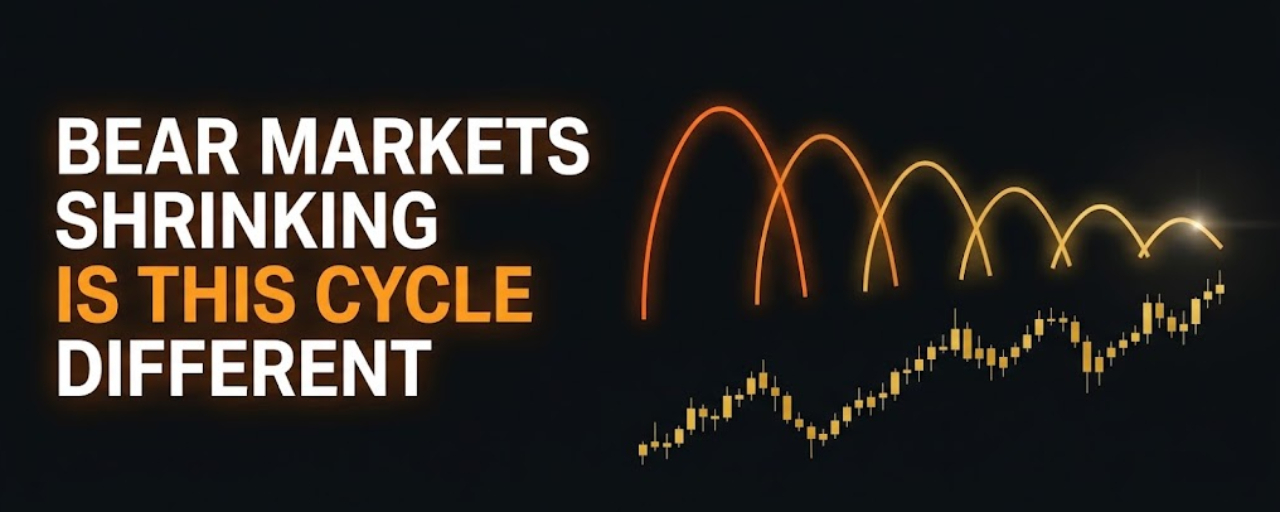
Bitcoin has now been through seven distinct bear markets since 2014. Line them upside by side and one pattern stands out immediately, each one has hit less hard than the last.
📊 Let's look at the actual numbers.
The two worst drawdowns in Bitcoin's history, 2014-2015 and 2018-2019, both wiped out roughly 83% of its value, triggered by real structural failures, the Mt. Gox collapse and the ICO bubble bursting. The 2022-2023 bear market, following Terra's implosion and FTX's collapse, was still painful, but noticeably shallower than those earlier crashes. Every major down cycle since has softened compared to the one before it.
🏦 So why does this keep happening?
The leading theory ties directly to how much the market has broadened. More institutional money, spot ETFs, corporate balance sheets holding BTC, regulated custody solutions, tends to dampen extreme price swings in both directions. Pantera Capital's founder has argued this explicitly, calling brutal 80%+ crashes a relic of Bitcoin's early, thinly traded past now that the asset has entered a genuinely different era.
⚖️ Here's the trade-off that comes with this thesis, and it's worth sitting with.
If bear markets are shrinking because the market is maturing, the explosive upside probably shrinks right along with it. The wild 100x rallies that made crypto's early years legendary and the brutal 80% crashes tend to be two sides of the same volatility coin, you rarely get one without the other fading too. A calmer market cuts both ways.
🧠 Why does this actually matter for how you invest?
This reshapes what a realistic expectation looks like going forward. If part of your thesis still assumes 2017-style, life-changing overnight gains, that assumption may need updating as the market structurally shifts. And if your biggest fear is another Terra or FTX-style 80% wipeout, the historical trend suggests that exact severity has become less likely, though "less likely" is never the same as "impossible."
✅ What this means for you
If you're holding long-term, this pattern offers real, data-backed reassurance, but treat it as context, not a guarantee. The base rate for severe drawdowns has genuinely shifted lower over time, which is useful for how you size risk, not a reason to stop planning for one.
If you built your strategy around chasing extreme volatility, recognize that a maturing market likely offers fewer of the dramatic swings that created those outsized historical returns. It's worth genuinely reconsidering whether your approach still fits where the market actually is now.
If you're forming a longer-term view on Bitcoin, this milder-cycles pattern is one of the stronger, data-supported cases for real structural maturity, worth taking seriously rather than writing off as wishful narrative.
🟢 Bullish scenario
Institutional involvement keeps expanding, volatility keeps compressing in both directions, and Bitcoin increasingly trades like a maturing macro-asset rather than a purely speculative one.
🔴 Risk scenario
A genuine structural shock, a major regulatory crackdown or a systemic failure at a large institutional holder, breaks the milder-cycles pattern right when the market has stopped bracing for severe downside.
👀 Three things to watch
1️⃣ Institutional participation trends
Does ETF and corporate treasury involvement keep climbing, reinforcing the maturity argument?
2️⃣ Volatility metrics over time
Does Bitcoin's realized volatility keep compressing cycle over cycle, or does a future shock reverse the trend?
3️⃣ The next real bear market
When it eventually arrives, does its severity actually follow this shallowing pattern, or does something break it?
💡 The key takeaway
Seven cycles in, Bitcoin's bear markets have gotten measurably milder each time, and there's a real structural case for why, institutional maturity smoothing out extreme swings on both ends.
The real question isn't whether this pattern has held, the data says it has. It's whether you're actually prepared for what comes bundled with it, steadier cycles, but likely fewer of the explosive rallies that defined crypto's wildest early years.
That is the part worth watching.
This post is for informational and educational purposes only and is not financial advice. Crypto markets are volatile. Always conduct your own research before making financial decisions.
#BinanceSquare #Bitcoin #BTC #MarketCycles #Crypto
