


There is a meaningful difference between AI that is impressive in a demonstration and AI that is useful in production. The demonstration problem is common in the industry — products that look compelling in controlled settings but degrade under real-world load, real-world latency requirements, and real-world user behavior that does not match the assumptions built into the prototype.
Binance Agent OS has moved past the demonstration phase. The production data from its first weeks live makes the transition concrete.
The Performance Numbers
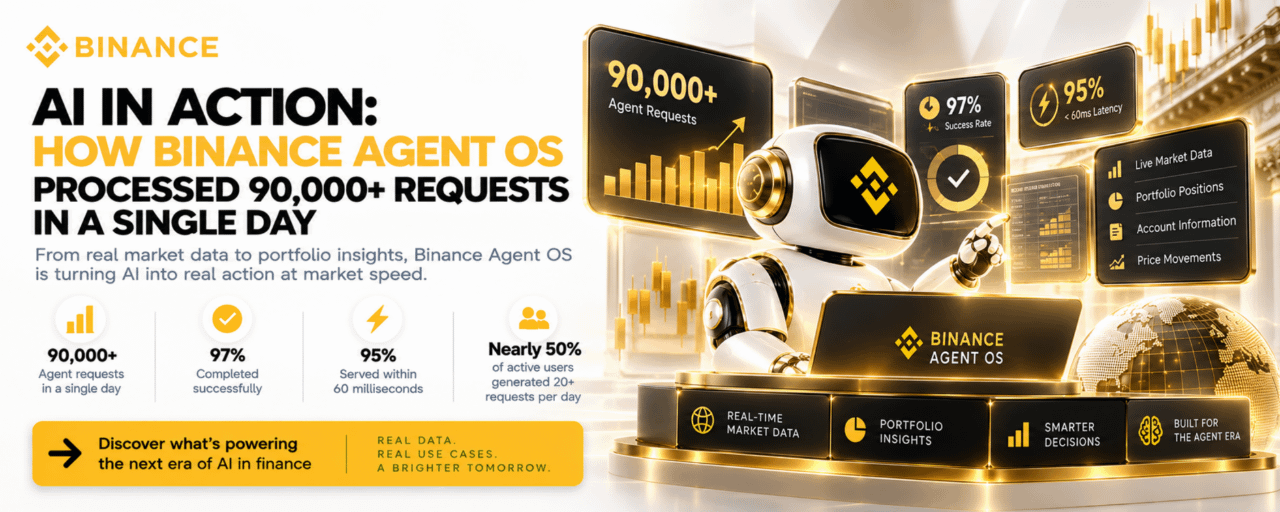
In a single day during its first weeks of operation, Binance Agent OS processed more than 90,000 agent requests. Of those, 97% completed successfully. 95% were served within 60 milliseconds.
These numbers deserve unpacking because each one addresses a different dimension of production readiness.
The 90,000+ daily request volume is a scale signal. It reflects not just that the product is live, but that it has attracted sufficient adoption to generate meaningful load. A product that processes 90,000 requests in a day is being used — not just installed.
The 97% success rate is a reliability signal. In any distributed system processing requests at scale, failures occur. Network timeouts, upstream data provider issues, edge cases in request formatting — a 97% success rate at this volume means approximately 2,700 failures per 90,000 requests, which in an agentic context is a significant engineering achievement. Agents that fail to get responses they need will either retry, fail gracefully, or produce incorrect outputs. A 97% success rate keeps agents functioning correctly across the vast majority of their interactions.
The 95% sub-60ms latency is the most operationally significant metric for financial applications. In markets that move continuously, a 60-millisecond response to a market data query is the difference between an agent acting on current information and an agent acting on information that has been superseded. For agents that monitor price movements and trigger position management, sub-60ms is not a performance benchmark — it is a functional requirement. The fact that 95% of requests are meeting it suggests the infrastructure was built for the financial use case specifically, not adapted from a general-purpose API architecture.
How Users Are Actually Using It
The usage pattern data is as revealing as the performance data.
Nearly half of active users generated 20 or more requests per day. This is the behavioral signature of genuine agentic use — not users querying data manually once or twice in a session, but agents running automated workflows that continuously query market state, portfolio positions, and price movements on behalf of their operators.
The most-used capabilities confirm this pattern. The four highest-volume query types were live market data, portfolio positions, account information, and price movements. These are not exploratory queries. They are the inputs that a functioning financial agent needs to make decisions — the same information that a systematic trader monitors continuously when managing a live book.
The combination of high per-user request rates and financially-specific query patterns suggests that the user base adopting Binance Agent OS in its first weeks is not casual experimenters. It is people who have built or configured agents for genuine financial monitoring and management tasks, and who are running those agents continuously.
The Three-Angle Framework
The brief summary describes three distinct angles through which this data is worth examining: how agents stay connected to fast-moving markets, how users retain control and visibility when agents act on their behalf, and how the broader AI economy is being tested on its ability to convert investment into durable growth.
Agents and market connectivity. The sub-60ms latency data addresses this directly. A financial agent that cannot receive current market data within the latency envelope required for its decision logic is not a functional financial agent — it is a delayed snapshot viewer. Binance Agent OS's 95% sub-60ms performance means that agents built on its infrastructure are receiving data that is current enough to be acted upon. Live market data is genuinely live.
User control and visibility. This is the dimension that separates useful agentic infrastructure from dangerous agentic infrastructure. An agent that acts on behalf of a user without that user being able to see what it is doing, audit what it has done, or constrain what it is permitted to do creates risk that may not be visible until something goes wrong.
Binance Agent OS addresses this through the MCP perimeter architecture described in prior coverage: every capability exposed to agents is explicitly defined, every request is logged, and the scope of what an agent can do is bounded by the manifest it received at discovery. Users do not need to trust that the agent model will exercise good judgment. They need the infrastructure to enforce the authorized perimeter — and that enforcement is architectural rather than behavioral.
When an agent processes 20+ requests in a day, the user can review what those requests were, what data was returned, and what actions were taken. The audit trail exists. The perimeter held.
The broader AI economy test. The 90,000 daily requests represent the AI industry's production moment for financial infrastructure. The question that has followed the extraordinary investment in AI infrastructure — whether the capability translates into durable, useful applications — is being answered in specific, measurable terms by Binance Agent OS's first-week data. 90,000 requests. 97% success. 95% under 60ms. Half of users at 20+ requests daily.
These are not capability demonstrations. They are production metrics. The next chapter of AI is not about intelligence — it is about useful action at scale.
What This Means for the Agent Era
The first weeks of Binance Agent OS provide a concrete answer to a question that has been abstract for most of the AI adoption cycle: what does AI actually doing useful work in financial markets look like?
It looks like 90,000 requests in a day, most of them from agents continuously monitoring market data and portfolio positions on behalf of users who have delegated those monitoring tasks to software. It looks like 95% of those requests completing fast enough to be genuinely useful for financial decision-making. It looks like nearly half of active users running agents that generate more than 20 requests daily — agents that are operating as a persistent background process, not a one-off query tool.
The transition from AI answering questions to AI taking action is not a future event. It is a current one. The production data is in. And the infrastructure that makes financial action safe, auditable, and fast enough to be useful at market speed is already operating at scale.
Disclaimer: This article is for educational purposes only and does not constitute financial advice. All trading and investment activities involve risk. Automated agent workflows carry additional risk. Please conduct your own research before making any decisions.