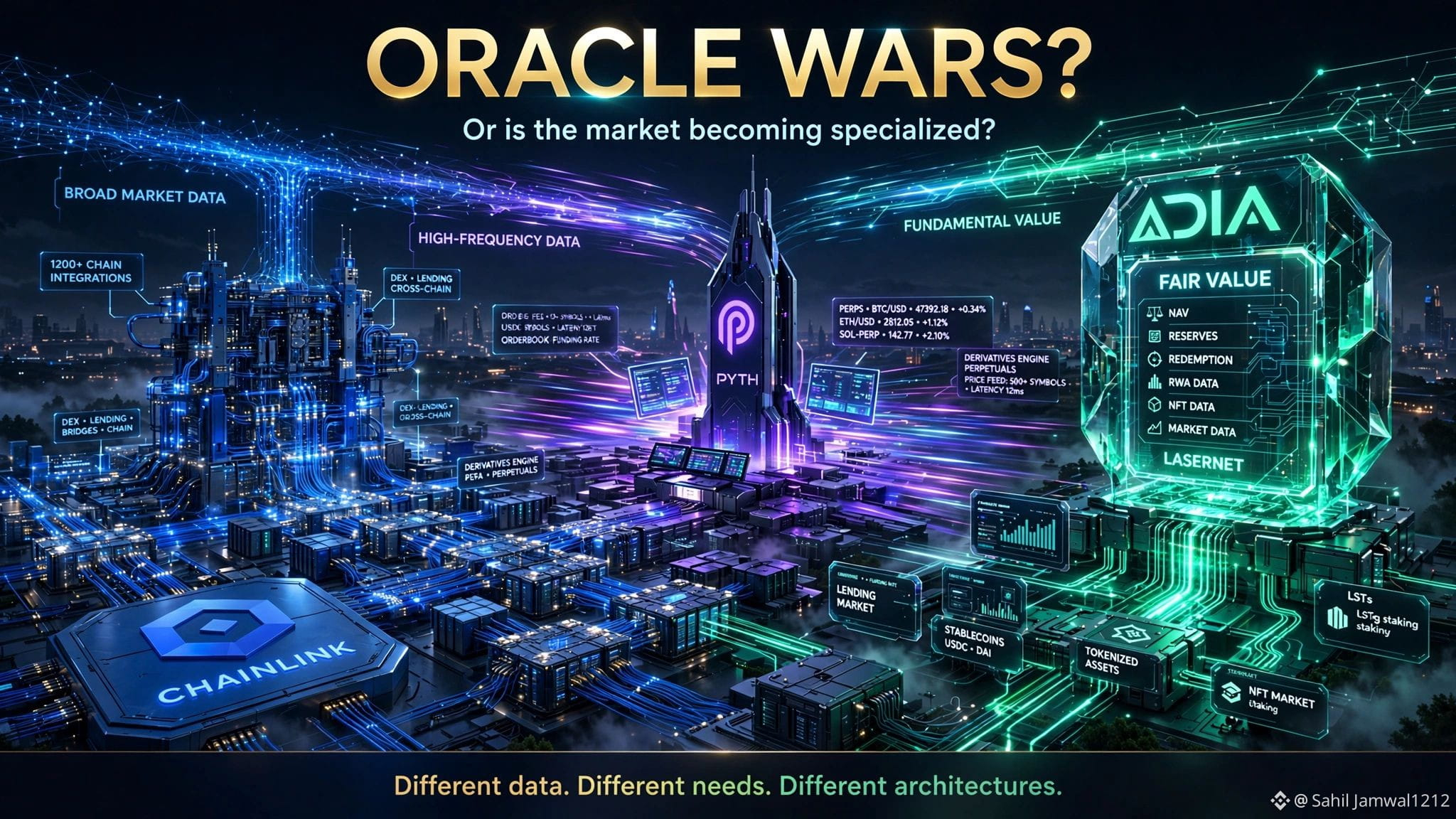
I've been digging deeper into the oracle market, and one thing stands out:
Chainlink, Pyth and DIA aren't necessarily fighting for exactly the same use cases.
🔗 Chainlink has the biggest footprint.
DeFiLlama currently shows roughly $40B+ in TVS across 500+ protocols.
Its strength is broad adoption, established infrastructure and deep DeFi integration.
🐍 Pyth takes a different approach.
Its pull-based architecture is designed for frequent, low-latency updates, making it particularly relevant for trading and derivatives.
📊 Then there's $DIA
.
What caught my attention isn't simply another crypto price feed.
DIA combines market-price feeds with:
• Fundamental valuation
• Proof of Reserves
• RWA data
• NFT pricing
• Randomness
• ZK-verifiable data
• Onchain oracle computation through Lasernet
The fundamental valuation piece is especially interesting.
For some assets, the last traded price isn't necessarily the number a lending protocol actually needs.
DIA supports methodologies including NAV, redemption value, reserve backing and contract exchange rates.
Think about an LST, vault token, reserve-backed stablecoin or tokenized asset with limited secondary-market liquidity.
The question isn't always:
"What did it last trade for?"
Sometimes it's:
"What is this asset fundamentally worth?"
That's where I think the oracle landscape gets much more interesting.
Maybe the future isn't one oracle winning every category.
Maybe different architectures specialize in different forms of onchain data.
Chainlink, Pyth and DIA aren't necessarily fighting for exactly the same use cases.
🔗 Chainlink has the biggest footprint.
DeFiLlama currently shows roughly $40B+ in TVS across 500+ protocols.
Its strength is broad adoption, established infrastructure and deep DeFi integration.
🐍 Pyth takes a different approach.
Its pull-based architecture is designed for frequent, low-latency updates, making it particularly relevant for trading and derivatives.
📊 Then there's $DIA
.
What caught my attention isn't simply another crypto price feed.
DIA combines market-price feeds with:
• Fundamental valuation
• Proof of Reserves
• RWA data
• NFT pricing
• Randomness
• ZK-verifiable data
• Onchain oracle computation through Lasernet
The fundamental valuation piece is especially interesting.
For some assets, the last traded price isn't necessarily the number a lending protocol actually needs.
DIA supports methodologies including NAV, redemption value, reserve backing and contract exchange rates.
Think about an LST, vault token, reserve-backed stablecoin or tokenized asset with limited secondary-market liquidity.
The question isn't always:
"What did it last trade for?"
Sometimes it's:
"What is this asset fundamentally worth?"
That's where I think the oracle landscape gets much more interesting.
Maybe the future isn't one oracle winning every category.
Maybe different architectures specialize in different forms of onchain data.