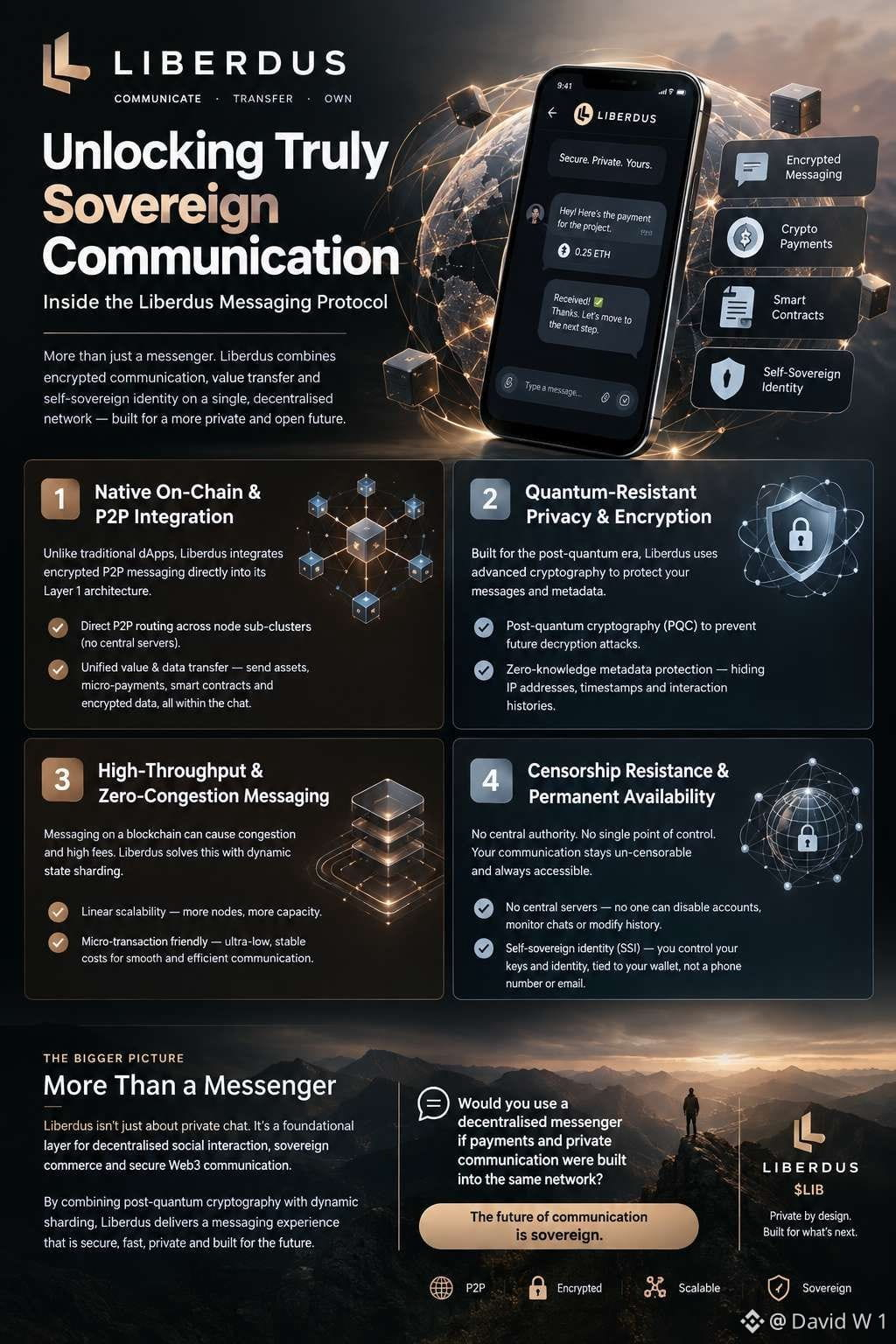
🔐 What if messaging and value transfer could exist on the same decentralised network?
That is the idea behind Liberdus
Most messaging platforms still depend on centralised infrastructure. Even when messages are encrypted, metadata, identities and communication patterns can remain connected to centralised systems.
Liberdus takes a different architectural approach.
1️⃣ Messaging at the protocol level
Instead of treating communication as an external service, Liberdus integrates encrypted P2P messaging directly into its Layer 1 network.
This creates a unified environment where users can communicate and transfer value without constantly switching between separate platforms.
2️⃣ Built with the post-quantum era in mind
Liberdus is designed around post-quantum cryptography, aiming to protect communications against future advances in computing that could challenge older cryptographic systems.
The focus is not only on keeping messages private, but also on reducing exposure of sensitive communication metadata.
3️⃣ Designed to scale
Putting messaging directly on a blockchain raises an obvious question:
What happens when activity grows?
Liberdus uses dynamic state sharding to distribute network activity across sub-networks, with the goal of increasing capacity as the network expands while keeping transactions and communication efficient.
4️⃣ Self-sovereign communication
No phone number or traditional centralised account needs to define your digital identity.
Users can maintain control of their cryptographic keys and identity, bringing communication closer to the principles of self-sovereignty.
The bigger picture is interesting.
Liberdus isn't simply trying to build another messaging app.
@Liberdus #LIB #Liberdus
That is the idea behind Liberdus
Most messaging platforms still depend on centralised infrastructure. Even when messages are encrypted, metadata, identities and communication patterns can remain connected to centralised systems.
Liberdus takes a different architectural approach.
1️⃣ Messaging at the protocol level
Instead of treating communication as an external service, Liberdus integrates encrypted P2P messaging directly into its Layer 1 network.
This creates a unified environment where users can communicate and transfer value without constantly switching between separate platforms.
2️⃣ Built with the post-quantum era in mind
Liberdus is designed around post-quantum cryptography, aiming to protect communications against future advances in computing that could challenge older cryptographic systems.
The focus is not only on keeping messages private, but also on reducing exposure of sensitive communication metadata.
3️⃣ Designed to scale
Putting messaging directly on a blockchain raises an obvious question:
What happens when activity grows?
Liberdus uses dynamic state sharding to distribute network activity across sub-networks, with the goal of increasing capacity as the network expands while keeping transactions and communication efficient.
4️⃣ Self-sovereign communication
No phone number or traditional centralised account needs to define your digital identity.
Users can maintain control of their cryptographic keys and identity, bringing communication closer to the principles of self-sovereignty.
The bigger picture is interesting.
Liberdus isn't simply trying to build another messaging app.
@Liberdus #LIB #Liberdus