


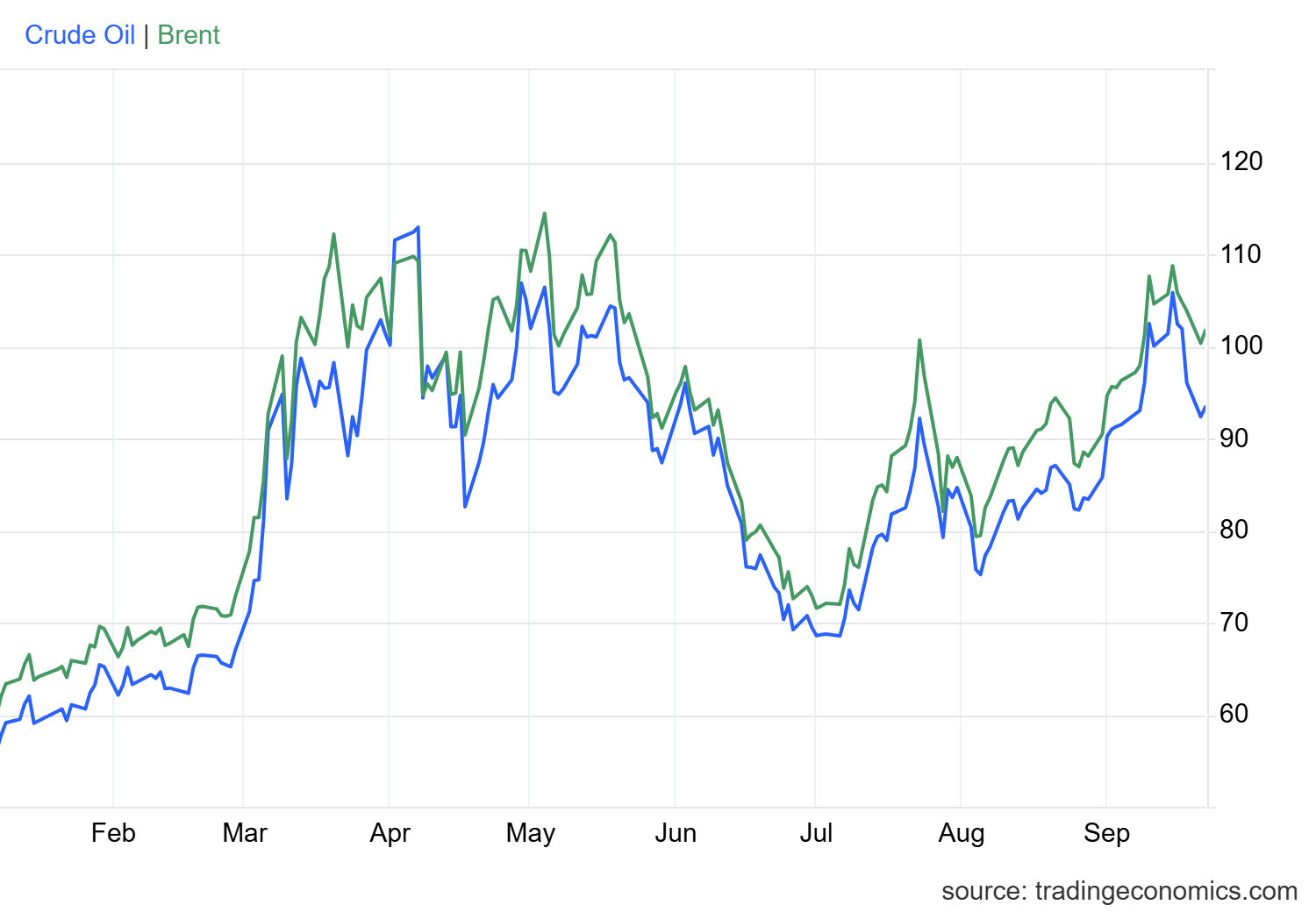
Oil fell Monday, settling near $100 a barrel, as Saudi Arabia showed signs of pushing more crude through the Strait of Hormuz and hopes built for a diplomatic opening in the Iran war. Crude briefly dropped below $100 after Trump signaled he was open to meeting Iranian President Masoud Pezeshkian on the sidelines of this week's UN General Assembly, though Tehran has yet to confirm any reciprocal interest.
Trump has kept sanctions and military options on the table, but the prospect of talks, combined with evidence that the disruption to Saudi Arabia's East-West pipeline was less severe than initially feared, was enough to pull the war premium out of the market. Iran's Foreign Minister Araghchi had already arrived in New York for the UN General Assembly.
Prices were also weighed down by reports that Saudi Aramco loaded roughly 14 million barrels of crude onto seven supertankers inside the Mideast Gulf on Sunday, according to data from TankerTrackers.com, as the kingdom ramped up loadings from its Gulf export terminals following an attack that disrupted shipments via the East-West pipeline to the Red Sea. The loadings point to a partial recovery in Saudi shipments, and expectations of higher volumes weighed on prices Monday, helping push the Brent benchmark below $100 a barrel for the first time since September 9.
The seven vessels were Very Large Crude Carriers, or VLCCs, TankerTrackers.com said. Satellite images reviewed by Reuters appeared to show seven tankers near Saudi Arabia's Ras Tanura port on Sunday. An Aramco spokesperson declined to comment. The loading of seven tankers would suggest an increase in Saudi supply. JPMorgan analysts wrote in a September 18 note that satellite data showed Saudi oil moving through the Strait of Hormuz averaging 2.9 million barrels per day over the prior six days, up from just 700,000 barrels a day in August.
Loadings have been shifting away from the Red Sea. Drone attacks forced Saudi Arabia to shut its East-West pipeline on September 13, halting crude loadings at the kingdom's Yanbu oil port on the Red Sea. Aramco responded by cancelling some crude cargo sales to European clients while boosting sales to Asia, sourced from crude loaded at its eastern ports inside the Strait of Hormuz.
Saudi Arabia's crude loadings have moved from the Red Sea to the Middle East Gulf over the past week. Gulf crude loadings have averaged about 3.7 million barrels a day since September 12, up from 2.9 million barrels a day earlier in the month, according to Vortexa, a separate firm that tracks oil flows. Red Sea loadings had averaged 3.9 million barrels a day in the September 1-11 period. Saudi Arabia sold about 60 million barrels of crude from its Ras Tanura port inside the Strait of Hormuz for loading via ship-to-ship transfer at the Omani port of Sohar this month and next, trade sources told Reuters last week.
On the diplomatic front, Qatar's Foreign Ministry spokesperson said Doha is trying to mediate and open a path for talks between Iran and the United States, according to Tasnim. The comments point to Qatar's active role as a mediator in the discussions between Washington and Tehran, with Tasnim reporting that Doha's efforts extend to exploring a possible short-term arrangement as part of broader engagement between the two sides. The report gave no further detail on the scope, timeline or terms of any potential deal. Separately, Pakistan's interior minister consulted with his Iranian counterpart on efforts to advance the peace process, ISNA reported.
The moves left prices with little room to go but down. West Texas Intermediate futures dropped 4.5% to $95.78 a barrel, while international Brent touched a session low of $98.98 before settling at $100.34, easing an inflation worry that had weighed on markets for weeks.
Even with oil flowing again, ships are still coming under attack in the strait. An LPG tanker was struck Monday by debris from unknown projectiles in the Strait of Hormuz, the UK Maritime Trade Operations Center said. "The Master reports all crew are safe and no environmental impact. The tanker will continue to its next port of call," the center said.
"Authorities are investigating," UKMTO added in a statement posted on the social media platform X, calling on vessels transiting the strait to exercise caution and "report any suspicious activity." No further details were immediately available.
The UK is close to agreeing to provide defensive military support to Saudi Arabia as the kingdom faces repeated attacks from the Iran-backed Houthis. Prime Minister Andy Burnham is reportedly leaning toward offering assistance such as aerial refuelling and encouraging other countries to provide similar support, aiming to help Saudi Arabia counter Houthi attacks, stabilise the region and reduce the risk to shipping through the Bab el-Mandeb strait. If approved, it would be one of Burnham's first major military decisions since he became prime minister in July.
That kind of support, if finalized, would come at a useful moment. Trump has found himself torn between his desire to help his friend and ally, Saudi Crown Prince Mohammed bin Salman, and his wish to avoid getting drawn into a new front of the Middle East war, Barak Ravid of News 12 reported. Trump considered ordering a strike against Houthi rebels in Yemen over the weekend but decided to hold off for now, two senior US officials told Ravid.
Separately, the Trump administration has proposed investing $5 billion to rebuild energy infrastructure across the Middle East. Under the initiative, called the Partnership for Allied Trust and Construction, or Pact, the US would seek a matching $5 billion from eight Middle Eastern partners to help rebuild energy infrastructure damaged in the Iran war, according to US and Middle East officials and documents reviewed by the Wall Street Journal. The plan aims to cut the region's reliance on the Strait of Hormuz for moving oil and gas. It remains unclear when, or if, other countries will sign on.
The shutdown of Saudi Arabia's East-West pipeline threatens to squeeze already tight crude supply for Asia's four largest importers, with South Korea the most directly exposed. Saudi crude made up 34.1% of South Korea's crude imports in July, according to the Korea International Trade Association. The figure stood at 27.3% for Japan, according to government data, and 14.9% for China, based on customs data. For India, it was 10.2%, according to Kpler. Asian markets' dependence on Saudi crude doesn't translate directly into the number of barrels exposed to the pipeline shutdown, since export constraints at the Strait of Hormuz have shifted a large share of the kingdom's exports westward toward the pipeline-linked Yanbu port.
Meanwhile, Very Large Crude Carriers are seeing an unprecedented surge in freight rates as the Hormuz crisis disrupts global oil shipping. Bloomberg reported that daily charter rates on the benchmark Persian Gulf-to-Asia route have jumped twelvefold in just a few months to a record $1.1 million a day, while the cost of moving crude through Hormuz has climbed from about $2 to more than $22 a barrel.
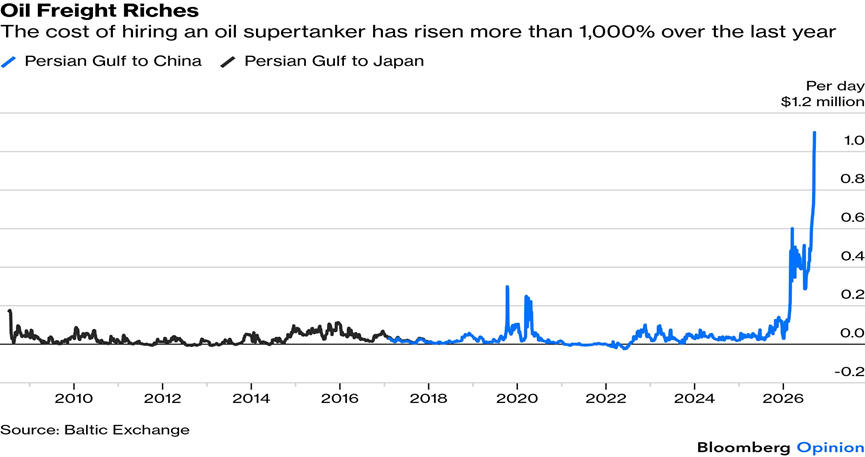
The global VLCC market is extremely tight, Bloomberg noted, with only about 925 supertankers in operation worldwide. Roughly a quarter of the fleet belongs to a "dark fleet" used to move sanctioned oil from Iran, Russia and Venezuela, cutting into the vessels available to the mainstream market. Demand has grown strong enough that second-hand VLCCs now cost about $150 million, more than a new tanker priced around $130 million that carries a two-year wait for delivery.
Bloomberg added that while tanker rates are expected to eventually settle, they're likely to land at a structurally higher level than before the Hormuz disruption began. The supply crunch is increasingly touching China too, where rising oil demand is reversing an earlier pullback from global markets and giving Beijing a stronger economic incentive to back diplomatic efforts aimed at limiting the conflict's impact on global energy markets.