
Bitcoin’s biggest strengths have always been its scarcity, liquidity, and long-term value proposition. But for institutional markets, one important question has remained:
How can institutions use Bitcoin as productive capital without having to sell their BTC exposure?
Circle (CRCL) may now be opening a new chapter in answering that question.
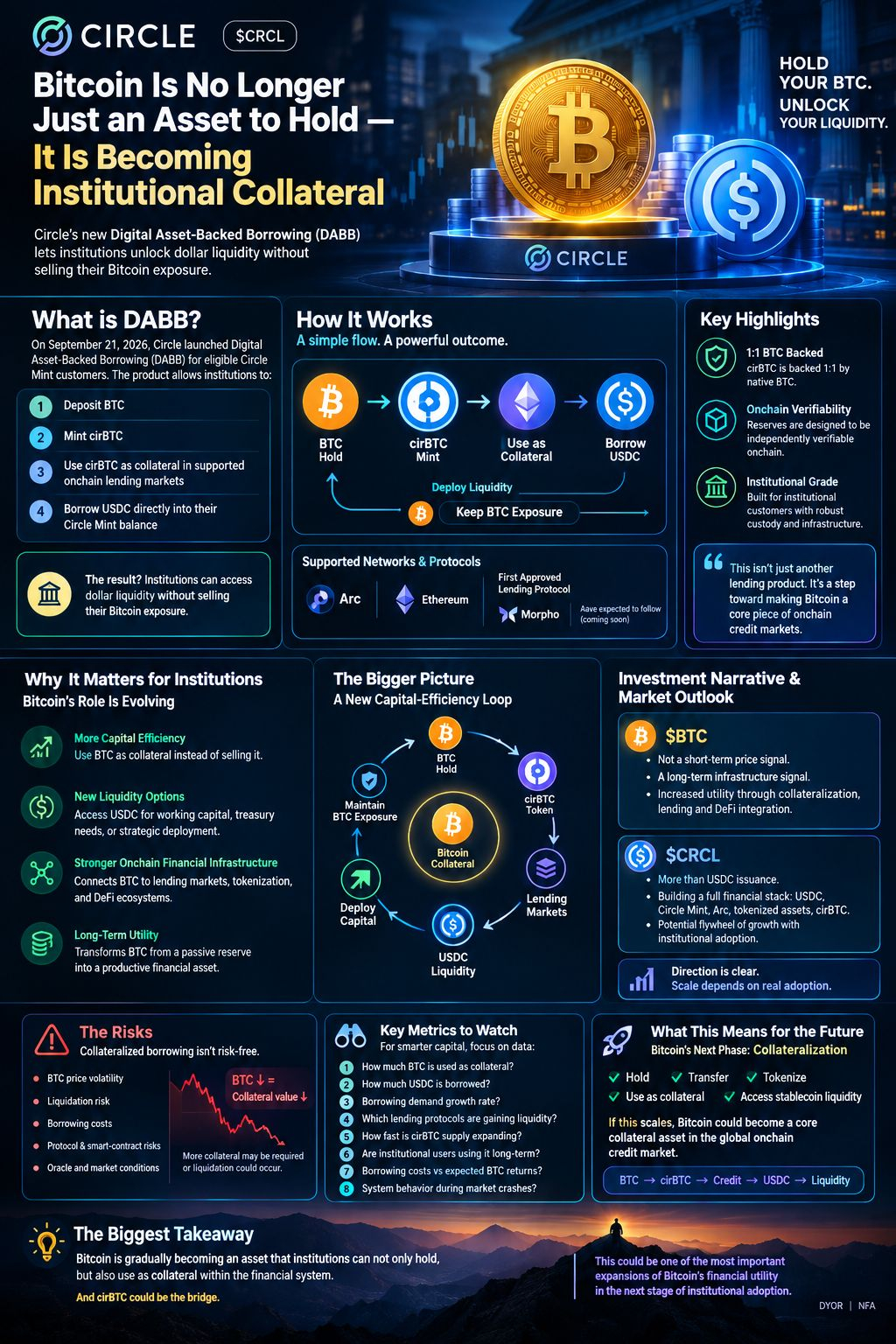
On September 21, 2026, Circle announced the launch of Digital Asset-Backed Borrowing (DABB) for eligible Circle Mint customers. The product allows institutions to deposit BTC, mint cirBTC, use cirBTC as collateral in supported onchain lending markets, and borrow USDC directly back into their Circle Mint balance.
In simple terms, institutions can potentially unlock dollar liquidity without selling their underlying Bitcoin exposure.
And that makes this more than just another crypto lending product.
It could represent an important step toward turning Bitcoin into a more productive form of institutional collateral.
🔥 Hold Bitcoin → Use It as Collateral → Borrow USDC
The basic structure is straightforward:
Hold BTC
⬇️
Deposit BTC
⬇️
Mint cirBTC
⬇️
Use cirBTC as collateral
⬇️
Borrow USDC
⬇️
Deploy liquidity
⬇️
Maintain BTC exposure
Traditionally, if an institution wanted to extract dollar liquidity from its Bitcoin holdings, one obvious option was to sell part of its BTC.
Now, eligible institutional users have another potential route:
Use Bitcoin as collateral instead of selling it.
At launch, Circle’s DABB product supports Arc and Ethereum, with Morpho serving as the first approved third-party lending protocol. Circle has also indicated that additional protocols, including Aave, are expected to follow.
This could become increasingly important as institutional demand for onchain credit infrastructure grows.
🏦 Is Institutional Bitcoin Entering a New Phase?
When people discuss institutional Bitcoin adoption, the conversation usually focuses on ETFs, custody, treasury holdings, or long-term portfolio allocation.
But institutional maturity is not determined only by how much capital enters an asset.
Another important question is:
How efficiently can that asset be used?
Traditional financial assets such as Treasury securities can serve as collateral across different financial markets.
Bitcoin is now gradually moving toward a similar role within onchain financial infrastructure.
Circle’s DABB is an example of that transition.
If an institutional holder wants to maintain long-term BTC exposure while also needing dollar liquidity, collateralized borrowing creates another financial option.
That potentially increases Bitcoin’s economic utility.
💵 Why cirBTC Matters
Native BTC cannot simply operate directly inside Ethereum-based smart-contract lending markets.
This is where wrapped Bitcoin infrastructure becomes important.
Circle’s cirBTC is designed to represent BTC on a 1:1 basis. Circle says each cirBTC is backed by native BTC, with reserve information designed to be independently verifiable onchain.
That combination is important:
1:1 BTC backing + reserve transparency + institutional infrastructure.
For any wrapped asset, the token price is only one part of the equation.
Institutions also need to consider:
Where is the underlying BTC held?
How are the reserves managed?
Does the reserve correspond to the circulating supply?
What happens during extreme market volatility?
Where can the wrapped asset be used?
What are the lending protocol’s liquidation mechanisms?
What are the counterparty and smart-contract risks?
These questions become even more important when the asset is being used as collateral.
🔄 A New Capital-Efficiency Loop for Bitcoin
This is where the development becomes particularly interesting.
Imagine an institution wants to hold BTC for the long term.
The traditional structure could look like:
BTC → Hold
But when liquidity is needed:
BTC → Sell → Obtain USD/USDC liquidity
The new structure can potentially look like:
BTC → cirBTC → Collateral → USDC → Liquidity
The institution attempts to maintain its BTC exposure while simultaneously accessing liquidity.
This is essentially a capital-efficiency concept.
However, capital efficiency does not mean zero risk.
In fact, collateralized borrowing makes risk management even more important.
📈 What Does This Mean for the Bitcoin Investment Narrative?
There is an important distinction here.
Circle launching DABB does not guarantee that Bitcoin’s price will rise.
But it could strengthen Bitcoin’s utility narrative.
Institutional adoption is no longer simply about:
“Institutions will buy BTC.”
The next question is:
“How will institutions use BTC as part of the financial system?”
If Bitcoin becomes increasingly integrated into lending markets, liquidity venues, treasury operations, tokenization infrastructure, and institutional DeFi, then BTC could gradually evolve from a passive reserve asset into a more productive financial asset.
That could become an important part of the long-term Bitcoin thesis.
🌐 Ethereum + Arc: Two Important Liquidity Environments
Circle has not limited DABB to a single blockchain.
The product is currently available on Ethereum and Arc.
Ethereum already has a large and established DeFi ecosystem covering lending, decentralized exchanges, stablecoins, tokenization, and onchain liquidity.
Arc, meanwhile, is Circle’s institutional-focused blockchain infrastructure.
If these environments continue to attract lending protocols, stablecoin liquidity, tokenized assets, and institutional users, Bitcoin collateral could potentially become part of a much broader onchain financial ecosystem.
The potential long-term structure is:
BTC collateral + USDC liquidity + institutional infrastructure + onchain lending
If these four components scale together, Bitcoin’s utility could extend well beyond the Bitcoin network itself.
🏦 What Could This Mean for $CRCL ?
There is also a broader Circle investment narrative here.
Circle’s value proposition is not limited to USDC issuance.
The company is building a broader financial infrastructure stack involving USDC, Circle Mint, Arc, tokenized assets, and institutional liquidity services.
cirBTC adds another potential component to that ecosystem.
A possible flywheel could look like this:
BTC → cirBTC
cirBTC → DeFi collateral
Collateral → USDC borrowing
USDC → Institutional liquidity
Liquidity → More onchain financial activity
More activity → Greater use of Circle’s infrastructure
This is still a developing ecosystem, so the size of this potential flywheel will ultimately depend on actual adoption.
But the direction of development is becoming increasingly visible.
⚠️ The Biggest Risk: Liquidation
No matter how attractive the investment narrative may appear, collateralized borrowing should never be treated as “free liquidity.”
Circle’s own terms highlight risks associated with digital-asset volatility, liquidation, protocol parameters, oracle readings, interest accrual, and broader market conditions.
Consider a sharp Bitcoin decline:
BTC ↓
→ Collateral value decreases
→ Loan-to-value or collateral health comes under pressure
→ Additional collateral may be required
→ Otherwise, liquidation could occur
So while institutions may be able to access liquidity without immediately selling BTC, liquidation risk does not disappear.
That makes collateral buffers, leverage ratios, borrowing costs, and liquidation thresholds extremely important.
🧠 For Smart Capital, Structure May Matter More Than Price
When evaluating developments like this, focusing only on:
“Will BTC reach $X?”
can miss a much bigger part of the story.
More important questions may include:
1. How much BTC is being used as collateral?
2. How much USDC is being borrowed against BTC?
3. How quickly is borrowing demand growing?
4. Which lending protocols are attracting liquidity?
5. How quickly is cirBTC supply expanding?
6. Are institutional users returning and using the infrastructure over the long term?
7. How do borrowing costs compare with expected BTC returns?
8. What happens to the system during a major market crash?
These metrics could eventually provide more meaningful signals about institutional adoption than price charts alone.
🚀 Is Bitcoin’s Next Phase “Collateralization”?
Bitcoin began with a digital-money narrative.
Then its store-of-value narrative became increasingly important.
Institutional allocation followed.
Now another narrative is emerging:
Bitcoin as Institutional Collateral
If this model scales, Bitcoin’s utility could enter another phase.
An asset that can simultaneously be:
Held
Transferred
Tokenized
Used as collateral
Used to access stablecoin liquidity
has significantly greater potential capital efficiency.
That could make Bitcoin increasingly relevant within the broader onchain financial system.
📊 What Does This Mean for BTC Holders?
For ordinary retail investors, Circle’s DABB may not be directly accessible because the product is currently designed for eligible Circle Mint institutional customers and is subject to eligibility and jurisdictional requirements.
But the broader market implication is still important.
Institutional financial infrastructure rarely appears overnight.
Usually, the progression looks something like:
Custody
↓
Trading infrastructure
↓
Settlement
↓
Collateralization
↓
Lending
↓
Structured financial products
If Bitcoin continues moving through this infrastructure stack, the structure of the BTC market could gradually evolve as well.
🔥 The Biggest Takeaway
The most important part of Circle’s Digital Asset-Backed Borrowing may not simply be the ability to borrow USDC against BTC.
The bigger development is this:
Bitcoin is gradually becoming an asset that institutions can not only hold, but also use as collateral within the financial system.
And cirBTC could serve as an important bridge between the two worlds.
On one side:
Native BTC
On the other:
Ethereum and Arc-based programmable financial markets
In between:
A 1:1 BTC-backed token
Then:
Collateral
Then:
USDC liquidity
This creates a new potential financial rail:
BTC → cirBTC → Credit → $USDC → Liquidity
If institutional adoption scales, Bitcoin’s future narrative may become harder to define purely as “digital gold” or “store of value.”
Another narrative could become increasingly important:
Bitcoin as Productive Institutional Collateral
And that could represent one of the most important expansions of Bitcoin’s financial utility in the next stage of institutional adoption.
💡 Investment Perspective
For $BTC , this development may be more useful to view as a long-term infrastructure signal rather than a short-term price signal.
For $CRCL, attention will likely remain on how effectively Circle can connect USDC, Circle Mint, Arc, and cirBTC into a broader institutional financial ecosystem.
But the same risk-management principles still apply:
Do not use leverage simply because the narrative looks attractive.
BTC volatility, borrowing costs, liquidation thresholds, protocol risks, smart-contract risks, and liquidity conditions all matter when evaluating collateralized borrowing.
Bitcoin becoming more useful as collateral can increase its utility.
It does not eliminate market risk.
Ultimately, the bigger question is:
Will Bitcoin remain primarily an institutional asset to hold, or will it increasingly become one of the core collateral assets powering the global onchain credit market?
Adoption, liquidity, and real-world usage will provide the answer.
DYOR |



#CircleLaunchesInstitutionalBTCBackedBorrowing #BitcoinHits$85K #CRCL #USDC✅ #BTC