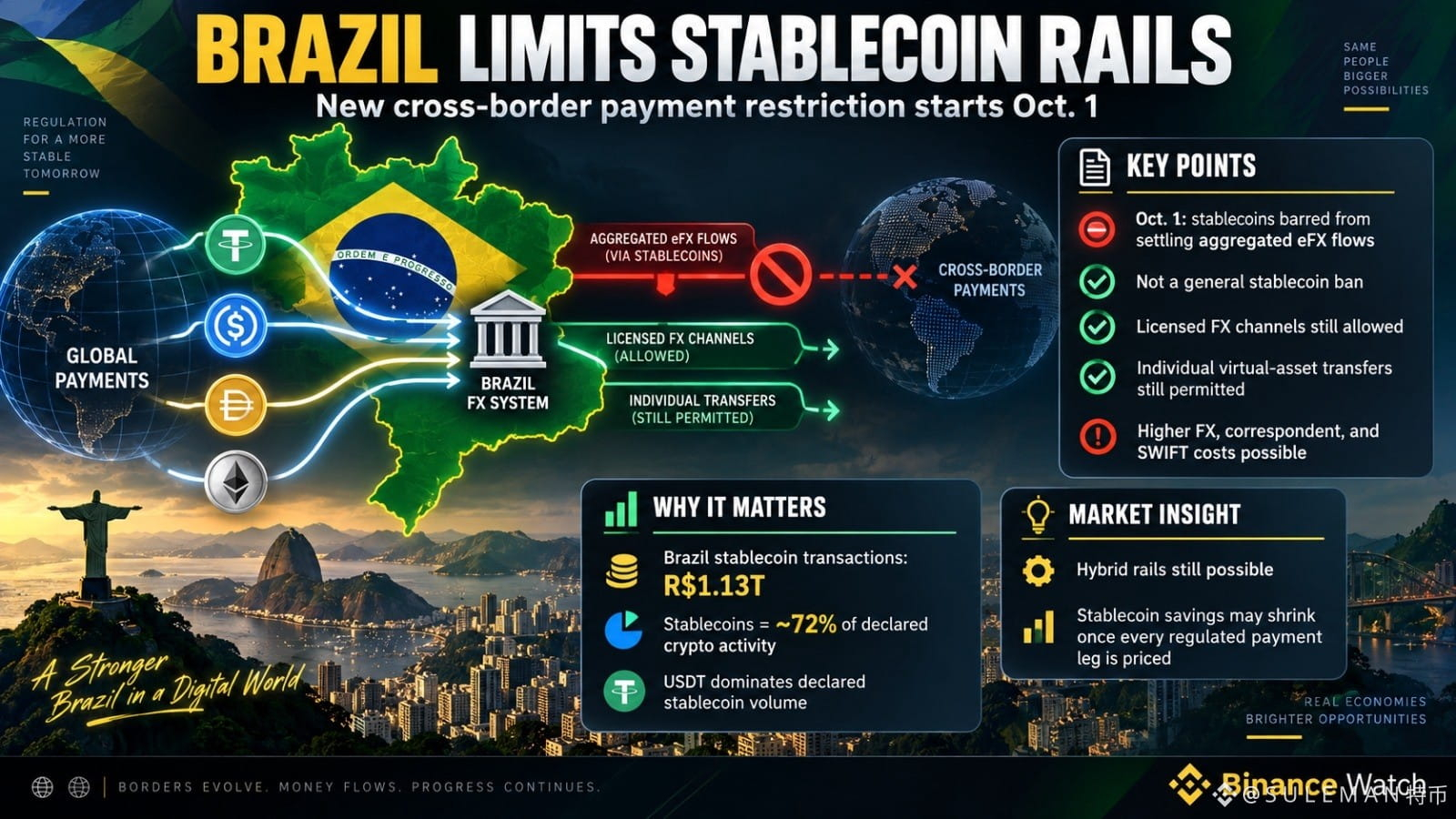
🚨 BRAZIL ISN’T BANNING STABLECOINS — BUT IT IS CLOSING ONE OF THEIR BIGGEST CROSS-BORDER SHORTCUTS.
Starting Oct. 1, Brazil’s central bank will block stablecoins from being used to settle certain aggregated international eFX payment flows. The bulk-payment model itself remains allowed, but the final settlement between regulated FX providers and overseas counterparties must move through licensed FX channels or qualifying non-resident real accounts.
That matters because the stablecoin route helped firms avoid some traditional FX, correspondent-bank, and SWIFT costs.
Brazil is already a huge stablecoin market, with R$1.13 trillion in declared stablecoin transactions between 2019 and 2025, while USDT dominated that activity.
For crypto users and traders on Binance, the key point is that this is not a general stablecoin ban. Individual international transfers using virtual assets are still permitted.
The bigger question is whether stablecoins can keep their cost advantage once every regulated payment leg is added back in.
👀 Brazil may become an important test case for how stablecoins fit into real-world global payments.
$ONE
$CELR
$ZIL
Starting Oct. 1, Brazil’s central bank will block stablecoins from being used to settle certain aggregated international eFX payment flows. The bulk-payment model itself remains allowed, but the final settlement between regulated FX providers and overseas counterparties must move through licensed FX channels or qualifying non-resident real accounts.
That matters because the stablecoin route helped firms avoid some traditional FX, correspondent-bank, and SWIFT costs.
Brazil is already a huge stablecoin market, with R$1.13 trillion in declared stablecoin transactions between 2019 and 2025, while USDT dominated that activity.
For crypto users and traders on Binance, the key point is that this is not a general stablecoin ban. Individual international transfers using virtual assets are still permitted.
The bigger question is whether stablecoins can keep their cost advantage once every regulated payment leg is added back in.
👀 Brazil may become an important test case for how stablecoins fit into real-world global payments.
$ONE
$CELR
$ZIL