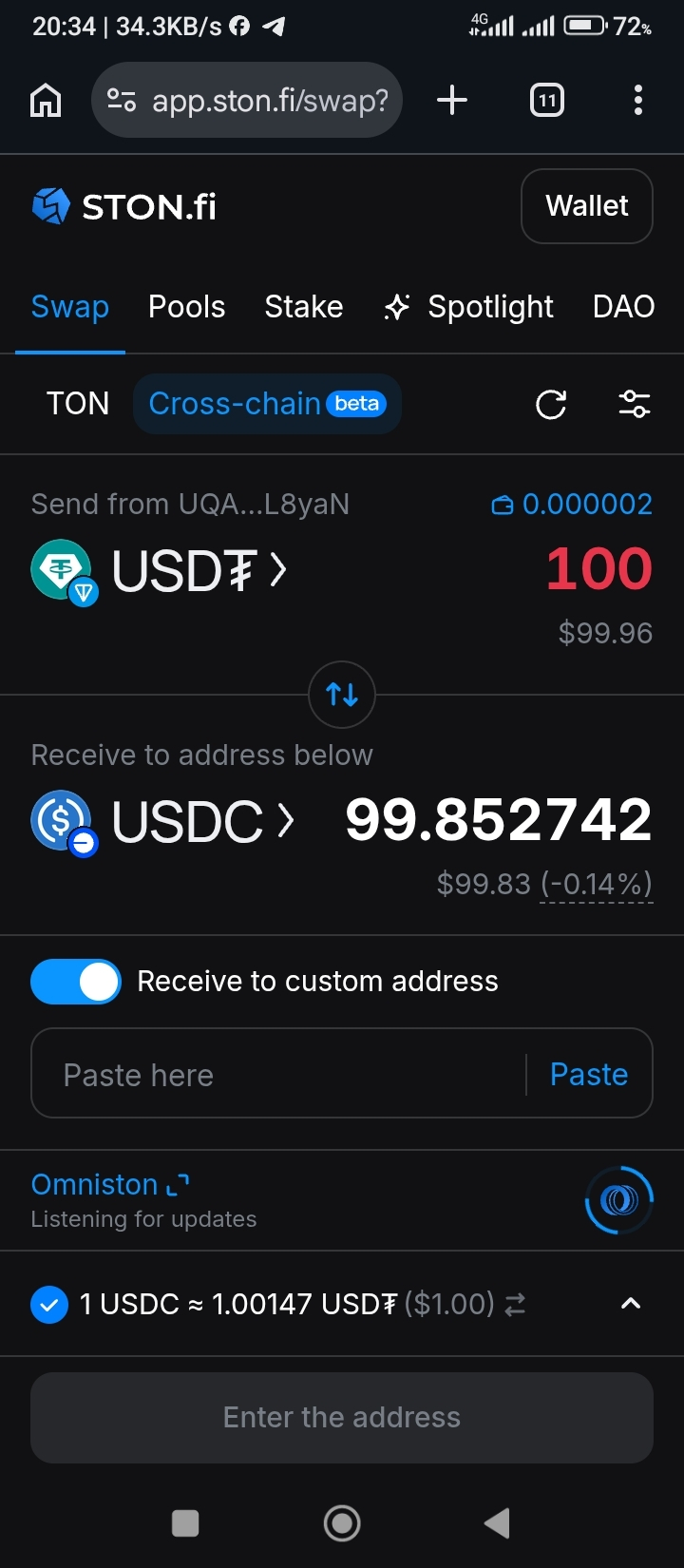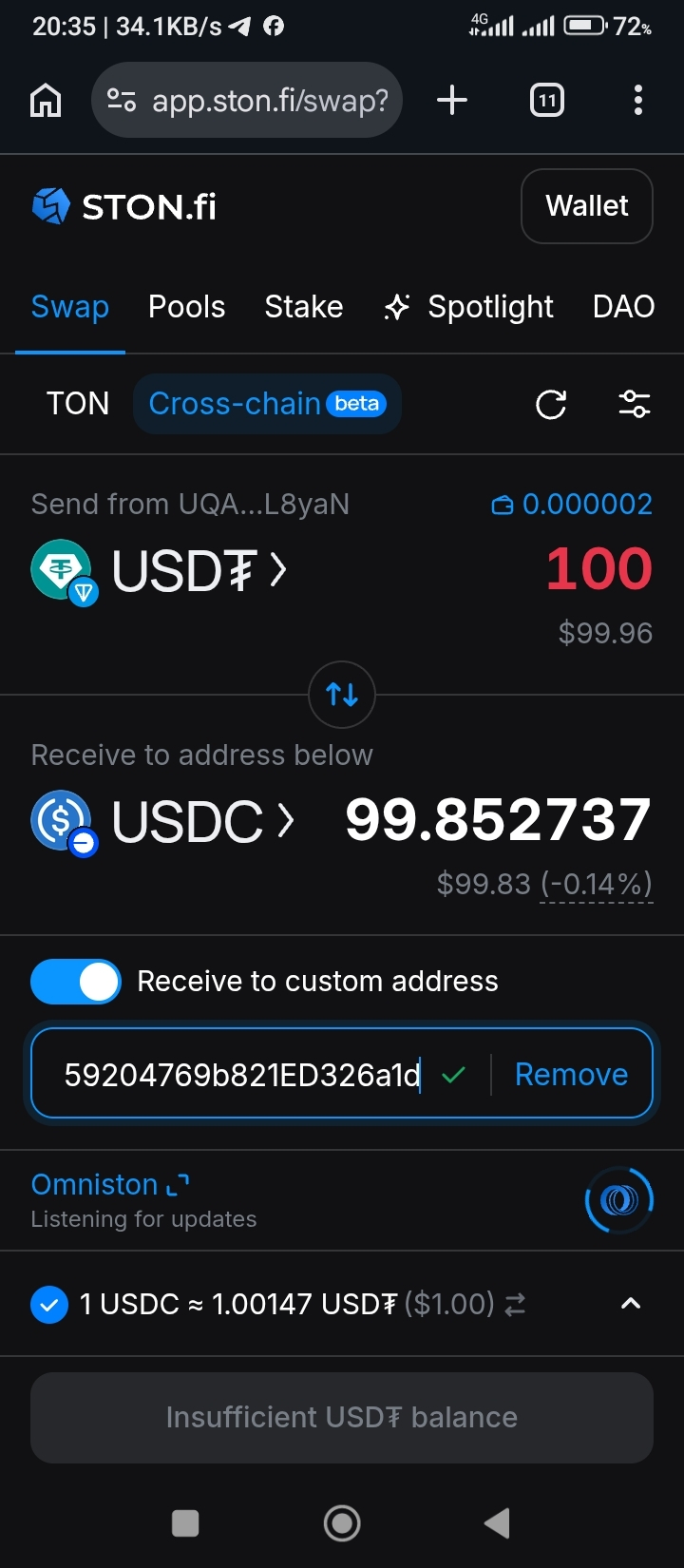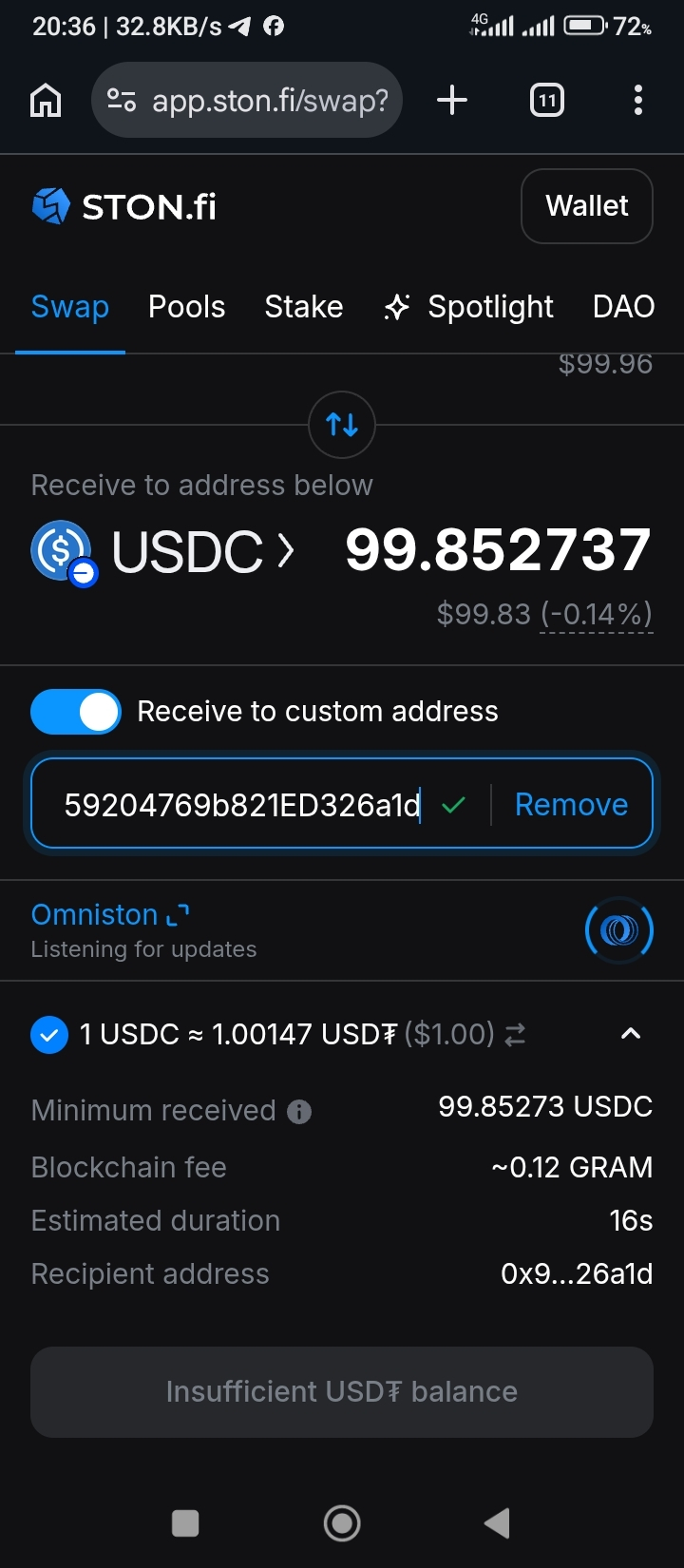

When I first started using different blockchain networks, I thought moving stablecoins would be straightforward.
I had USDT on one network, so I assumed I could simply send it to another wallet and receive the same token there.
That assumption can get expensive.
TON and Base are two different blockchain networks. So when the goal is to go from USDT on TON → USDC on Base, we're dealing with two changes at the same time:
The network changes.
The stablecoin changes.
That's where a cross-chain swap comes in.
STON.fi's cross-chain flow is designed to handle this in one route instead of making users manually bridge an asset and then perform another swap.
1. START WITH USDT ALREADY ON TON
Let's say I already have USDT in my TON wallet.
My goal isn't to keep the USDT on TON. I want to end up with USDC on Base.
So the journey looks like this:
TON / USDT → Base / USDC
The important thing here is that my starting asset and destination asset are different.
I'm not simply transferring USDT from one TON wallet to another.
I'm asking for a cross-chain swap that moves value from TON to Base while also converting USDT into USDC.
2. WHY DO BOTH THE NETWORK AND STABLECOIN NEED TO CHANGE?
This is probably the most important part to understand.
TON and Base are separate blockchains. A normal token transfer doesn't magically move an asset from one blockchain to another. A cross-chain mechanism is needed to execute the transaction across the two networks.
Then there's the stablecoin.
USDT and USDC are different tokens.
So we're not just asking:
"Move my USDT from TON to Base."
We're asking:
"Take my USDT on TON and give me USDC on Base."
That means the route has to handle both the chain change and the asset conversion.
This is why a cross-chain swap can be much simpler than manually doing several separate transactions.
3. TON / USDT → Base / USDC
The basic flow is:
1. Connect your TON wallet.
This is where your USDT currently sits.
2. Connect your Base-compatible wallet.
Your destination wallet needs to support Base. EVM-compatible wallets such as MetaMask, Rabby and other supported wallets can be used for Base.
3. Select USDT on TON as the asset you're sending.
4. Select USDC on Base as the asset you're receiving.
5. Enter the amount.
The interface should then show the route and the amount of USDC you can expect to receive.
6. Review everything before signing.
STON.fi says its cross-chain interface displays the expected amount, fees and final exchange rate before confirmation.
Then confirm the transaction in your wallet.
The goal is simple:
You start with USDT on TON → the cross-chain route executes → you receive USDC on Base.
No need to manually move a wrapped asset first and then perform a second swap.
4. ALWAYS REVIEW THE QUOTE BEFORE CONFIRMING
This is the part I would never rush.
Before pressing that final confirmation button, I would check:
✅ The amount
How much USDT am I spending?
How much USDC will I actually receive?
Don't look only at the headline exchange rate. Look at the actual final amount.
✅ The destination wallet
This is especially important when switching networks.
Make sure the receiving address is your Base-compatible wallet and not an address belonging to another network or another person.
✅ The destination network
It should clearly say:
Base
Not TON.
Not Ethereum.
Not another EVM network.
✅ The asset
Make sure the destination token is:
USDC
and not another similarly named token.
✅ Fees
Look at the estimated fees before signing.
STON.fi's cross-chain documentation says the confirmation screen shows the expected amount, fees and final exchange rate.
✅ Price impact
Price impact matters because the size of your swap relative to available liquidity can affect the rate you receive.
For a large transaction, this becomes even more important.
5. Native USDC on Base vs a wrapped bridge asset
Here's another concept that took me some time to understand.
Receiving USDC on Base isn't necessarily the same thing as receiving a wrapped representation of another token.
With a traditional bridge, an asset can be locked on the source chain while a corresponding wrapped representation is created or delivered on the destination chain.
That wrapped asset may technically represent the value of the original asset, but it is not necessarily the same as the native asset issued for that destination network.
This distinction matters.
Imagine I want USDC that I can immediately use in the Base ecosystem.
My preference would be to receive the intended native destination asset, rather than ending up with some wrapped representation that I later need to identify, swap or bridge again.
STON.fi's cross-chain model is built around selecting the destination asset directly, rather than requiring the user to manually bridge first and then figure out the second swap. �
Ston
That's a major difference in the user experience.
The whole journey in one picture
Think of it like exchanging money while travelling.
You have:
USDT 💵
on
TON 🌐
But where you're going, you need:
USDC 💵
on
Base 🌐
Instead of manually doing:
USDT on TON → bridge → wrapped asset on Base → swap → USDC
a cross-chain swap can handle the journey as:
USDT on TON → cross-chain swap → USDC on Base
The important thing is that you should still understand what is happening behind the scenes.
My checklist before making a cross-chain swap
Before I confirm a TON → Base swap, I'd quickly check:
☑️ Source network: TON
☑️ Source asset: USDT
☑️ Destination network: Base
☑️ Destination asset: USDC
☑️ Destination wallet: my correct Base address
☑️ Expected USDC amount
☑️ Fees
☑️ Exchange rate
☑️ Price impact
☑️ Wallet has the required network fee balance
And for a large amount, I'd consider doing a small test transaction first. STON.fi specifically recommends testing with a small amount when moving larger sums. �
Ston
Final thoughts
The biggest lesson for me is that cross-chain swapping isn't just about moving a token.
You're dealing with three things:
Asset → Network → Destination asset
In this example:
USDT → TON → USDC → Base
Once you understand that, the process becomes much less confusing.
And before signing anything, slow down and verify the destination network, destination token, wallet address, expected amount and fees.
Because cross-chain transactions aren't something you want to guess your way through.
Understand the route first. Confirm the details second. Swap third. 🗿
Try STON.fi Cross-Chain Swap
This is not a financial advise, always do your own research