
🚀


Publier

MrStar
·
--
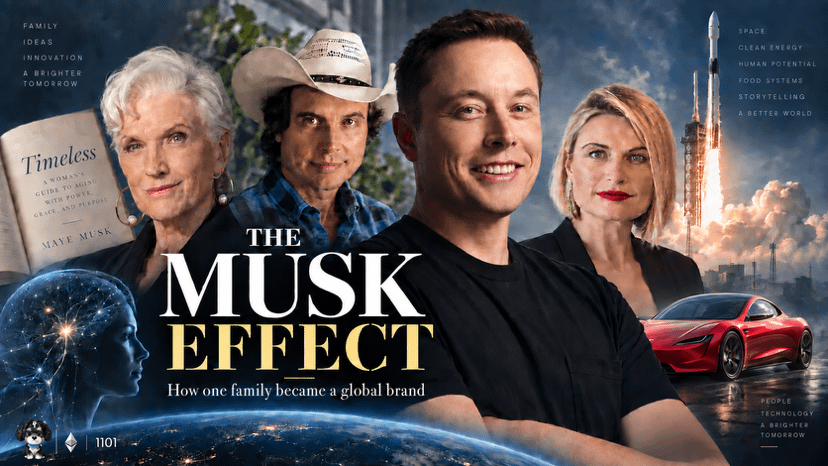
The Musk story is no longer just about #ElonMusk . It is becoming a family brand.
$TSLA
For years the public story was simple: Elon Musk built #Tesla and #SpaceX while becoming one of the most recognizable entrepreneurs in the world.
But look at the Musk family today and the picture is much bigger.
Maye Musk has built her own global identity as a model, dietitian and author. Her earlier book A Woman Makes a Plan sold more than one million copies and her new memoir Timeless was released this week. At 78 she is still appearing on runways, magazine covers and international stages.
#timeless
Kimbal Musk took a completely different route through food, restaurants and sustainable agriculture while Tosca Musk built Passionflix around film and romance storytelling.
Then there is Elon.
SpaceX went public this year in a record $75 billion IPO at a valuation of roughly $1.77 trillion. Reuters reported that the listing pushed Musk into territory no individual had reached before in personal wealth.
$SPCX
At the same time Neuralink has moved from science fiction language into human trials. The company said it had 21 participants enrolled worldwide by January 2026 with users controlling computers and even assistive robotic devices through neural signals.
That is what makes the Musk story interesting to me. This is not one person succeeding in one industry.
It is a family spread across space, AI, electric vehicles, brain computer interfaces, food, film, fashion and publishing.
Some people see genius. Others see extraordinary concentration of influence.
I see something slightly different:
The Musk name itself has become an economic asset.
When a family name begins to carry attention across technology, culture and capital markets the name starts behaving almost like a brand with its own network effect.
The question now is not whether Elon Musk can build another company.
The more interesting question is this:
How valuable can the Musk ecosystem itself become?
$TSLA
For years the public story was simple: Elon Musk built #Tesla and #SpaceX while becoming one of the most recognizable entrepreneurs in the world.
But look at the Musk family today and the picture is much bigger.
Maye Musk has built her own global identity as a model, dietitian and author. Her earlier book A Woman Makes a Plan sold more than one million copies and her new memoir Timeless was released this week. At 78 she is still appearing on runways, magazine covers and international stages.
#timeless
Kimbal Musk took a completely different route through food, restaurants and sustainable agriculture while Tosca Musk built Passionflix around film and romance storytelling.
Then there is Elon.
SpaceX went public this year in a record $75 billion IPO at a valuation of roughly $1.77 trillion. Reuters reported that the listing pushed Musk into territory no individual had reached before in personal wealth.
$SPCX
At the same time Neuralink has moved from science fiction language into human trials. The company said it had 21 participants enrolled worldwide by January 2026 with users controlling computers and even assistive robotic devices through neural signals.
That is what makes the Musk story interesting to me. This is not one person succeeding in one industry.
It is a family spread across space, AI, electric vehicles, brain computer interfaces, food, film, fashion and publishing.
Some people see genius. Others see extraordinary concentration of influence.
I see something slightly different:
The Musk name itself has become an economic asset.
When a family name begins to carry attention across technology, culture and capital markets the name starts behaving almost like a brand with its own network effect.
The question now is not whether Elon Musk can build another company.
The more interesting question is this:
How valuable can the Musk ecosystem itself become?
Avertissement : ce contenu inclut des opinions de tiers. Il ne constitue pas un conseil. Binance Ai peut être utilisée, sans garantie de résultat. Consultez les CG.