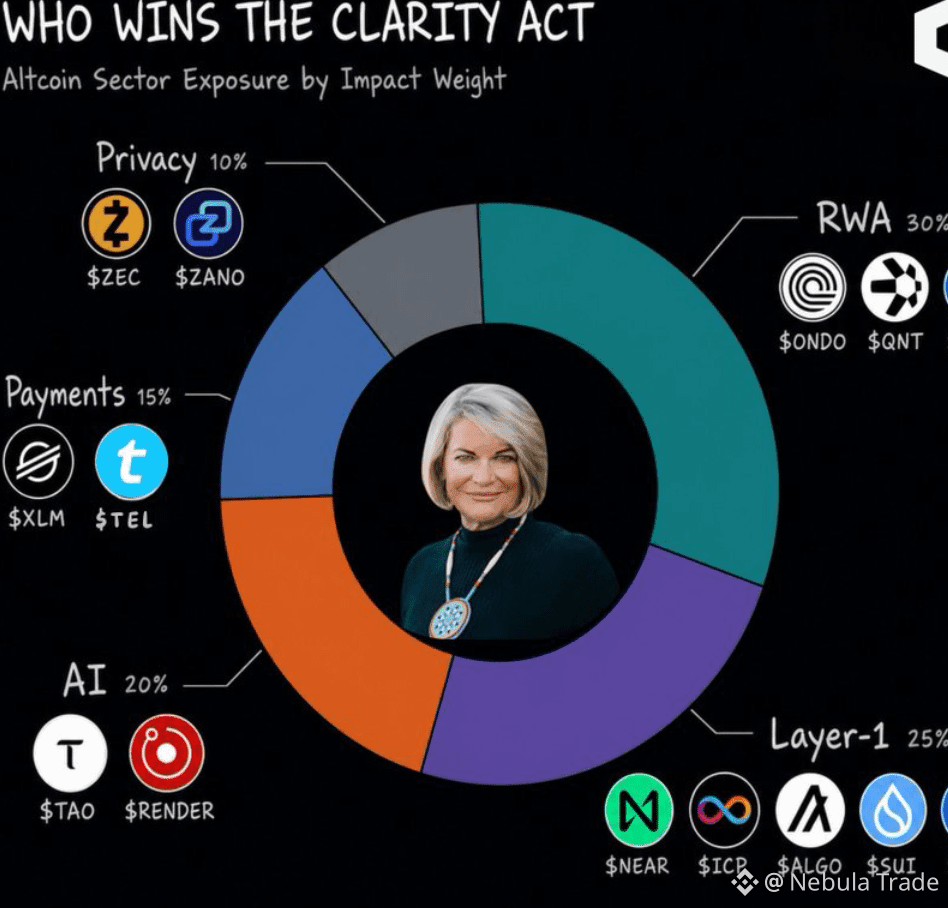
The Clarity Act Voting Impact on Altcoin Narratives
> RWA : 30%
> Layer-1 : 25%
> AI : 20%
> Payments : 15%
> Privacy : 10%
A month ago, everyone treated the CLARITY Act like it was passed.
Odds were near 80%, altcoin content was pricing it in as a certainty, and every regulatory clarity post sounded like the same easy bullish take.
Now those odds are falling down.
The real point is which sectors benefit if it is passed or not, and which sectors get hit hardest if it slips.
👉 RWA HAS THE MOST TO OFFER
This is where the upside is cleanest. $ONDO sits directly on the institutional tokenization thesis, $QNT becomes more important if TradFi rails need to connect with on-chain infrastructure, and $LINK is still the oracle layer every tokenized asset needs for verified off-chain data.
If the bill passes, RWA gets the strongest capital-unlock narrative. If it stalls, tokenization still happens, but more of it can stay inside traditional rails instead of flowing through crypto tokens.
👉 LAYER-1S ARE LESS DEPENDENT
$NEAR, $ICP, $ALGO, $SUI and $TON can benefit from a clearer network-token pathway, but these are not purely CLARITY Act trades. They still move on usage, developer activity, ecosystem liquidity and their own catalysts.
Regulatory clarity helps them, but it does not define them.
👉 AI AND PRIVACY ARE THE MESSY PART
$TAO and $RENDER sound bullish under a digital commodity framework, but their classification is not automatic. The market wants a clean AI upside story, but the legal path is still not guaranteed.
Privacy is even trickier. $ZEC and $ZANO may get “clarity,” but clarity could mean more AML scrutiny, not more freedom.
👉 PAYMENTS AND DEFI SIT IN THE MIDDLE
$XLM benefits if stablecoin and payment-token treatment keeps improving, while $HYPE matters because DeFi rules are still one of the unresolved pressure points.
This is why the odds drop matters.
RWA gets unlocked capital.
Privacy gets more scrutiny.
AI gets ambiguity.
L1s get optionality.
$BR $AKE $G
> RWA : 30%
> Layer-1 : 25%
> AI : 20%
> Payments : 15%
> Privacy : 10%
A month ago, everyone treated the CLARITY Act like it was passed.
Odds were near 80%, altcoin content was pricing it in as a certainty, and every regulatory clarity post sounded like the same easy bullish take.
Now those odds are falling down.
The real point is which sectors benefit if it is passed or not, and which sectors get hit hardest if it slips.
👉 RWA HAS THE MOST TO OFFER
This is where the upside is cleanest. $ONDO sits directly on the institutional tokenization thesis, $QNT becomes more important if TradFi rails need to connect with on-chain infrastructure, and $LINK is still the oracle layer every tokenized asset needs for verified off-chain data.
If the bill passes, RWA gets the strongest capital-unlock narrative. If it stalls, tokenization still happens, but more of it can stay inside traditional rails instead of flowing through crypto tokens.
👉 LAYER-1S ARE LESS DEPENDENT
$NEAR, $ICP, $ALGO, $SUI and $TON can benefit from a clearer network-token pathway, but these are not purely CLARITY Act trades. They still move on usage, developer activity, ecosystem liquidity and their own catalysts.
Regulatory clarity helps them, but it does not define them.
👉 AI AND PRIVACY ARE THE MESSY PART
$TAO and $RENDER sound bullish under a digital commodity framework, but their classification is not automatic. The market wants a clean AI upside story, but the legal path is still not guaranteed.
Privacy is even trickier. $ZEC and $ZANO may get “clarity,” but clarity could mean more AML scrutiny, not more freedom.
👉 PAYMENTS AND DEFI SIT IN THE MIDDLE
$XLM benefits if stablecoin and payment-token treatment keeps improving, while $HYPE matters because DeFi rules are still one of the unresolved pressure points.
This is why the odds drop matters.
RWA gets unlocked capital.
Privacy gets more scrutiny.
AI gets ambiguity.
L1s get optionality.
$BR $AKE $G