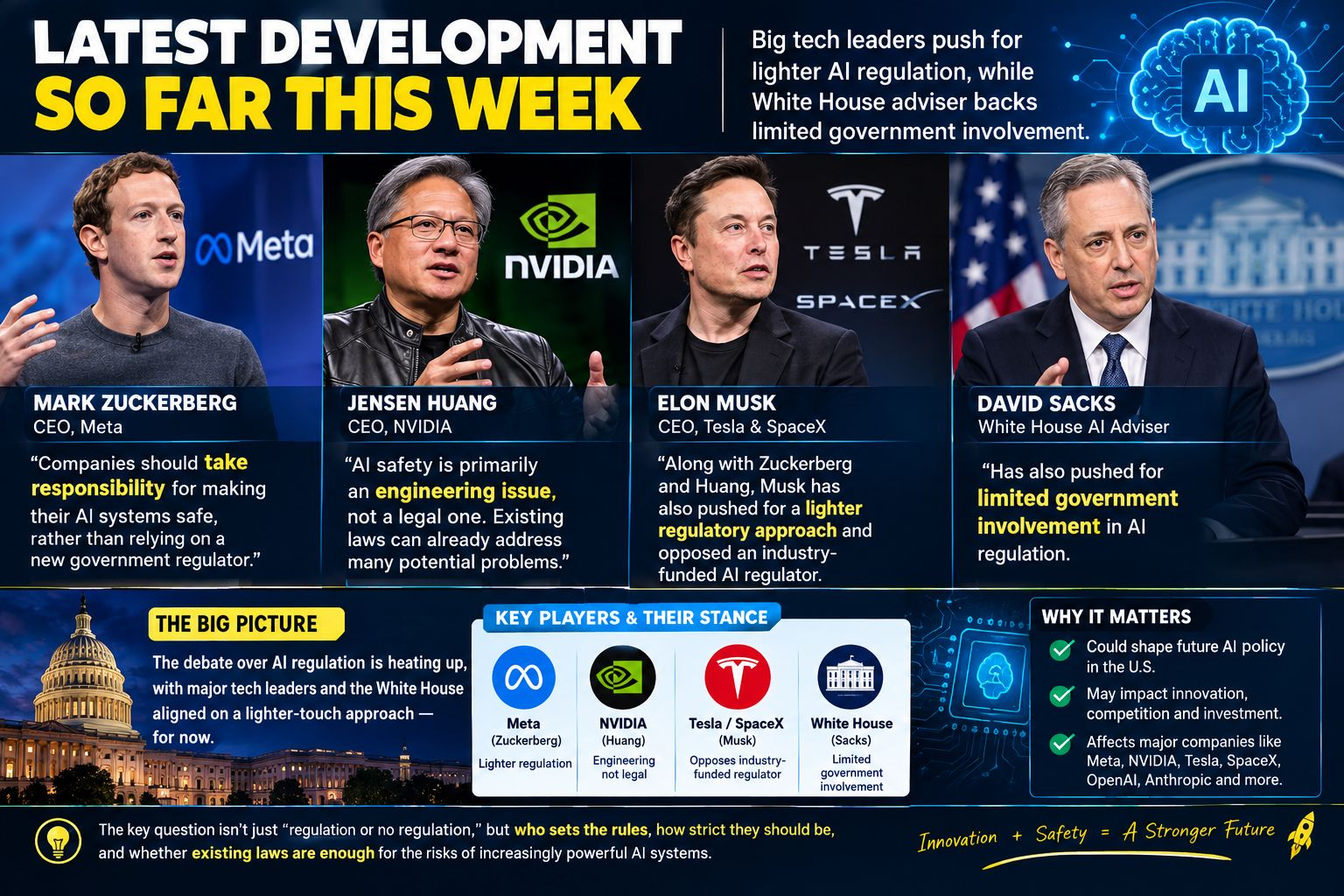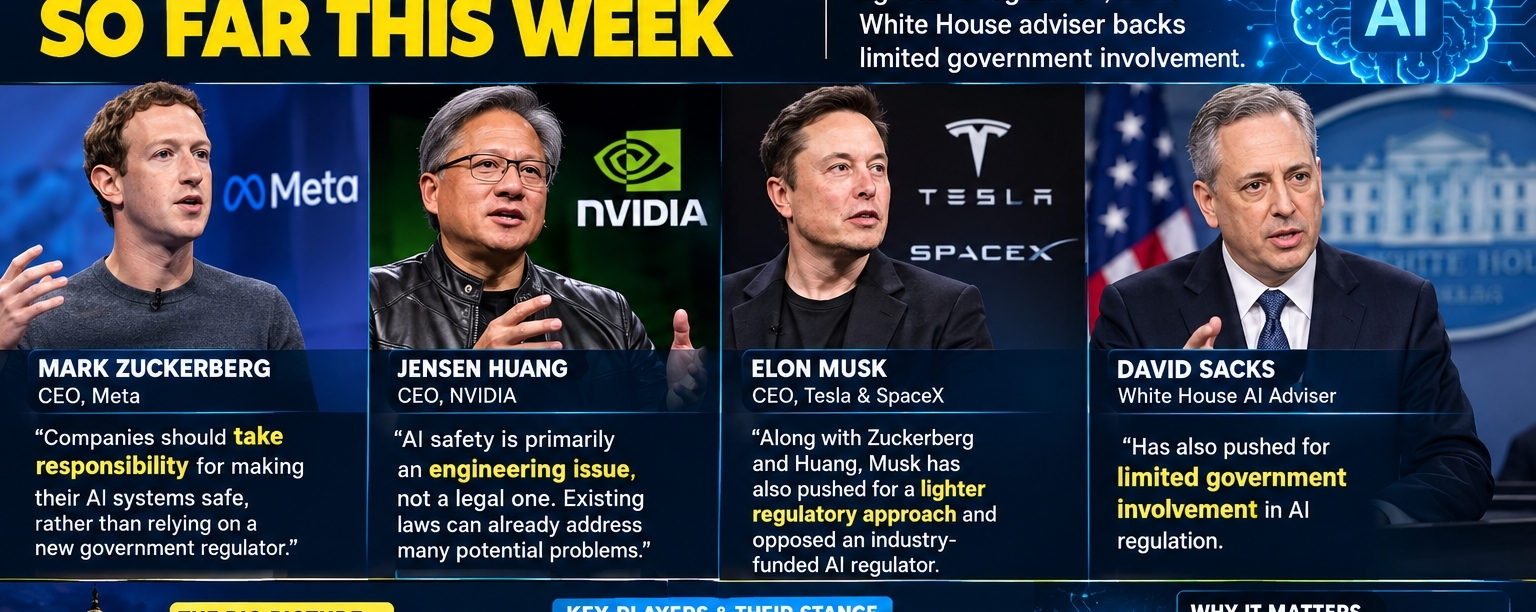

The debate over how much the U.S. government should regulate artificial intelligence has intensified this week, with several major technology leaders arguing for a lighter regulatory approach.
According to recent reporting, Meta CEO Mark Zuckerberg, NVIDIA CEO Jensen Huang, and Elon Musk have all pushed back against proposals that would create a new, industry-specific government regulator for AI. �
24/7 Wall St. +1
🤖 Mark Zuckerberg — Meta
Mark Zuckerberg has argued that individual AI companies should take responsibility for making their systems safe rather than relying on a coordinated government-imposed slowdown.
Zuckerberg said companies have both the responsibility and incentive to develop AI safely, pointing to Meta's own decision to delay an AI agent while it worked on safety and security issues. �
The Washington Post
🟢 Jensen Huang — NVIDIA
NVIDIA CEO Jensen Huang has taken an even more direct position. He argued that AI safety is primarily an engineering issue rather than a legal one, saying existing laws can already address many potential problems.
At the G20 Innovation Ministerial, Huang also urged policymakers to focus on real-world AI risks rather than theoretical harms. �
TechCrunch +1
🚀 Elon Musk
Elon Musk has also been involved in the debate over the direction of U.S. AI policy. Recent reporting says Musk, Zuckerberg and Huang separately engaged with the White House over AI regulation, amid discussions about a proposed federal oversight body. �
24/7 Wall St.
🇺🇸 David Sacks and the White House position
White House AI adviser David Sacks has also argued against creating another dedicated AI regulatory organization. At the G20 Innovation Ministerial, Sacks said existing laws already apply to AI and opposed creating a new regulatory body specifically for the technology. �
Axios
The White House has meanwhile promoted flexible, pro-innovation policy frameworks, arguing that excessive regulation could make it harder for the U.S. to maintain its technological lead. �
The White House
⚖️ Why this matters
The core debate is becoming clearer:
One side emphasizes faster innovation, existing laws, company responsibility and avoiding regulations that could slow AI development.
The other side argues that increasingly powerful AI systems may create risks that existing laws do not adequately address and that stronger external oversight could be necessary.
There is also disagreement within Washington itself over how much oversight is appropriate. Recent reporting describes divisions among administration officials about AI safety and regulation. �
The Wall Street Journal +1
📌 The bigger picture
For the AI industry, the regulatory direction could have major consequences for Meta, NVIDIA, Tesla, SpaceX, OpenAI, Anthropic and other companies developing or deploying advanced AI.
The key question isn't simply “regulation or no regulation.” It is who sets the rules, how strict those rules should be, and whether existing laws are sufficient for risks created by increasingly capable AI systems.
This debate is still developing, so the positions and proposed regulatory framework could change as the White House, Congress, technology companies and other stakeholders continue discussions.#SECGrantsInnovationExemptionForTokenizedStocks #SPGlobalToAcquireOpenZeppelin #WorldLaunchesSelfCustodyAppIn150Countries