Why STON.fi Lists Several Pools for One Token Pair
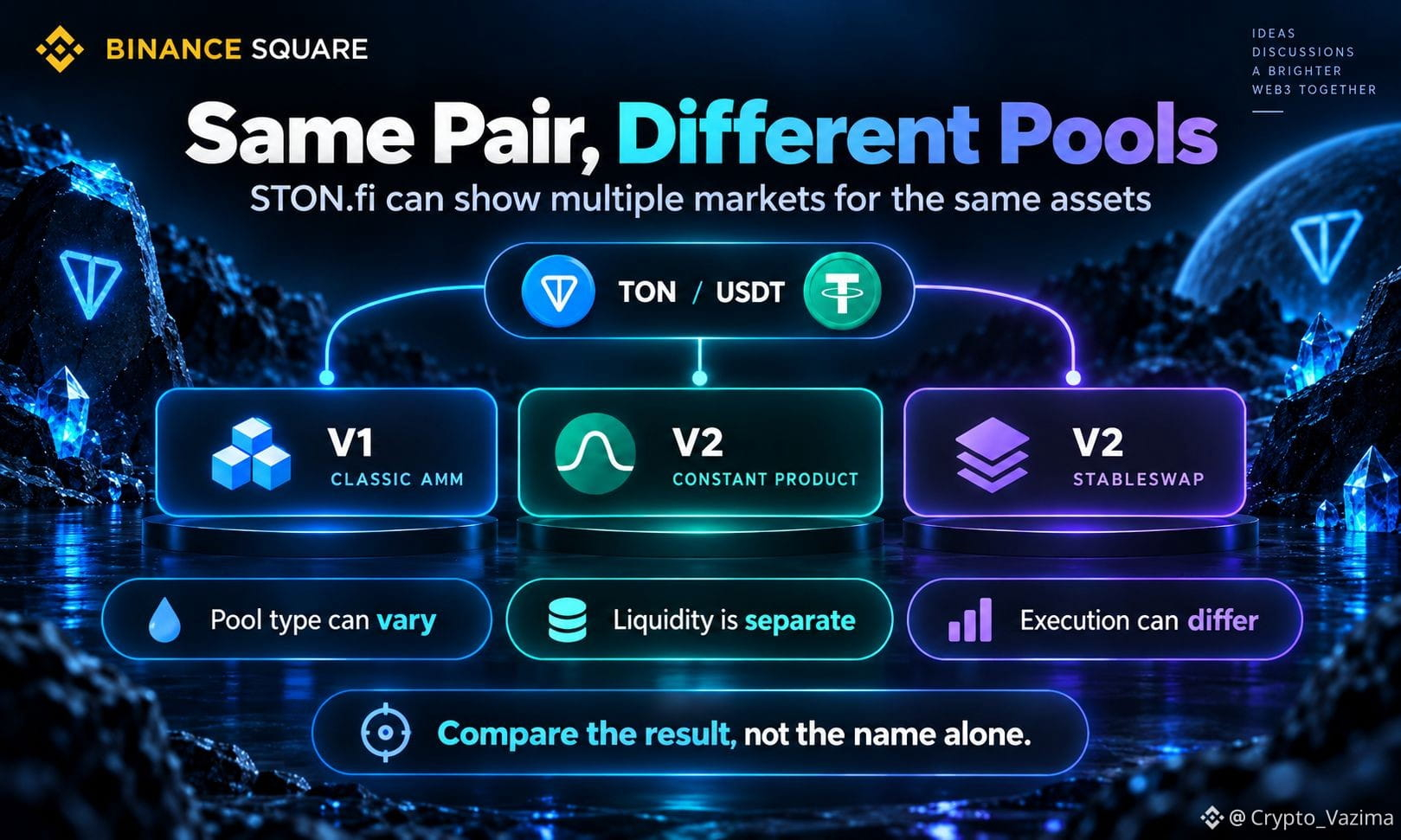
STON.fi shows multiple pools for one token pair because each pool is its own smart contract market. Same asset names can still sit in V1 and V2 contracts or in different V2 pricing models, so quotes, fees and LP economics can diverge.
🔥 Same Pair, Different Market
- Token names describe what can be traded.
- The pool contract holds the reserves and sets the AMM logic.
- Two A/B cards can still have different depth, fees and LP tokens.
🚀 How STON.fi Splits Those Markets
- V1 stays available for compatibility while V2 adds newer liquidity tools.
- V2 pool types include constant product, Stableswap, weighted constant product and weighted Stableswap.
- Router type and pool type decide the curve, not the ticker text alone.
🧠 Why the Quote Can Change
A smaller pool usually takes a larger hit from the same trade size. Fees default to 0.3% but can differ by pool. Liquidity never flows automatically from one pool into another that happens to list the same tokens. A lower fee is also not automatically better if price impact is worse.
⚡ How I Would Compare Before Signing
1. Verify official Jetton contracts on TON.
2. Note whether the pool is V1 or V2 and which pool type it uses.
3. Compare rate, price impact, minimum received and fee for the size you want.
4. If providing liquidity, weigh TVL, volume, APR and any farm separately.
My take: the label TOKEN A / TOKEN B is only the start. On STON.fi, execution quality lives in the specific pool you actually route through.
Which STON.fi check matters more to you on a large swap: depth or fee? 👇
Share the pool detail you always open before confirming a trade.
Not investment advice - research on your own! 🚀
$GRAM @STONfi DEX
STON.fi shows multiple pools for one token pair because each pool is its own smart contract market. Same asset names can still sit in V1 and V2 contracts or in different V2 pricing models, so quotes, fees and LP economics can diverge.
🔥 Same Pair, Different Market
- Token names describe what can be traded.
- The pool contract holds the reserves and sets the AMM logic.
- Two A/B cards can still have different depth, fees and LP tokens.
🚀 How STON.fi Splits Those Markets
- V1 stays available for compatibility while V2 adds newer liquidity tools.
- V2 pool types include constant product, Stableswap, weighted constant product and weighted Stableswap.
- Router type and pool type decide the curve, not the ticker text alone.
🧠 Why the Quote Can Change
A smaller pool usually takes a larger hit from the same trade size. Fees default to 0.3% but can differ by pool. Liquidity never flows automatically from one pool into another that happens to list the same tokens. A lower fee is also not automatically better if price impact is worse.
⚡ How I Would Compare Before Signing
1. Verify official Jetton contracts on TON.
2. Note whether the pool is V1 or V2 and which pool type it uses.
3. Compare rate, price impact, minimum received and fee for the size you want.
4. If providing liquidity, weigh TVL, volume, APR and any farm separately.
My take: the label TOKEN A / TOKEN B is only the start. On STON.fi, execution quality lives in the specific pool you actually route through.
Which STON.fi check matters more to you on a large swap: depth or fee? 👇
Share the pool detail you always open before confirming a trade.
Not investment advice - research on your own! 🚀
$GRAM @STONfi DEX