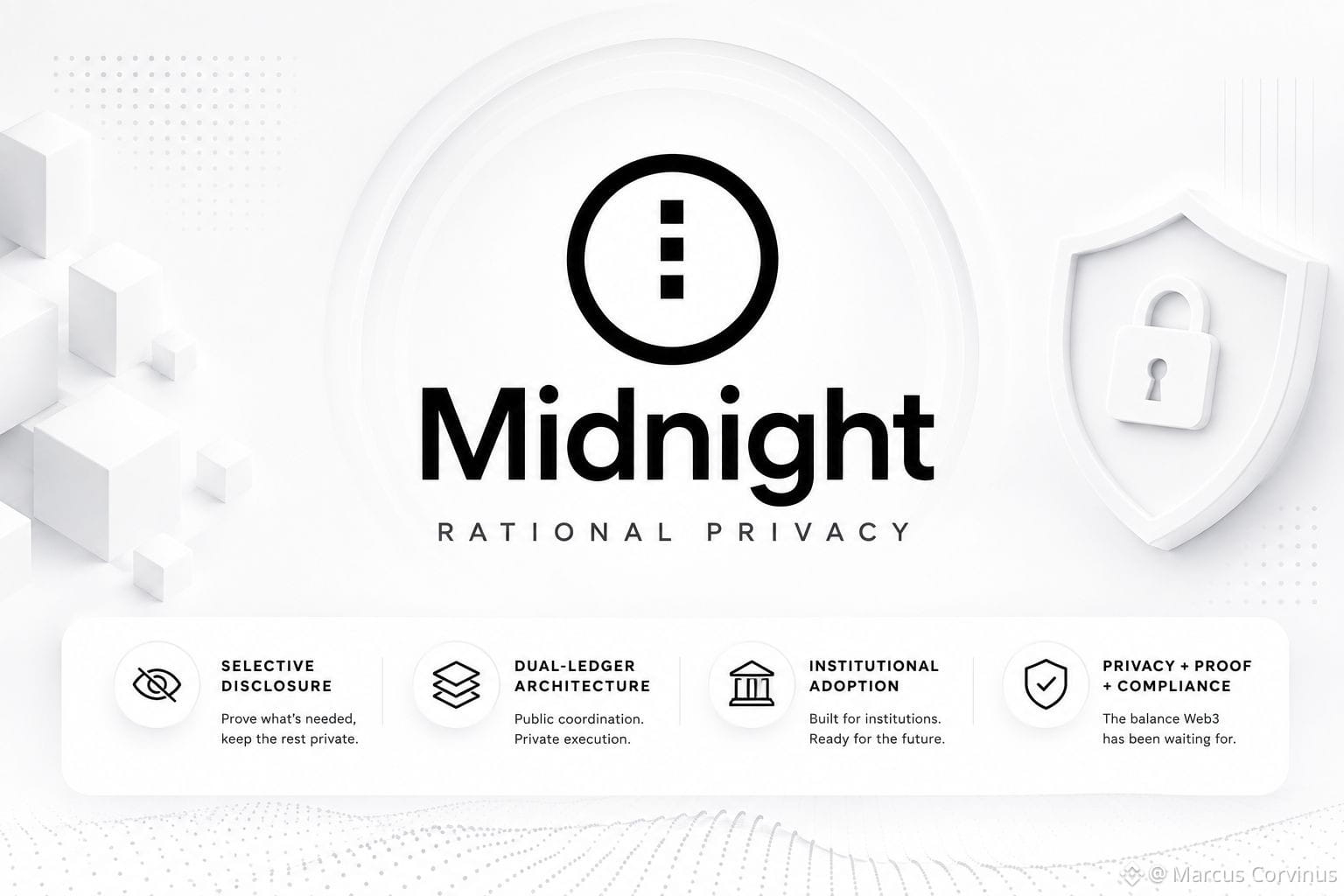

Midnight is building a privacy layer for Web3 that could change how institutions think about blockchain.
The problem is simple:
Public blockchain = too much exposure
Total secrecy = difficult compliance
Midnight is targeting the middle ground.
Its core idea is selective disclosure → prove something is true without revealing the private data it.
Think about identity verification.
A company may need proof that you meet an age requirement. It does not need your full identity, address and every detail on your ID.
That is rational privacy.
And this philosophy runs through Midnight’s entire design.
$NIGHT = the public governance and value asset.
Holding NIGHT automatically generates DUST.
DUST = a non-transferable, regenerating resource used for private transaction fees.
Simply:
NIGHT → DUST → private transactions
The network architecture is equally interesting.
Public layer = transaction coordination + metadata
Shielded layer = private execution + sensitive details
This gives institutions a way to use blockchain while keeping confidential information protected and still proving what needs to be verified.
The adoption side makes.
Monument Bank, a Bank of England regulated institution, is working to tokenize up to £250M of customer deposits on Midnight.
Google Cloud, MoneyGram, Pairpoint by Vodafone, eToro, Bullish, Worldpay and Blockdaemon are also part of its enterprise validator roster.
And one distinction matters:
Midnight = standalone Layer 1.
It is not a Cardano L2 or subchain. NIGHT is distinct from $ADA , even though Input Output provides an important engineering connection.
$ZEC has helped define blockchain privacy, while $ADA represents a major smart-contract ecosystem.
Midnight is exploring another equation:
Privacy + Proof + Compliance.
As institutions move more real-world assets and sensitive data on-chain, that combination could become increasingly important.
The next privacy breakthrough may not be about hiding everything.
It may be about proving what matters → without revealing what doesn't.
NFA + DYOR
#Midnight
The problem is simple:
Public blockchain = too much exposure
Total secrecy = difficult compliance
Midnight is targeting the middle ground.
Its core idea is selective disclosure → prove something is true without revealing the private data it.
Think about identity verification.
A company may need proof that you meet an age requirement. It does not need your full identity, address and every detail on your ID.
That is rational privacy.
And this philosophy runs through Midnight’s entire design.
$NIGHT = the public governance and value asset.
Holding NIGHT automatically generates DUST.
DUST = a non-transferable, regenerating resource used for private transaction fees.
Simply:
NIGHT → DUST → private transactions
The network architecture is equally interesting.
Public layer = transaction coordination + metadata
Shielded layer = private execution + sensitive details
This gives institutions a way to use blockchain while keeping confidential information protected and still proving what needs to be verified.
The adoption side makes.
Monument Bank, a Bank of England regulated institution, is working to tokenize up to £250M of customer deposits on Midnight.
Google Cloud, MoneyGram, Pairpoint by Vodafone, eToro, Bullish, Worldpay and Blockdaemon are also part of its enterprise validator roster.
And one distinction matters:
Midnight = standalone Layer 1.
It is not a Cardano L2 or subchain. NIGHT is distinct from $ADA , even though Input Output provides an important engineering connection.
$ZEC has helped define blockchain privacy, while $ADA represents a major smart-contract ecosystem.
Midnight is exploring another equation:
Privacy + Proof + Compliance.
As institutions move more real-world assets and sensitive data on-chain, that combination could become increasingly important.
The next privacy breakthrough may not be about hiding everything.
It may be about proving what matters → without revealing what doesn't.
NFA + DYOR
#Midnight