
Muzamil Abbas⁷⁵ 穆扎米尔_阿巴斯
10k Publications

Muzamil Abbas⁷⁵ 穆扎米尔_阿巴斯
X ACC @Muzamil39825275 // BINANCE SQUARE CREATOR // CRYPTO TRADER // BITCOIN ENTHUSIAST // CALM MIND BIG DREAMS // BUILDING A FUTURE NOT CHASING ATTENTION✨
837 Suivis
15.4K+ Abonnés
23.3K+ J’aime
Publications
Tous
Citations
Vidéos
Direct
PINNED
🎉 15K Followers Celebration Giveaway! 🎉
Alhamdulillah, we have reached 15K followers on Binance Square Thank you all for your support and trust. To celebrate this milestone, I'm giving away SOL Coin to lucky winners. 🔥
✅ Like this post
✅ Repost this post
✅ Comment 1
✅ Claim 🎁
The more support you show, the bigger the future giveaways can become.
Good luck everyone
#BinanceSquare #SOL #Giveaway #15KMilestone #ThankYou
Alhamdulillah, we have reached 15K followers on Binance Square Thank you all for your support and trust. To celebrate this milestone, I'm giving away SOL Coin to lucky winners. 🔥
✅ Like this post
✅ Repost this post
✅ Comment 1
✅ Claim 🎁
The more support you show, the bigger the future giveaways can become.
Good luck everyone
#BinanceSquare #SOL #Giveaway #15KMilestone #ThankYou

PINNED
🎁 $SHIB GIVEAWAY WORTH $100 🎁
I’m giving away SHIB Gift Boxes to 3,000 lucky people! 🐕🔥
To participate:
❤️ Like this post ✅
🔁 Repost this post ✅
💬 Comment “1” below ✅
🎁 Claim your Gift Box ✅
Good luck everyone🚀✨
#SHIB #Giveaway #Binance #CryptoGiveaway
I’m giving away SHIB Gift Boxes to 3,000 lucky people! 🐕🔥
To participate:
❤️ Like this post ✅
🔁 Repost this post ✅
💬 Comment “1” below ✅
🎁 Claim your Gift Box ✅
Good luck everyone🚀✨
#SHIB #Giveaway #Binance #CryptoGiveaway

go

ANUUONCHAIN
·
--
🤝🤝🤝🤝🤝🤝🤝🤝🤝🤝🤝🤝🤝🤝🤝
❤❤❤❤❤follow me please ❤❤❤❤
✅✅✅✅✅✅✅✅✅✅✅✅✅✅✅
❤❤❤❤❤follow me please ❤❤❤❤
✅✅✅✅✅✅✅✅✅✅✅✅✅✅✅

go


AbdullRauf
·
--
YOUR SUPPORT = OUR THANKS. 2000 GIFTS, GO! 🚀🎁💐
Square Family, you rock! 🧧 To celebrate YOU, we’re giving away 2000 GIFTS. Let’s go!
How to enter:
👉 Follow us
👉 Share this post
👉 Comment “666”
Random draws. Huge wins. Enter now!
Square Family, you rock! 🧧 To celebrate YOU, we’re giving away 2000 GIFTS. Let’s go!
How to enter:
👉 Follow us
👉 Share this post
👉 Comment “666”
Random draws. Huge wins. Enter now!

go

白鲨观点
·
--
混币圈久了,发现一个挺有意思的现象:
越是亏得多的人,越喜欢教别人怎么赚钱。
你去各种社群里看,天天喊单的、分析行情头头是道的、晒单子晒收益的,十有八九账户里没多少钱,甚至可能还在深套。真正稳定赚钱的人,反而很少说话,更不会到处教人怎么操作。
为什么?因为亏钱的人需要存在感。实盘赚不到钱,就在嘴上找补——说对了一次,能吹半年;说错了,反正没人查他账户,第二天换个说法继续。而真正赚钱的人,时间都花在研究和等待上,没功夫在群里指点江山。
还有一个规律:越喜欢预测行情的人,预测得越不准。 不是他技术差,是他根本就没把心思放在研究上,全放在怎么让别人觉得自己很厉害上了。
所以刚入行的新人,别到处找老师找带单。你想想,真能稳定赚钱的方法,谁会到处说?闷声发大财不好吗?
币圈最不缺的就是老师,
最缺的,是愿意老老实实交学费、自己慢慢悟的学生。
#BinanceSquare #BTC #交易心得 #币圈观察
越是亏得多的人,越喜欢教别人怎么赚钱。
你去各种社群里看,天天喊单的、分析行情头头是道的、晒单子晒收益的,十有八九账户里没多少钱,甚至可能还在深套。真正稳定赚钱的人,反而很少说话,更不会到处教人怎么操作。
为什么?因为亏钱的人需要存在感。实盘赚不到钱,就在嘴上找补——说对了一次,能吹半年;说错了,反正没人查他账户,第二天换个说法继续。而真正赚钱的人,时间都花在研究和等待上,没功夫在群里指点江山。
还有一个规律:越喜欢预测行情的人,预测得越不准。 不是他技术差,是他根本就没把心思放在研究上,全放在怎么让别人觉得自己很厉害上了。
所以刚入行的新人,别到处找老师找带单。你想想,真能稳定赚钱的方法,谁会到处说?闷声发大财不好吗?
币圈最不缺的就是老师,
最缺的,是愿意老老实实交学费、自己慢慢悟的学生。
#BinanceSquare #BTC #交易心得 #币圈观察

go

Aiman艾曼_BNB
·
--
Haussiergo
and
claim
red packet🧧🧧🧧
$SKR $ZKC
and
claim
red packet🧧🧧🧧
$SKR $ZKC

go

x_Rex
·
--
Remember yesterday when I said the SEC was voting on crypto regulation today? 😅🧧
They cancelled it.
One day notice. No explanation. No replacement date.
The vote that would have given crypto projects a legal path to raise up to $75M without securities registration - gone. Just like that.
Senate left for recess without voting on the Clarity Act. SEC cancelled Regulation Crypto. Commissioner Hester Peirce, the most crypto-friendly voice at the SEC, is leaving in November.
And yet BTC is still at $62,969. ETH at $1,872. Market barely moved 😂
This is actually the most important lesson in crypto , Regulation delays are annoying. But the market has stopped waiting for regulators to catch up. $1.82 trillion market cap. $678M in ETF inflows last week. BlackRock buying daily.
The builders kept building. The buyers kept buying.
With or without Washington's permission
Grab the Red Packet — crypto doesn't wait for anyone 🧧
#BinanceSquareFamily #BinanceSquareTalks #redpacket
$BTC $ETH
They cancelled it.
One day notice. No explanation. No replacement date.
The vote that would have given crypto projects a legal path to raise up to $75M without securities registration - gone. Just like that.
Senate left for recess without voting on the Clarity Act. SEC cancelled Regulation Crypto. Commissioner Hester Peirce, the most crypto-friendly voice at the SEC, is leaving in November.
And yet BTC is still at $62,969. ETH at $1,872. Market barely moved 😂
This is actually the most important lesson in crypto , Regulation delays are annoying. But the market has stopped waiting for regulators to catch up. $1.82 trillion market cap. $678M in ETF inflows last week. BlackRock buying daily.
The builders kept building. The buyers kept buying.
With or without Washington's permission
Grab the Red Packet — crypto doesn't wait for anyone 🧧
#BinanceSquareFamily #BinanceSquareTalks #redpacket
$BTC $ETH

go

A L I A N S A R I
·
--
guys claim gift 🎁🎁🎁

go

Ahmed Ali Nizamani
·
--
666 + 666 = 🎁🎁🎁✨✨✨

🎁 $AAPLB $NVDAB
Muzamil Abbas⁷⁵ 穆扎米尔_阿巴斯
·
--
Haussier🎉 15K Followers Celebration Giveaway! 🎉
Alhamdulillah, we have reached 15K followers on Binance Square Thank you all for your support and trust. To celebrate this milestone, I'm giving away SOL Coin to lucky winners. 🔥
✅ Like this post
✅ Repost this post
✅ Comment 1
✅ Claim 🎁
The more support you show, the bigger the future giveaways can become.
Good luck everyone
#BinanceSquare #SOL #Giveaway #15KMilestone #ThankYou
Alhamdulillah, we have reached 15K followers on Binance Square Thank you all for your support and trust. To celebrate this milestone, I'm giving away SOL Coin to lucky winners. 🔥
✅ Like this post
✅ Repost this post
✅ Comment 1
✅ Claim 🎁
The more support you show, the bigger the future giveaways can become.
Good luck everyone
#BinanceSquare #SOL #Giveaway #15KMilestone #ThankYou
Trade sur 30 j $DUSK 3.3K USDT
#dusk $DUSK @Dusk
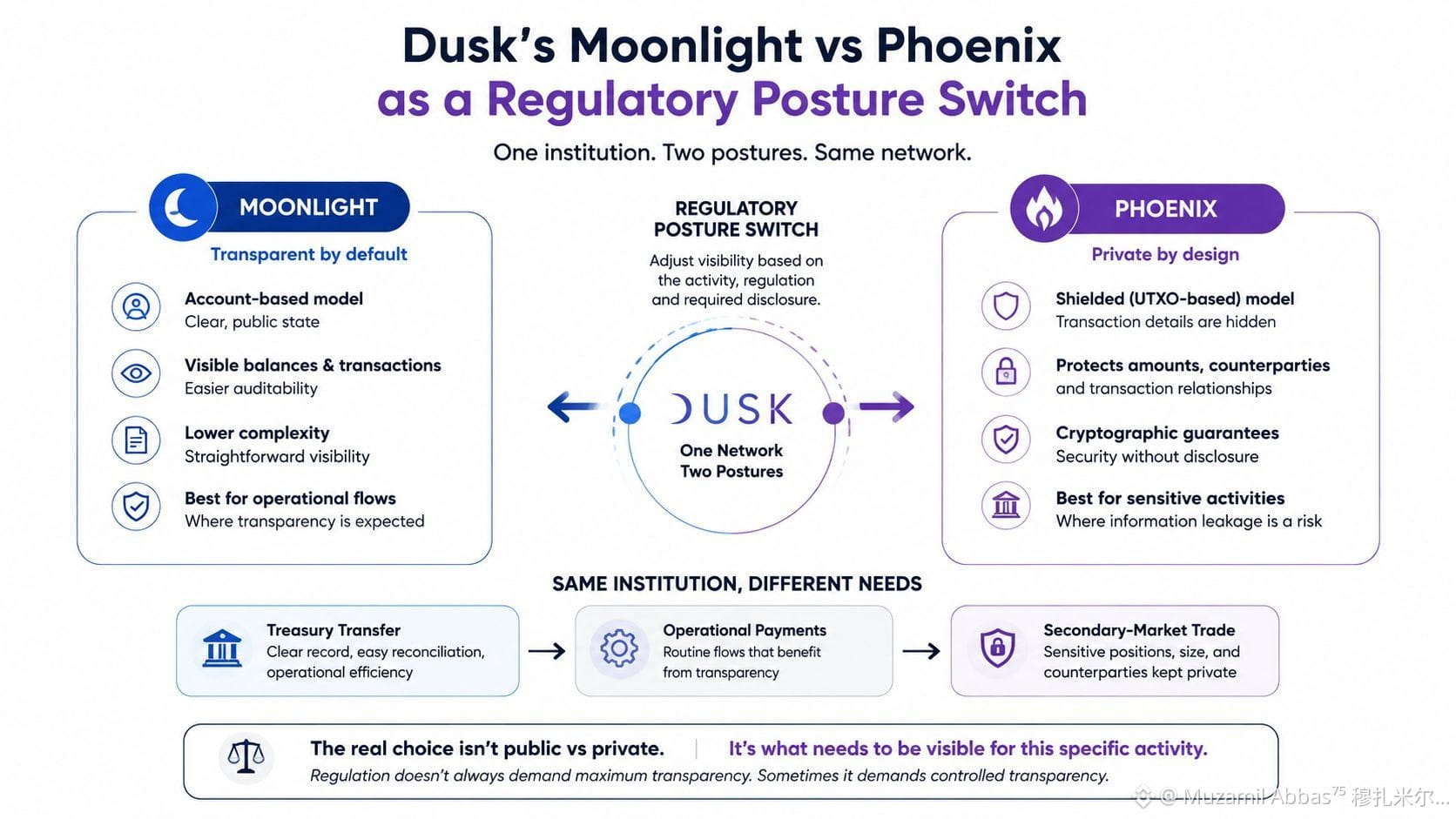
One thing I find interesting about @DuskNetwork is that Moonlight and Phoenix don’t have to be viewed as competing privacy models.
For the same institution, they could represent different regulatory postures.
A treasury transfer or operational payment might benefit from Moonlight’s account-based, transparent structure. There’s a clear record and less complexity around visibility.
But imagine that institution entering a sensitive secondary-market trade. Broadcasting the amount, counterparties or transaction relationships could reveal information that doesn’t need to be public.
That’s where Phoenix becomes more interesting.
Its shielded model can keep transaction details private while still supporting the cryptographic guarantees needed by the network.
So the real choice isn’t simply public vs private.
It’s more like:
What needs to be visible for this specific activity?
I think that’s a much more realistic institutional use of privacy.
Regulation doesn’t always demand maximum transparency.
Sometimes it demands controlled transparency.
And Dusk’s architecture seems designed around that distinction.
One thing I find interesting about @DuskNetwork is that Moonlight and Phoenix don’t have to be viewed as competing privacy models.
For the same institution, they could represent different regulatory postures.
A treasury transfer or operational payment might benefit from Moonlight’s account-based, transparent structure. There’s a clear record and less complexity around visibility.
But imagine that institution entering a sensitive secondary-market trade. Broadcasting the amount, counterparties or transaction relationships could reveal information that doesn’t need to be public.
That’s where Phoenix becomes more interesting.
Its shielded model can keep transaction details private while still supporting the cryptographic guarantees needed by the network.
So the real choice isn’t simply public vs private.
It’s more like:
What needs to be visible for this specific activity?
I think that’s a much more realistic institutional use of privacy.
Regulation doesn’t always demand maximum transparency.
Sometimes it demands controlled transparency.
And Dusk’s architecture seems designed around that distinction.
Trade sur 30 j $DUSK 3.3K USDT
#dusk $DUSK @Dusk
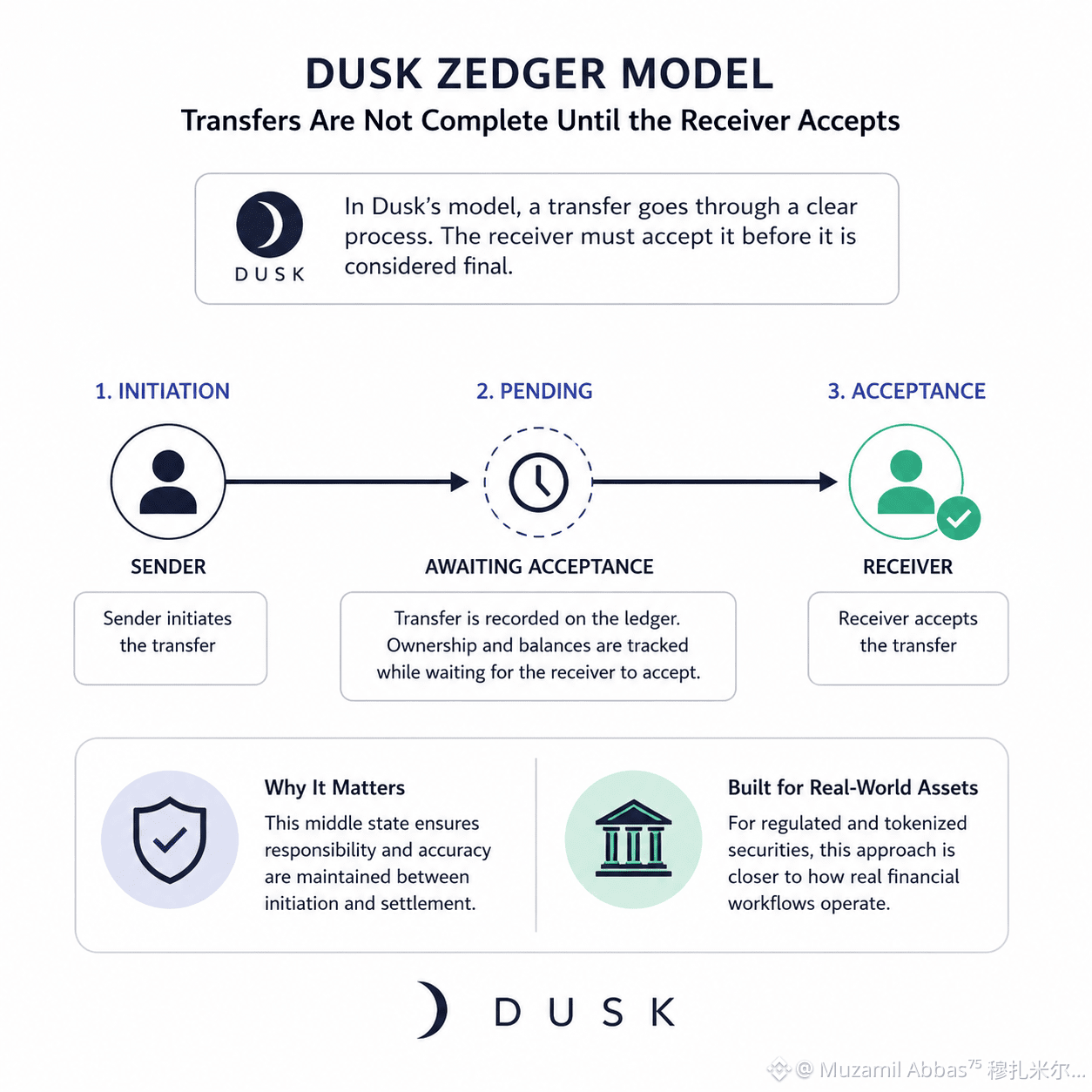
I was reading through Dusk’s approach to security tokenization and one detail kept pulling my attention. Most blockchain transfers feel instant from the outside. Assets move, balances change, and the transaction is considered finished. But regulated assets do not always work that way.
In Dusk’s Zedger model, a transfer is not automatically complete the moment it is sent. The receiver must explicitly accept it first. Until that happens, the transferred amount still needs to be accounted for correctly. That sounds like a small design choice, but it solves a surprisingly difficult problem.
I started thinking about situations where one side of a transaction is ready before the other. Maybe the sender has already initiated the transfer, but the receiver has not approved it yet. Traditional crypto systems usually focus on moving value as fast as possible. Dusk seems more focused on tracking responsibility during the period between initiation and settlement.
What I find interesting is that this middle state is treated as part of the process rather than an exception. The system keeps track of ownership and balances while waiting for the final approval step.
For tokenized securities and regulated assets, that feels much closer to how real financial workflows actually operate. The question is whether more blockchain systems will eventually need similar settlement logic as tokenization grows.
I was reading through Dusk’s approach to security tokenization and one detail kept pulling my attention. Most blockchain transfers feel instant from the outside. Assets move, balances change, and the transaction is considered finished. But regulated assets do not always work that way.
In Dusk’s Zedger model, a transfer is not automatically complete the moment it is sent. The receiver must explicitly accept it first. Until that happens, the transferred amount still needs to be accounted for correctly. That sounds like a small design choice, but it solves a surprisingly difficult problem.
I started thinking about situations where one side of a transaction is ready before the other. Maybe the sender has already initiated the transfer, but the receiver has not approved it yet. Traditional crypto systems usually focus on moving value as fast as possible. Dusk seems more focused on tracking responsibility during the period between initiation and settlement.
What I find interesting is that this middle state is treated as part of the process rather than an exception. The system keeps track of ownership and balances while waiting for the final approval step.
For tokenized securities and regulated assets, that feels much closer to how real financial workflows actually operate. The question is whether more blockchain systems will eventually need similar settlement logic as tokenization grows.
#dusk $DUSK @Dusk
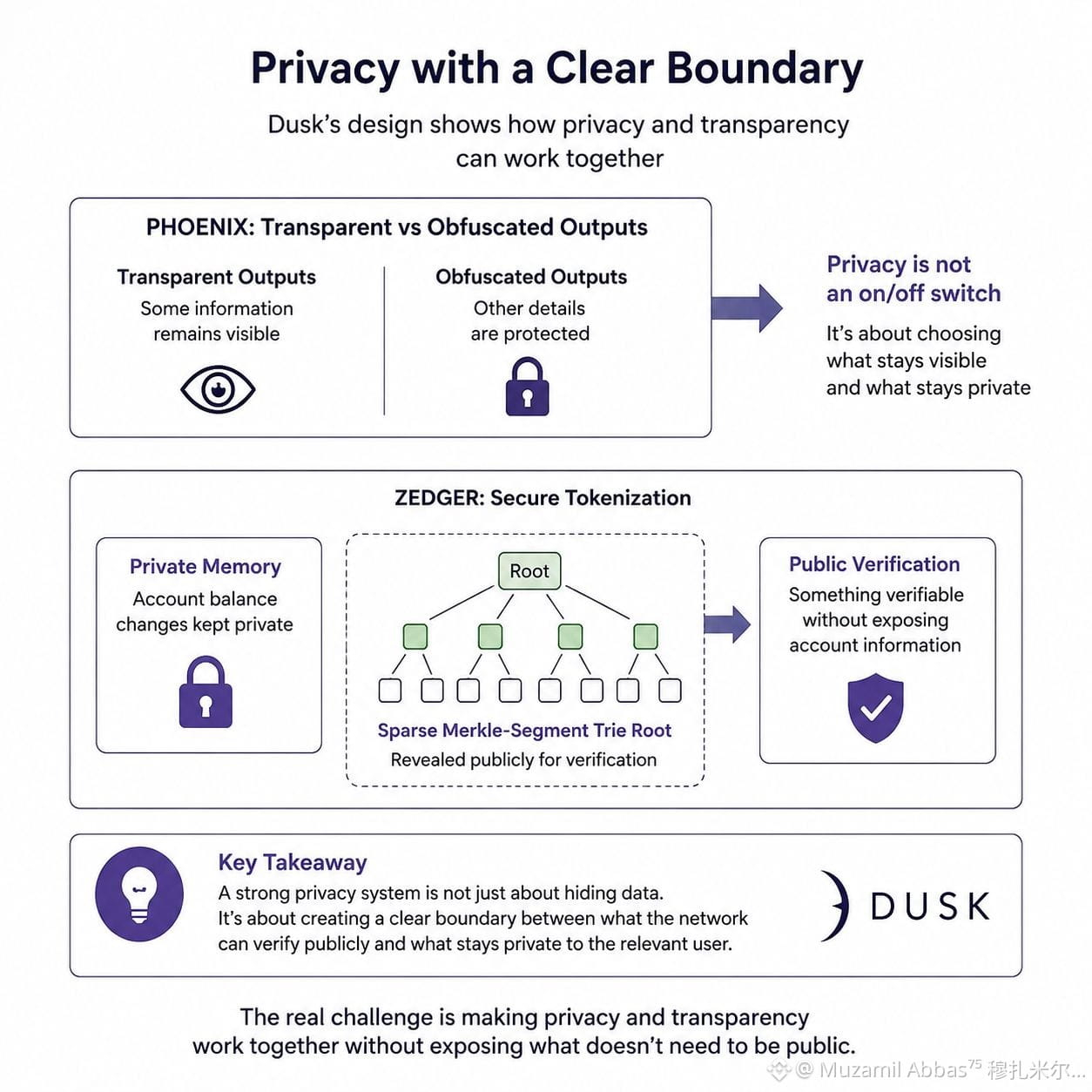
i think privacy becomes much more useful when you can clearly understand what is actually being hidden.
That is one reason Dusk’s design stands out to me. In Phoenix the whitepaper separates outputs into transparent and obfuscated types. So privacy is not treated as a simple switch where everything disappears. Some information can remain visible, while other details are protected.
Zedger takes this idea further for security tokenization. Account balance changes can be kept in private memory, while a Sparse Merkle Segment Trie root is revealed publicly. That gives the system something verifiable without exposing the underlying account information itself.
To me, that distinction is important. A privacy system is not only about hiding data. It also needs a clear boundary between what the network can verify publicly and what stays private to the relevant user.
That is where Dusk’s approach gets interesting. Privacy and transparency are not necessarily opposites. The real question is whether the protocol can make both work together without exposing information that does not need to be public.
i think privacy becomes much more useful when you can clearly understand what is actually being hidden.
That is one reason Dusk’s design stands out to me. In Phoenix the whitepaper separates outputs into transparent and obfuscated types. So privacy is not treated as a simple switch where everything disappears. Some information can remain visible, while other details are protected.
Zedger takes this idea further for security tokenization. Account balance changes can be kept in private memory, while a Sparse Merkle Segment Trie root is revealed publicly. That gives the system something verifiable without exposing the underlying account information itself.
To me, that distinction is important. A privacy system is not only about hiding data. It also needs a clear boundary between what the network can verify publicly and what stays private to the relevant user.
That is where Dusk’s approach gets interesting. Privacy and transparency are not necessarily opposites. The real question is whether the protocol can make both work together without exposing information that does not need to be public.
Trade sur 30 j $DUSK 2.8K USDT
#dusk $DUSK @Dusk
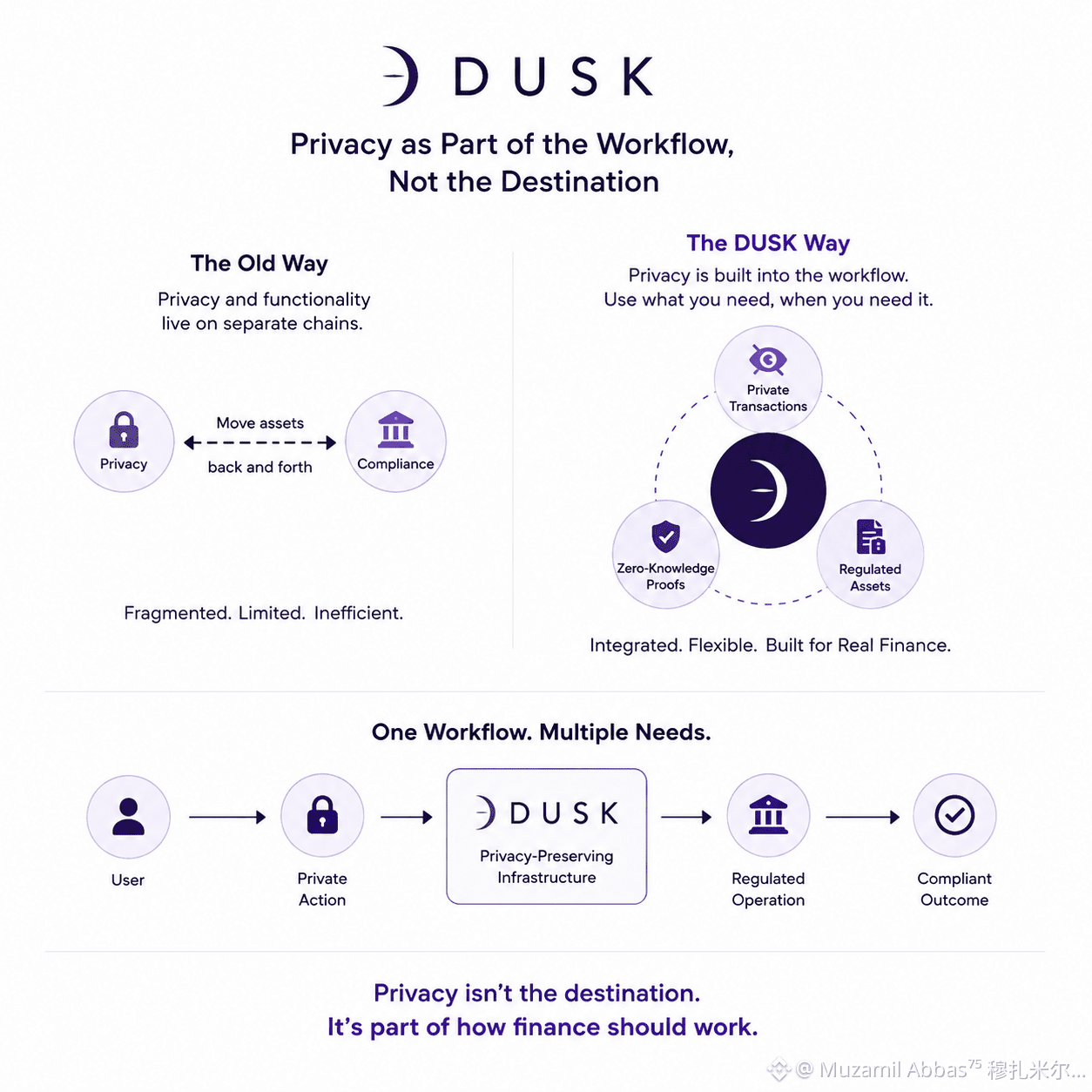
I was thinking about how most crypto discussions still treat privacy as something that belongs to a specific chain. If you want privacy, you move assets there. If you need compliance or other functionality, you move somewhere else. That separation has always felt a bit limiting to me.
What caught my attention with DUSK is the idea that privacy can become part of the workflow itself rather than the destination. The network was designed around confidential transactions, zero-knowledge proofs, and structures that can support regulated assets without exposing every detail publicly. Instead of forcing users to choose between transparency and privacy, the goal seems to be making both exist within the same environment depending on what the situation requires.
That feels more practical than the usual debate of private chain versus public chain. Real financial activity is rarely one-dimensional. Different participants need different levels of visibility, and a system that can adapt to that may be more useful than one built around a single rule for everyone.
The question is whether the market will eventually value privacy as infrastructure rather than a niche feature attached to a particular blockchain.
I was thinking about how most crypto discussions still treat privacy as something that belongs to a specific chain. If you want privacy, you move assets there. If you need compliance or other functionality, you move somewhere else. That separation has always felt a bit limiting to me.
What caught my attention with DUSK is the idea that privacy can become part of the workflow itself rather than the destination. The network was designed around confidential transactions, zero-knowledge proofs, and structures that can support regulated assets without exposing every detail publicly. Instead of forcing users to choose between transparency and privacy, the goal seems to be making both exist within the same environment depending on what the situation requires.
That feels more practical than the usual debate of private chain versus public chain. Real financial activity is rarely one-dimensional. Different participants need different levels of visibility, and a system that can adapt to that may be more useful than one built around a single rule for everyone.
The question is whether the market will eventually value privacy as infrastructure rather than a niche feature attached to a particular blockchain.
Trade sur 30 j $DUSK 2.8K USDT
#dusk $DUSK @Dusk
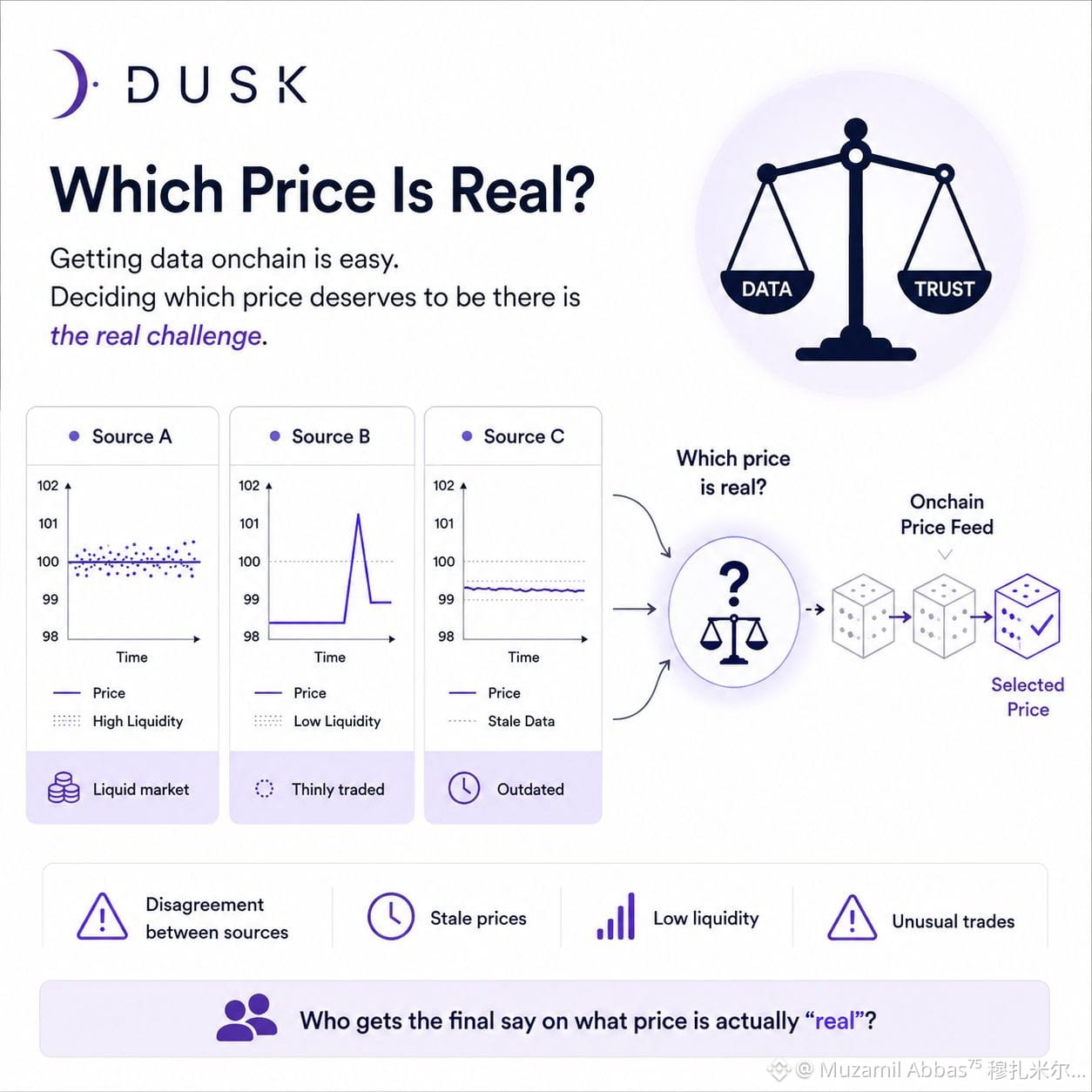
I’ve been thinking more about Dusk’s approach to putting market data onchain and one thing keeps bothering me
Getting a price onto a blockchain is one problem
Deciding which price deserves to be there is another
For a liquid asset several active markets can give you a reasonable reference because there is enough trading activity to compare
But a thinly traded security is different
One small trade can move the quoted price while the last traded price might not represent what someone could actually sell the asset for
If that number becomes part of an onchain workflow the data source suddenly matters almost as much as the infrastructure carrying it
That makes me look at Dusk’s role differently
The interesting question for me isn’t simply whether price data can be brought onchain
It’s how the system handles disagreement between sources stale prices low liquidity or unusual trades
There has to be some way to judge data quality rather than simply record whatever arrives first
I’d want to see how this works in practice across less liquid regulated assets especially when different sources produce slightly different valuations
Because at that point the real question becomes simple
Who gets the final say on what price is actually “real”?
I’ve been thinking more about Dusk’s approach to putting market data onchain and one thing keeps bothering me
Getting a price onto a blockchain is one problem
Deciding which price deserves to be there is another
For a liquid asset several active markets can give you a reasonable reference because there is enough trading activity to compare
But a thinly traded security is different
One small trade can move the quoted price while the last traded price might not represent what someone could actually sell the asset for
If that number becomes part of an onchain workflow the data source suddenly matters almost as much as the infrastructure carrying it
That makes me look at Dusk’s role differently
The interesting question for me isn’t simply whether price data can be brought onchain
It’s how the system handles disagreement between sources stale prices low liquidity or unusual trades
There has to be some way to judge data quality rather than simply record whatever arrives first
I’d want to see how this works in practice across less liquid regulated assets especially when different sources produce slightly different valuations
Because at that point the real question becomes simple
Who gets the final say on what price is actually “real”?
Trade sur 30 j $DUSK 2.8K USDT
#dusk $DUSK @Dusk
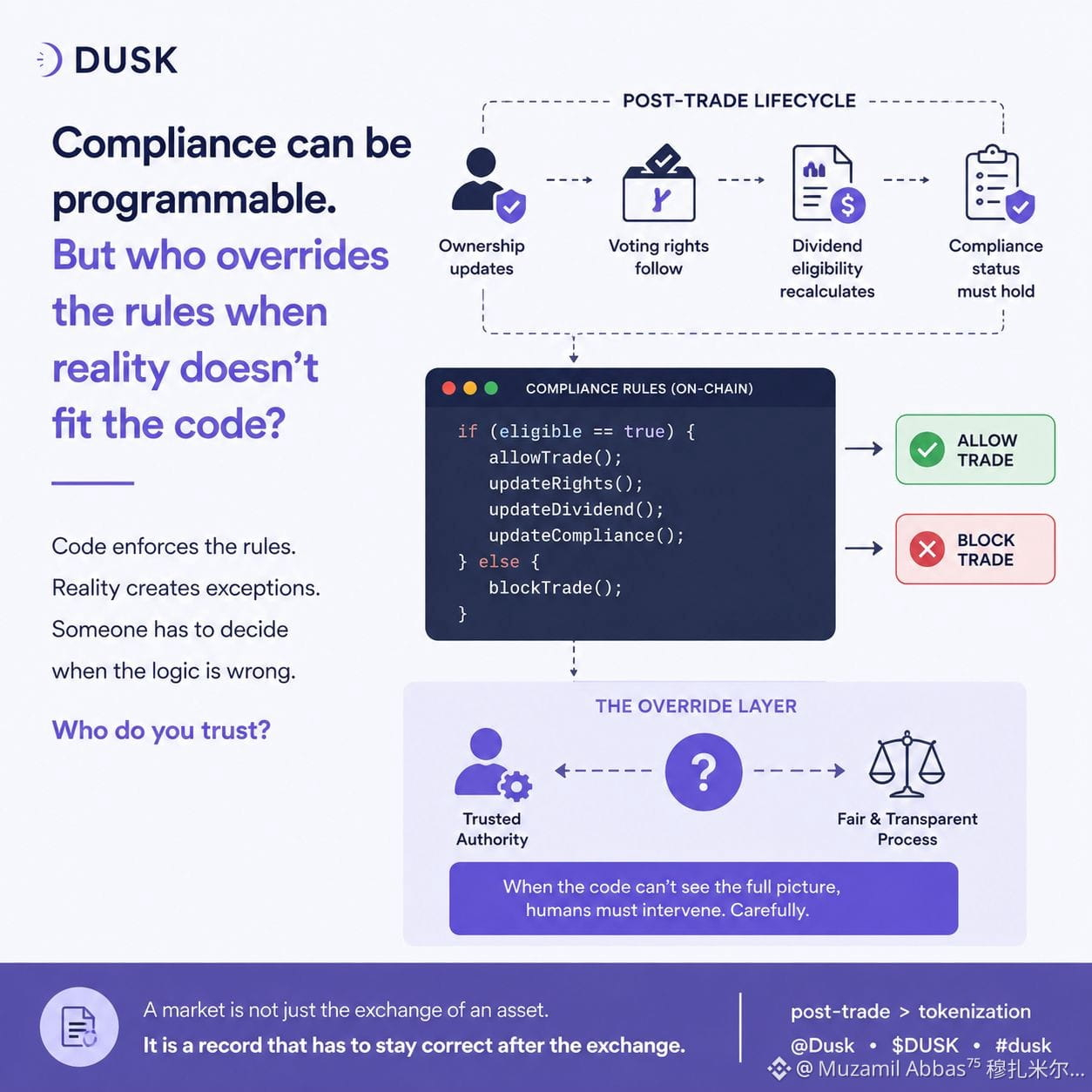
I’ve been thinking about Dusk’s post-trade design a bit differently after reading through the lifecycle material. I used to think programmable compliance was mostly about making sure a trade is allowed before it happens. But the harder question seems to start after the trade, when ownership, voting rights, dividend eligibility, and compliance status all have to stay correct.
That makes the idea of compliance becoming programmable pretty useful, but also slightly uncomfortable. Code can enforce a rule consistently. It can’t automatically know what to do when the real-world situation behind that rule changes or doesn’t fit the assumptions it was built around. If a holder’s eligibility changes, or some regulatory condition needs an exception, there has to be a mechanism for handling that state rather than simply trusting the original logic.
That’s where I think Dusk gets more interesting than just tokenizing an asset. The token itself is almost the easy layer. The harder problem is keeping the record accurate as trades keep happening. But I’m still left wondering about the override layer. Who is actually trusted to intervene when the coded rules produce the wrong result, and how do you prevent that authority from becoming the weakest point in an otherwise programmable system?
I’ve been thinking about Dusk’s post-trade design a bit differently after reading through the lifecycle material. I used to think programmable compliance was mostly about making sure a trade is allowed before it happens. But the harder question seems to start after the trade, when ownership, voting rights, dividend eligibility, and compliance status all have to stay correct.
That makes the idea of compliance becoming programmable pretty useful, but also slightly uncomfortable. Code can enforce a rule consistently. It can’t automatically know what to do when the real-world situation behind that rule changes or doesn’t fit the assumptions it was built around. If a holder’s eligibility changes, or some regulatory condition needs an exception, there has to be a mechanism for handling that state rather than simply trusting the original logic.
That’s where I think Dusk gets more interesting than just tokenizing an asset. The token itself is almost the easy layer. The harder problem is keeping the record accurate as trades keep happening. But I’m still left wondering about the override layer. Who is actually trusted to intervene when the coded rules produce the wrong result, and how do you prevent that authority from becoming the weakest point in an otherwise programmable system?
#TermMax
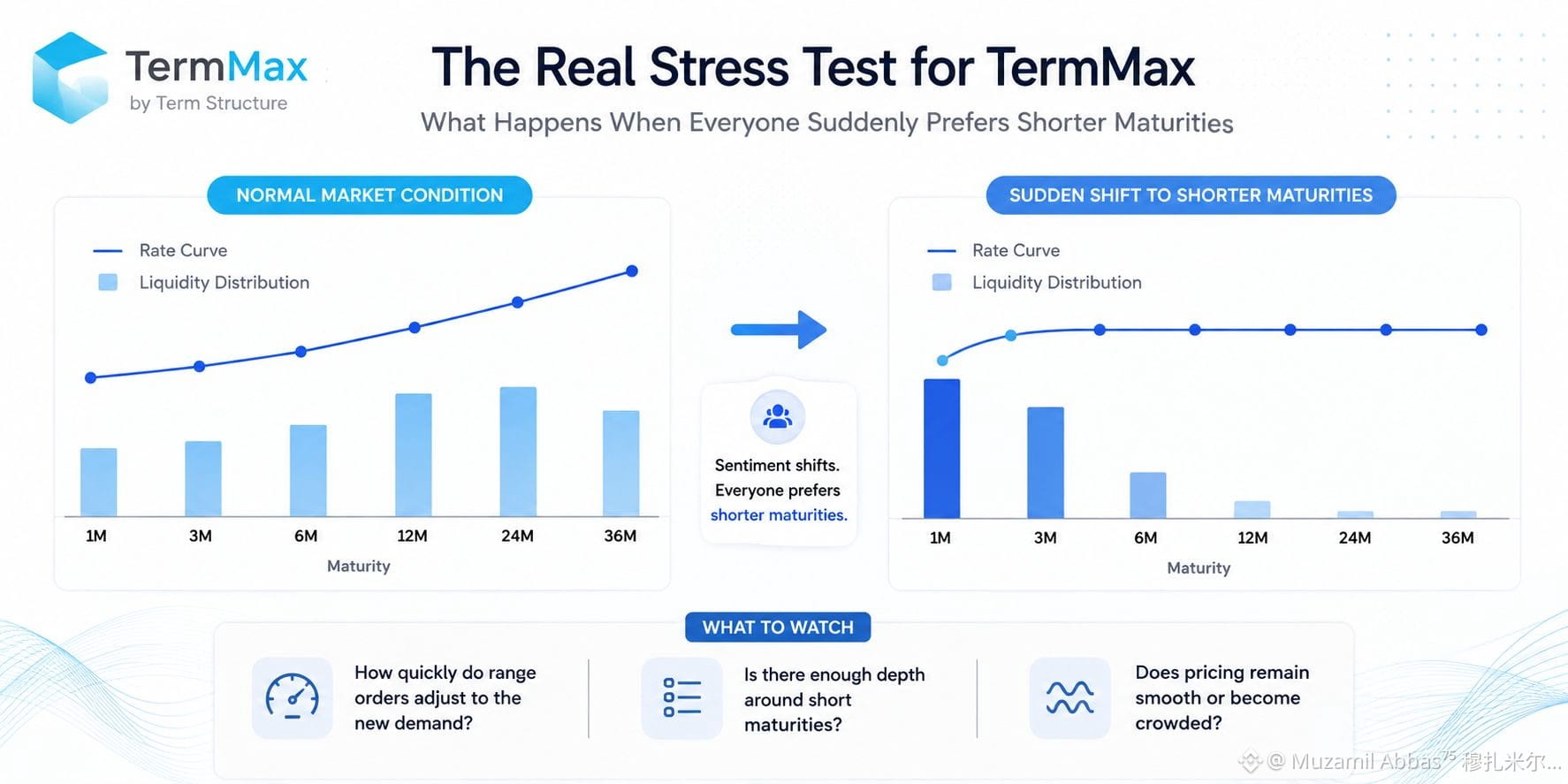
I’ve been thinking about TermMax’s maturity structure a bit differently lately. At first, I mostly saw fixed terms as a way to make borrowing costs easier to understand. But then I started wondering what happens when market sentiment changes quickly and suddenly everyone wants shorter maturities.
That seems like a more useful stress test than simply asking whether fixed-term markets work during normal conditions. If borrowers become uncomfortable locking capital for longer, demand could move toward shorter terms at the same time. Lenders might react too, especially if they start expecting better rates elsewhere. The pricing curve then has to adjust, and that is where I’m more curious about TermMax.
The range-order design makes this interesting because liquidity isn’t necessarily offered at one single maturity or rate. A market maker can express different terms across a range, but that doesn’t automatically mean liquidity will remain attractive when preferences shift abruptly. There is still a dependency on how quickly participants update their orders and how much depth exists around the maturities people suddenly prefer.
That’s the part I want to watch. Not just whether TermMax has liquidity, but how that liquidity behaves when users collectively change their time preference. Does the market reprice smoothly, or do the shorter maturities become crowded while longer ones are left behind?
#termmax @TermMax
I’ve been thinking about TermMax’s maturity structure a bit differently lately. At first, I mostly saw fixed terms as a way to make borrowing costs easier to understand. But then I started wondering what happens when market sentiment changes quickly and suddenly everyone wants shorter maturities.
That seems like a more useful stress test than simply asking whether fixed-term markets work during normal conditions. If borrowers become uncomfortable locking capital for longer, demand could move toward shorter terms at the same time. Lenders might react too, especially if they start expecting better rates elsewhere. The pricing curve then has to adjust, and that is where I’m more curious about TermMax.
The range-order design makes this interesting because liquidity isn’t necessarily offered at one single maturity or rate. A market maker can express different terms across a range, but that doesn’t automatically mean liquidity will remain attractive when preferences shift abruptly. There is still a dependency on how quickly participants update their orders and how much depth exists around the maturities people suddenly prefer.
That’s the part I want to watch. Not just whether TermMax has liquidity, but how that liquidity behaves when users collectively change their time preference. Does the market reprice smoothly, or do the shorter maturities become crowded while longer ones are left behind?
#termmax @TermMax
#TermMax
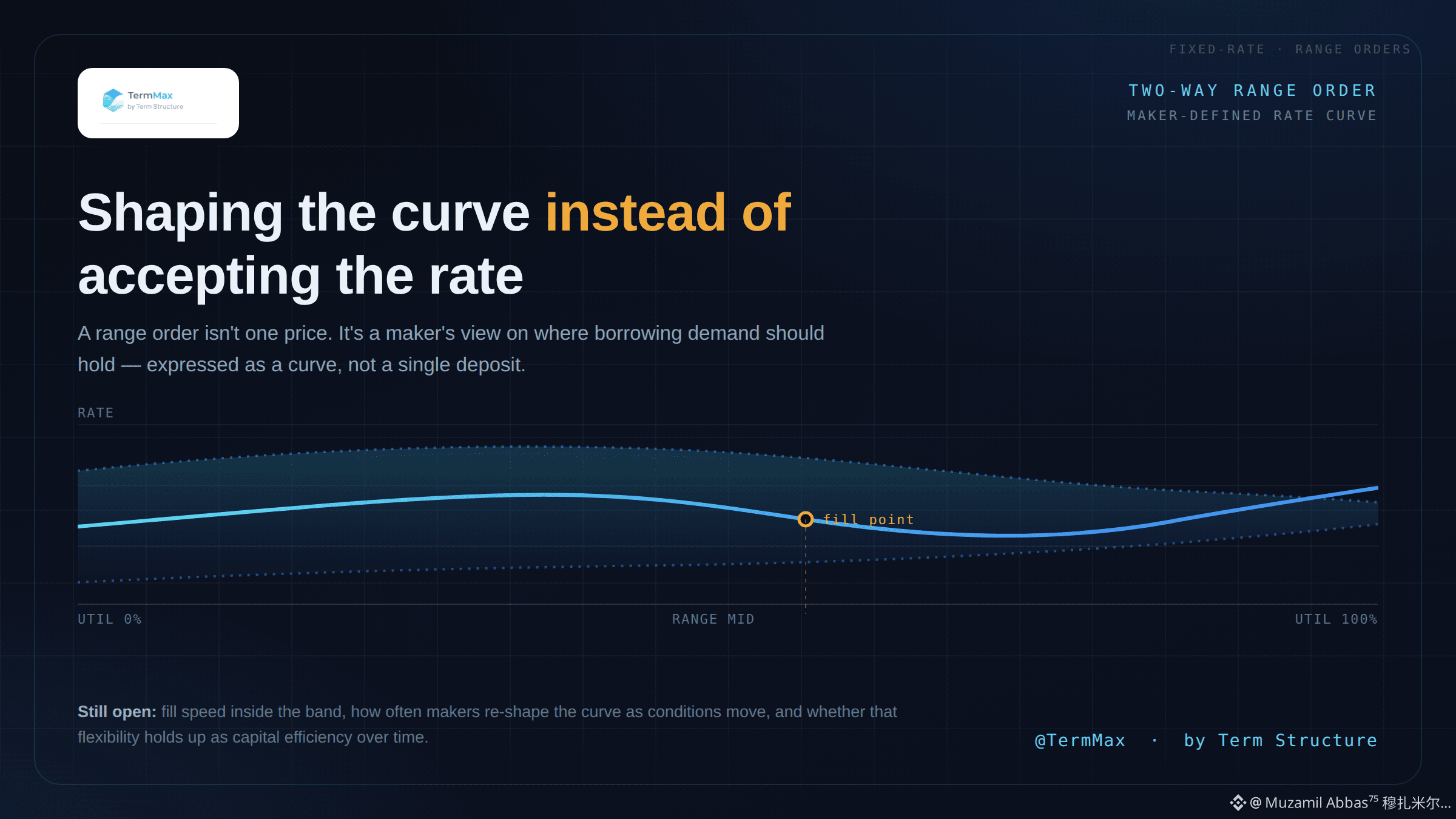
I’ve been looking at TermMax’s range orders differently lately. At first, I treated them as another way for market makers to place liquidity and earn from lending. But the more I think about the pricing curve, the more it looks like a way to express a rate view.
A market maker does not have to offer liquidity at one point. With a range order, they can define how terms change across a range, meaning their liquidity can reflect where they are comfortable participating. If I think borrowing demand will stay strong only up to a certain rate, I can shape my curve around that assumption instead of accepting whatever rate appears.
The Two-Way Range Order makes this more interesting because borrowing and lending curves can sit inside the same order. That makes liquidity provision feel closer to positioning around rates, rather than simply depositing capital and waiting.
Still, I’m curious about execution quality. A curve on paper means little if market activity stays outside it, or if changing conditions make the rate view stale. I’d want to watch how quickly these ranges fill, how often makers adjust them, and whether the flexibility translates into better capital efficiency over time.
#termmax @TermMax
I’ve been looking at TermMax’s range orders differently lately. At first, I treated them as another way for market makers to place liquidity and earn from lending. But the more I think about the pricing curve, the more it looks like a way to express a rate view.
A market maker does not have to offer liquidity at one point. With a range order, they can define how terms change across a range, meaning their liquidity can reflect where they are comfortable participating. If I think borrowing demand will stay strong only up to a certain rate, I can shape my curve around that assumption instead of accepting whatever rate appears.
The Two-Way Range Order makes this more interesting because borrowing and lending curves can sit inside the same order. That makes liquidity provision feel closer to positioning around rates, rather than simply depositing capital and waiting.
Still, I’m curious about execution quality. A curve on paper means little if market activity stays outside it, or if changing conditions make the rate view stale. I’d want to watch how quickly these ranges fill, how often makers adjust them, and whether the flexibility translates into better capital efficiency over time.
#termmax @TermMax
I was reading through a few old bridge exploit reports this week and ended up thinking about something that feels a bit uncomfortable. When a bridge gets hacked, people usually talk about the smart contract, the validator set, or the amount that was stolen. But after looking at enough cases, it seems like the bridge is often exposing something bigger than a bug in the bridge itself.
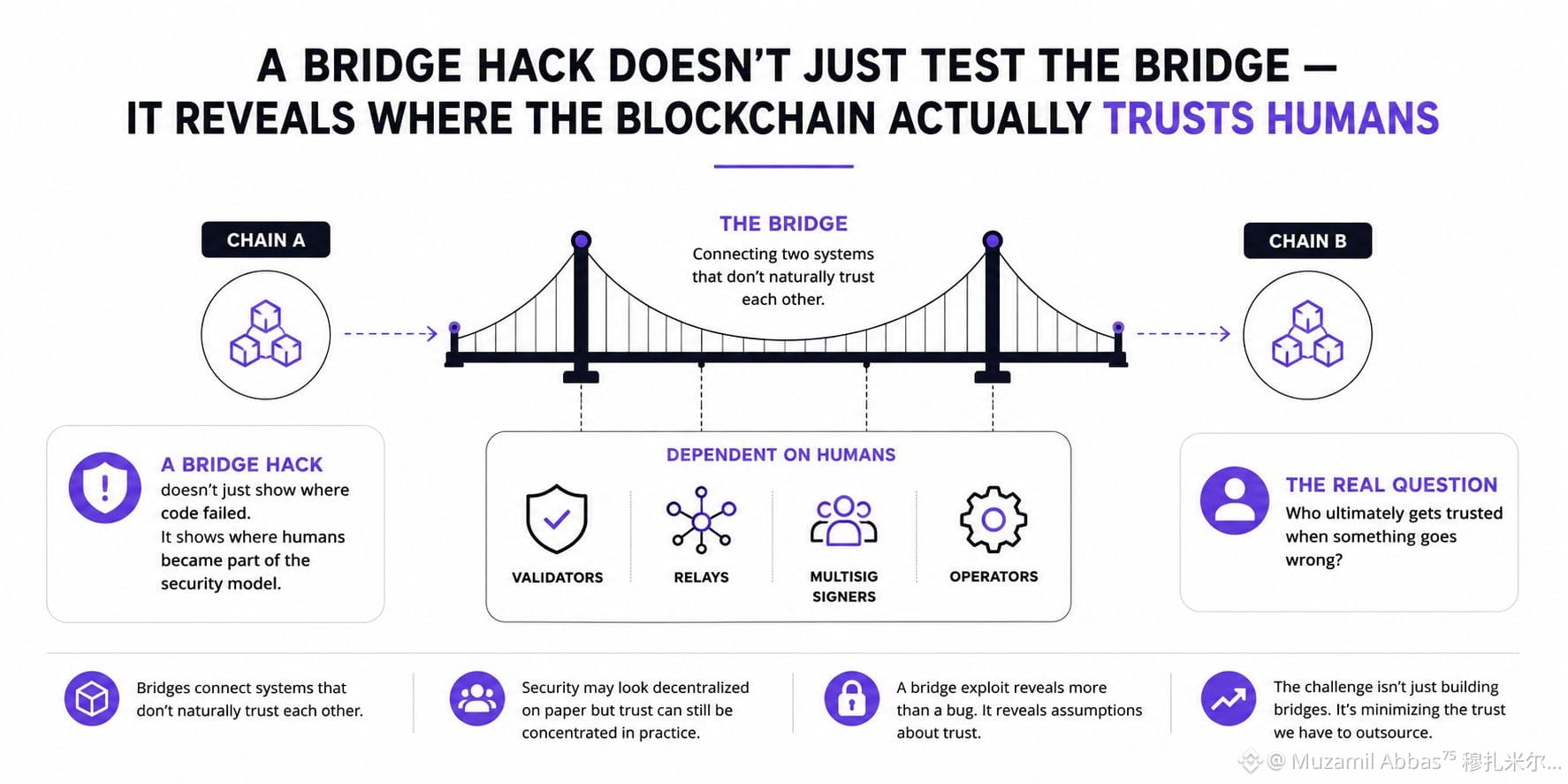
A bridge sits between systems that don't naturally trust each other. Because of that, it usually depends on some group of validators, relayers multisig signers, or operators to verify what happened on another chain. On paper that can look decentralized enough. In practice, a surprising amount of trust can still end up concentrated in a handful of people or operational processes.
That is the part I keep coming back to. A bridge hack doesn't only show where code failed. Sometimes it shows where humans became part of the security model, even if users assumed everything was being enforced by the chain itself. The blockchain may be decentralized, but the path connecting it to another network can introduce very different assumptions.
I'm not saying every bridge design has the same weaknesses. Some are clearly improving. Still, whenever I evaluate a cross-chain system now, I spend less time asking how assets move and more time asking who ultimately gets trusted when something goes wrong. Are we getting better at reducing that dependency, or are we mostly hiding it behind more complex infrastructure?
#dusk $DUSK @Dusk
A bridge sits between systems that don't naturally trust each other. Because of that, it usually depends on some group of validators, relayers multisig signers, or operators to verify what happened on another chain. On paper that can look decentralized enough. In practice, a surprising amount of trust can still end up concentrated in a handful of people or operational processes.
That is the part I keep coming back to. A bridge hack doesn't only show where code failed. Sometimes it shows where humans became part of the security model, even if users assumed everything was being enforced by the chain itself. The blockchain may be decentralized, but the path connecting it to another network can introduce very different assumptions.
I'm not saying every bridge design has the same weaknesses. Some are clearly improving. Still, whenever I evaluate a cross-chain system now, I spend less time asking how assets move and more time asking who ultimately gets trusted when something goes wrong. Are we getting better at reducing that dependency, or are we mostly hiding it behind more complex infrastructure?
#dusk $DUSK @Dusk
#TermMax
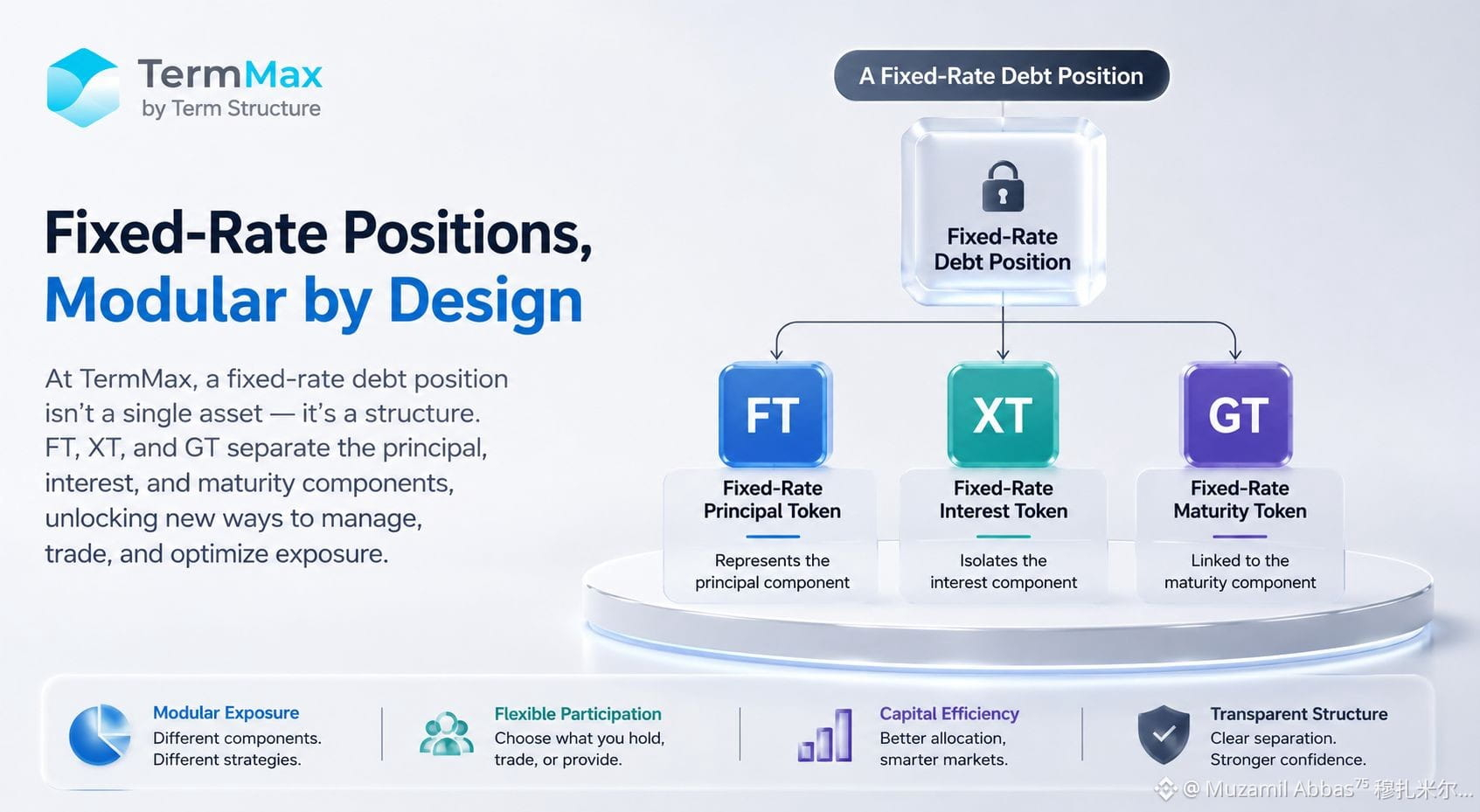
I’ve been looking at how TermMax handles fixed-rate positions, and the FT, XT and GT structure is probably the part I understand differently now. At first I thought splitting a fixed-rate position into separate tokens was mostly a cleaner way to represent the same debt. After digging into the mechanics a bit more, I’m starting to see why the separation matters.
FT represents the principal side while XT isolates the interest component, and GT is tied more closely to the maturity side of the position. What I find useful here is that a single fixed-rate debt position doesn’t have to behave like one indivisible asset anymore. Different parts of the economic exposure can potentially be handled separately depending on what a user actually wants to hold or trade.
But there’s a trade off I keep thinking about. More modularity can create more ways to manage exposure, yet it can also make pricing and liquidity harder to understand, especially if each token develops its own market depth. I’d want to see how consistently these components trade and whether the separation actually improves capital efficiency in real usage rather than just looking good at the protocol level.
I’m still watching that part closely. Does breaking fixed-rate debt into smaller pieces create genuinely better markets, or are we just moving complexity somewhere else?
#termmax @TermMax
I’ve been looking at how TermMax handles fixed-rate positions, and the FT, XT and GT structure is probably the part I understand differently now. At first I thought splitting a fixed-rate position into separate tokens was mostly a cleaner way to represent the same debt. After digging into the mechanics a bit more, I’m starting to see why the separation matters.
FT represents the principal side while XT isolates the interest component, and GT is tied more closely to the maturity side of the position. What I find useful here is that a single fixed-rate debt position doesn’t have to behave like one indivisible asset anymore. Different parts of the economic exposure can potentially be handled separately depending on what a user actually wants to hold or trade.
But there’s a trade off I keep thinking about. More modularity can create more ways to manage exposure, yet it can also make pricing and liquidity harder to understand, especially if each token develops its own market depth. I’d want to see how consistently these components trade and whether the separation actually improves capital efficiency in real usage rather than just looking good at the protocol level.
I’m still watching that part closely. Does breaking fixed-rate debt into smaller pieces create genuinely better markets, or are we just moving complexity somewhere else?
#termmax @TermMax
Connectez-vous pour découvrir plus de contenu