
Ayan -X
11.1k Publications

Ayan -X
 Compte Square Vérifié+
Daily Crypto Mix: Market Analysis 📊 | Altcoin Gems 💎 | News & Tips, X Liaqat123
Ouvert au trading
Trade régulièrement
1.4 an(s)
1.8K+ Suivis
33.8K+ Abonnés
14.4K+ J’aime
Publications
Portefeuille
Tous
Citations
Direct
PINNED
🎁 Claim your reward now!
✅ Follow
❤️ Like
🔁 Repost
💬 Comment
Don’t miss your reward! 🚀
#FedSeptRateHikeOddsRiseTo57%
✅ Follow
❤️ Like
🔁 Repost
💬 Comment
Don’t miss your reward! 🚀
#FedSeptRateHikeOddsRiseTo57%
PINNED
🔥 Engage & Claim Your Reward!
Like ❤️ Comment 💬 Repost 🔄
Complete the tasks and claim your reward 🎁
Don’t miss out. Let’s support each other and grow together! 🚀
Like ❤️ Comment 💬 Repost 🔄
Complete the tasks and claim your reward 🎁
Don’t miss out. Let’s support each other and grow together! 🚀
$MOODENG USDT
Short entry: 0.04180–0.04230 on rejection
Stop loss: Above 0.04300
TP1: 0.04070
TP2: 0.03980
TP3: 0.03850
Short entry: 0.04180–0.04230 on rejection
Stop loss: Above 0.04300
TP1: 0.04070
TP2: 0.03980
TP3: 0.03850
🔴 $ACT USDT
Short entry: 0.01105–0.01120 on rejection
Stop loss: Above 0.01140
TP1: 0.01080
TP2: 0.01050
TP3: 0.01020
Short entry: 0.01105–0.01120 on rejection
Stop loss: Above 0.01140
TP1: 0.01080
TP2: 0.01050
TP3: 0.01020
📊 $UMA USDT 1H Bullish Setup
UMA is showing strong bullish momentum with a confirmed breakout signal. 🚀
🟢 Entry: $0.374
🎯 TP1: $0.377
🎯 TP2: $0.385
🛑 SL: $0.364
RSI remains healthy at 66.47, MACD is bullish, and price is holding above key moving averages. Bulls remain in control as long as support holds. 📈
⚠️ Always use proper risk management.
#UMA #crypto #trading #BinanceSquare
UMA is showing strong bullish momentum with a confirmed breakout signal. 🚀
🟢 Entry: $0.374
🎯 TP1: $0.377
🎯 TP2: $0.385
🛑 SL: $0.364
RSI remains healthy at 66.47, MACD is bullish, and price is holding above key moving averages. Bulls remain in control as long as support holds. 📈
⚠️ Always use proper risk management.
#UMA #crypto #trading #BinanceSquare
📊 $BTC USDT Bullish Setup
BTC is showing strong bullish momentum after a breakout, but RSI is in the overbought zone, so patience is important.
🟢 Entry: $76,500 – $77,000
🎯 TP1: $78,000
🎯 TP2: $79,000
🎯 TP3: $80,000
🛑 SL: Below $75,500
Bullish as long as key support holds. Always manage your risk and avoid chasing pumps. 🚀
#BTC
BTC is showing strong bullish momentum after a breakout, but RSI is in the overbought zone, so patience is important.
🟢 Entry: $76,500 – $77,000
🎯 TP1: $78,000
🎯 TP2: $79,000
🎯 TP3: $80,000
🛑 SL: Below $75,500
Bullish as long as key support holds. Always manage your risk and avoid chasing pumps. 🚀
#BTC

📊 $BABY USDT 1H Analysis
BABY is trading at $0.01242, down 32.1% in 24h. The 1H bias remains bearish after price moved below the EMA20.
🔻 Key Resistance: $0.01244 – $0.01261
🔻 Key Support: $0.01225 – $0.01200
📉 Trade Setup
• Direction: Short
• Entry: $0.01242
• TP: $0.01200
• SL: $0.01255
• R/R: 1:1.6
• Confidence: 72%
⚠️ Watch $0.01225 closely. A breakdown with stronger volume could push price toward $0.01200, while a move back above EMA20 may invalidate the bearish setup.
Risk Management: Risk only 1–2% per trade and avoid chasing the move after such a large 24h decline.
#BABYUSDT #cryptotrading #BİNANCESQUARE
BABY is trading at $0.01242, down 32.1% in 24h. The 1H bias remains bearish after price moved below the EMA20.
🔻 Key Resistance: $0.01244 – $0.01261
🔻 Key Support: $0.01225 – $0.01200
📉 Trade Setup
• Direction: Short
• Entry: $0.01242
• TP: $0.01200
• SL: $0.01255
• R/R: 1:1.6
• Confidence: 72%
⚠️ Watch $0.01225 closely. A breakdown with stronger volume could push price toward $0.01200, while a move back above EMA20 may invalidate the bearish setup.
Risk Management: Risk only 1–2% per trade and avoid chasing the move after such a large 24h decline.
#BABYUSDT #cryptotrading #BİNANCESQUARE
📊 $SENT USDT 1H Analysis
Price: $0.0128 | Stochastic: 97.81 🔥 OVERBOUGHT
⚠️ The 1H signal suggests strong bullish momentum, but the extreme overbought reading increases the risk of a short-term pullback or consolidation.
🔹 Resistance: $0.0130 – $0.0135
🔹 Support: $0.0124 – $0.0120
Trade Setup
📌 Pair: SENTUSDT
📉 Direction: Short on confirmation
🎯 Entry: $0.0129 – $0.0131
💰 TP: $0.0124 / $0.0120
🛑 SL: $0.0135
⚖️ R/R: Approx. 1:2
📊 Confidence: Medium
Rationale: Stochastic at 97.81 shows extreme overbought conditions. Wait for bearish rejection confirmation before entering.
⚠️ Risk Management: Never short solely because Stochastic is overbought. Use confirmation, keep risk per trade low, and always respect your stop loss.
#SENTUSDT #cryptotrading #BİNANCE
Price: $0.0128 | Stochastic: 97.81 🔥 OVERBOUGHT
⚠️ The 1H signal suggests strong bullish momentum, but the extreme overbought reading increases the risk of a short-term pullback or consolidation.
🔹 Resistance: $0.0130 – $0.0135
🔹 Support: $0.0124 – $0.0120
Trade Setup
📌 Pair: SENTUSDT
📉 Direction: Short on confirmation
🎯 Entry: $0.0129 – $0.0131
💰 TP: $0.0124 / $0.0120
🛑 SL: $0.0135
⚖️ R/R: Approx. 1:2
📊 Confidence: Medium
Rationale: Stochastic at 97.81 shows extreme overbought conditions. Wait for bearish rejection confirmation before entering.
⚠️ Risk Management: Never short solely because Stochastic is overbought. Use confirmation, keep risk per trade low, and always respect your stop loss.
#SENTUSDT #cryptotrading #BİNANCE
🚨 $BNB Update: Bulls Still Have Something to Prove
BNB is facing short-term pressure after the broader crypto market reacted to the Fed’s latest signals.
But the bigger picture is interesting 👀
📌 BNB recently broke above the $690 resistance
📌 Price is now around the $690 area
📌 Holding this zone could keep the bullish structure alive
📌 Losing it could bring stronger selling pressure
With BTC also volatile, BNB needs confirmation before the next move.
For me, the key level is simple:
🔥 $690 = watch zone
Break & hold above → bullish continuation
Lose support → caution ⚠️
Trade with a plan, not emotions.
#bnb #BNBUSDT #crypto #BİNANCE #cryptotrading
BNB is facing short-term pressure after the broader crypto market reacted to the Fed’s latest signals.
But the bigger picture is interesting 👀
📌 BNB recently broke above the $690 resistance
📌 Price is now around the $690 area
📌 Holding this zone could keep the bullish structure alive
📌 Losing it could bring stronger selling pressure
With BTC also volatile, BNB needs confirmation before the next move.
For me, the key level is simple:
🔥 $690 = watch zone
Break & hold above → bullish continuation
Lose support → caution ⚠️
Trade with a plan, not emotions.
#bnb #BNBUSDT #crypto #BİNANCE #cryptotrading
$BTC USDT — 1H Technical Setup 📊
Price: $77,935
Bias: 🟢 Bullish reversal setup
RSI: 28.93 — oversold
Support: $77,777
Resistance: $79,094 → $82,000
Setup: BTC is holding key support and showing a potential double bottom + bullish RSI divergence. Increasing volume adds confirmation.
🎯 Long idea: Above $77,800 with confirmation
🛑 Invalidation: Below $77,777
🎯 Targets: $79,094 / $82,000
⚠️ Wait for confirmation before entering.
Price: $77,935
Bias: 🟢 Bullish reversal setup
RSI: 28.93 — oversold
Support: $77,777
Resistance: $79,094 → $82,000
Setup: BTC is holding key support and showing a potential double bottom + bullish RSI divergence. Increasing volume adds confirmation.
🎯 Long idea: Above $77,800 with confirmation
🛑 Invalidation: Below $77,777
🎯 Targets: $79,094 / $82,000
⚠️ Wait for confirmation before entering.
🚀$HBAR USDT 1H Setup
HBAR is showing a potential bullish breakout after holding support. Stochastic is oversold, while RSI has room to run. 👀
📍 Entry: 0.07810
🎯 TP: 0.08050
🛑 SL: 0.07700
⚡ R:R: 1:2.1
Break above 0.0786 could strengthen the move. Trade with proper risk management.
#hbar #crypto #Binance #trading
HBAR is showing a potential bullish breakout after holding support. Stochastic is oversold, while RSI has room to run. 👀
📍 Entry: 0.07810
🎯 TP: 0.08050
🛑 SL: 0.07700
⚡ R:R: 1:2.1
Break above 0.0786 could strengthen the move. Trade with proper risk management.
#hbar #crypto #Binance #trading
go

路人1688-luren
·
--
很多人把以和为贵奉为圭臬,把委曲求全当作大度。于是被人冒犯了笑着说没关系,被人越界了劝自己别计较,明明心里已经气到不行了,也强忍着不发作,以为这就是虚怀若谷、豁达大度。却不知,你每一次过度、无原则的忍让,就是在给自己的身心带来创伤。不要觉得忍一时就会风平浪静,退一步便能海阔天空。这世上有些人,不会因为你的忍让而收敛,你不断的妥协与忍让,换来的只会是他们更加的肆无忌惮与得寸进尺。你越是不停让步,别人就越觉得你是软柿子,越会变本加厉的拿捏你。不要把忍气吞声当成内心强大,更不要把无底线的退让当成胸怀天下。正如《“忍”的思考》所言:当忍者则忍,忍则有益;不当忍者则不忍,忍则有害。一次越界,善意提醒;二次冒犯,可以原谅;三次践踏,便不必再留情面。机会给过了,便不必再给;包容给够了,就无需再忍。



go

⁰MR RAJ⁰
·
--
Haussier💰 In 2015, Gravity Payments CEO Dan Price made headlines by cutting his own salary from about $1 million to $70,000 — a roughly 94% reduction. He used the move to help raise the company’s minimum salary to $70,000 for employees.
❤️🏢 Price said the decision was about giving his Seattle-based team greater financial stability, after seeing employees struggle with rising living costs. The move sparked a huge debate about CEO pay and fair wages.
$DUSK $RIVER $POWER
#XRPRallies44%InAWeek #IranSaysHormuzOmanDealNotFinalized #SECSendsCryptoCustodyRuleToWhiteHouse #CryptoFearGreedIndexHits74 #USBitcoinETFsExtendInflowsToSixthDay
❤️🏢 Price said the decision was about giving his Seattle-based team greater financial stability, after seeing employees struggle with rising living costs. The move sparked a huge debate about CEO pay and fair wages.
$DUSK $RIVER $POWER
#XRPRallies44%InAWeek #IranSaysHormuzOmanDealNotFinalized #SECSendsCryptoCustodyRuleToWhiteHouse #CryptoFearGreedIndexHits74 #USBitcoinETFsExtendInflowsToSixthDay

Victoria

VICTORIA _777
·
--
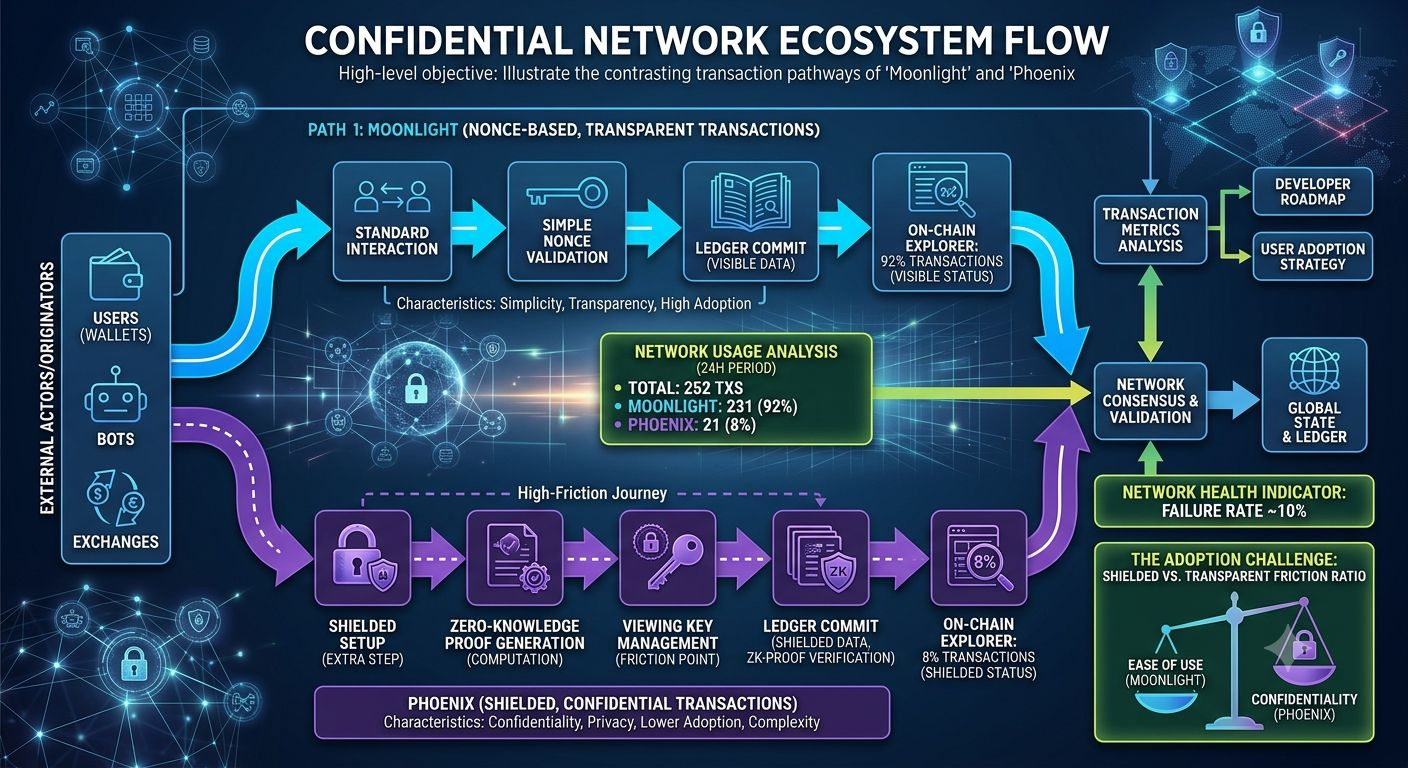
The 8% Privacy Question I Can’t Ignore
I pulled up the live explorer and honestly… the numbers made me stop for a second.
252 transactions in 24h.
231 through Moonlight.
Only 21 through Phoenix.
That’s roughly 92% transparent vs 8% shielded.
And this is a chain built around confidentiality.
At first, that feels strange.
Then I started thinking about the actual user journey.
Moonlight is simple. Nonce-based. Easier for exchanges, bots, and everyday transfers to integrate.
Phoenix is different. Shielded flow, viewing keys, extra setup, more friction.
So maybe this isn’t a privacy problem at all.
Maybe it’s an adoption problem.
I kept refreshing the explorer, and another number caught my attention: the failure rate was hovering around 10%.
Now that’s where things get interesting.
Because the real question isn’t whether confidential transactions exist.
They clearly do.
The question is:
What makes users choose them?
If privacy requires an extra step every time, most users will probably take the path with less friction.
That’s why I’m watching this ratio.
If Phoenix eventually moves from 8% toward 20%, 40%, or higher, that could tell us something much bigger about whether privacy becomes a default behavior or remains an advanced feature for users who deliberately seek it.
I’m not calling the design wrong.
I’m watching the behavior.
Because the explorer tells a story the roadmap can’t.
@Dusk #DUSK $DUSK
I pulled up the live explorer and honestly… the numbers made me stop for a second.
252 transactions in 24h.
231 through Moonlight.
Only 21 through Phoenix.
That’s roughly 92% transparent vs 8% shielded.
And this is a chain built around confidentiality.
At first, that feels strange.
Then I started thinking about the actual user journey.
Moonlight is simple. Nonce-based. Easier for exchanges, bots, and everyday transfers to integrate.
Phoenix is different. Shielded flow, viewing keys, extra setup, more friction.
So maybe this isn’t a privacy problem at all.
Maybe it’s an adoption problem.
I kept refreshing the explorer, and another number caught my attention: the failure rate was hovering around 10%.
Now that’s where things get interesting.
Because the real question isn’t whether confidential transactions exist.
They clearly do.
The question is:
What makes users choose them?
If privacy requires an extra step every time, most users will probably take the path with less friction.
That’s why I’m watching this ratio.
If Phoenix eventually moves from 8% toward 20%, 40%, or higher, that could tell us something much bigger about whether privacy becomes a default behavior or remains an advanced feature for users who deliberately seek it.
I’m not calling the design wrong.
I’m watching the behavior.
Because the explorer tells a story the roadmap can’t.
@Dusk #DUSK $DUSK
dj
Votre contenu coté a été supprimé

Bilverse
·
--
🚨 WHO WANTS TO WAKE UP TO FREE ETH? 👀
One community. One mission. One chance to be part of the ETH giveaway. 💎🚀
#Bilverse is making noise — and your ETH reward could be waiting. 👀
👇 Want to claim a portion of ETH?
💬 Comment “ETH” below to claim your reward! 🎁
The Bilverse Army is growing. 🟡
Click here to DOUBLE your Rewards! 🧧🚀
Are you in?
#ETH #RedPacketMission #CryptoGiveaway #CryptoCommunity
One community. One mission. One chance to be part of the ETH giveaway. 💎🚀
#Bilverse is making noise — and your ETH reward could be waiting. 👀
👇 Want to claim a portion of ETH?
💬 Comment “ETH” below to claim your reward! 🎁
The Bilverse Army is growing. 🟡
Click here to DOUBLE your Rewards! 🧧🚀
Are you in?
#ETH #RedPacketMission #CryptoGiveaway #CryptoCommunity

mahi

Mahi_玛希BNB
·
--
BTC Queen 👑₿
BTC is still the queen of the crypto market. 👑
Strong community, limited supply, and long-term potential make Bitcoin a favorite for many investors. 🚀
Keep learning, manage risk, and DYOR. 💎
1️⃣ **Follow MAHI BNB** ✅
2️⃣ **Like & Comment “BTC ”** ✅
3️⃣ **Repost This Post** 🔄✅
4️⃣ **Stay Tuned for the Next Gift 🎁🧧** ✅
#BTC☀ #Bitcoin❗ #Crypto_Jobs🎯 #BinanceSquareFamily #BTCQueen #CryptoCommunity #trading
$BTC $BNB $ETH
BTC is still the queen of the crypto market. 👑
Strong community, limited supply, and long-term potential make Bitcoin a favorite for many investors. 🚀
Keep learning, manage risk, and DYOR. 💎
1️⃣ **Follow MAHI BNB** ✅
2️⃣ **Like & Comment “BTC ”** ✅
3️⃣ **Repost This Post** 🔄✅
4️⃣ **Stay Tuned for the Next Gift 🎁🧧** ✅
#BTC☀ #Bitcoin❗ #Crypto_Jobs🎯 #BinanceSquareFamily #BTCQueen #CryptoCommunity #trading
$BTC $BNB $ETH

27.1k

龟龟财神到
·
--
关注吧,宇宙无敌财神龟

Connectez-vous pour découvrir plus de contenu