
AbdullRauf
8.2k Publications

AbdullRauf
 Binance Square Vérifié
Hi Guys i am Spot trader specialist in Intra Daytrade, DCA and Swing trade. Follow me tostay updated about market and Binance reward Campaigns.
Ouvert au trading
Trade régulièrement
1.3 an(s)
1.1K+ Suivis
30.8K+ Abonnés
27.6K+ J’aime
Publications
Portefeuille
Tous
Citations
Vidéos
Direct
PINNED
YOUR SUPPORT = OUR THANKS. 2000 GIFTS, GO! 🚀🎁💐
Square Family, you rock! 🧧 To celebrate YOU, we’re giving away 2000 GIFTS. Let’s go!
How to enter:
👉 Follow us
👉 Share this post
👉 Comment “666”
Random draws. Huge wins. Enter now!
Square Family, you rock! 🧧 To celebrate YOU, we’re giving away 2000 GIFTS. Let’s go!
How to enter:
👉 Follow us
👉 Share this post
👉 Comment “666”
Random draws. Huge wins. Enter now!

good night 💤
AbdullRauf
·
--
YOUR SUPPORT = OUR THANKS. 2000 GIFTS, GO! 🚀🎁💐
Square Family, you rock! 🧧 To celebrate YOU, we’re giving away 2000 GIFTS. Let’s go!
How to enter:
👉 Follow us
👉 Share this post
👉 Comment “666”
Random draws. Huge wins. Enter now!
Square Family, you rock! 🧧 To celebrate YOU, we’re giving away 2000 GIFTS. Let’s go!
How to enter:
👉 Follow us
👉 Share this post
👉 Comment “666”
Random draws. Huge wins. Enter now!

coin

Coin--King
·
--
We said so much without saying a word,
but sadly, there was no one who could understand.
but sadly, there was no one who could understand.

Ali

A L I A N S A R I
·
--
guys claim gift 🎁🎁🎁

Alone

Alone bro
·
--
Haussier#BNB_Market_Update .one again bnb well climb over the hurdles to prove...be happy Lucky holders and traders ..but be conscious .....*BNB Market Update - Today, 24 Aug 2026* 🟡
*Live Price*
- *Current*: *$699.45 USD*
- *24H Change*: +$1.82 = *+0.26%*
- *Day Range*: $676.98 → $701.79
- *Open*: $697.63
*Market Data*
- *Market Cap*: $91.4B
- *Rank*: #3 - #4 by market cap
- *Circulating Supply*: 133.2M - 144M BNB
- *24H Volume*: $1.50B
*Key Levels*
**Level** **Price**
**Resistance** $701.79
**Current** $699.45
**Support** $676.98
BNB آج $700 کے قریب consolidate کر رہا ہے۔ $702 بریک ہوا تو $720-$730 نیکسٹ ٹارگٹ بن سکتا ہے۔
*Other Pairs*
- *GBP*: £508.01
- *EUR*: €589.43 - €590.09
- *BRL*: R$3,559.50 a282378191c0002f
*خلاصہ*
BNB آج فلیٹ ٹو سلائٹ اپ ہے۔ وولیوم نارمل ہے اور پرائس $677 سپورٹ سے ریباؤنڈ کر کے $700 کے پاس ہے۔ BSC چین پر ایکٹیویٹی اور Binance کی خبریں ہی مین ڈرائیور رہتی ہیں۔
*نو😍😍😍 ہے۔ یہ investment advice نہیں ہے۔
..
*Live Price*
- *Current*: *$699.45 USD*
- *24H Change*: +$1.82 = *+0.26%*
- *Day Range*: $676.98 → $701.79
- *Open*: $697.63
*Market Data*
- *Market Cap*: $91.4B
- *Rank*: #3 - #4 by market cap
- *Circulating Supply*: 133.2M - 144M BNB
- *24H Volume*: $1.50B
*Key Levels*
**Level** **Price**
**Resistance** $701.79
**Current** $699.45
**Support** $676.98
BNB آج $700 کے قریب consolidate کر رہا ہے۔ $702 بریک ہوا تو $720-$730 نیکسٹ ٹارگٹ بن سکتا ہے۔
*Other Pairs*
- *GBP*: £508.01
- *EUR*: €589.43 - €590.09
- *BRL*: R$3,559.50 a282378191c0002f
*خلاصہ*
BNB آج فلیٹ ٹو سلائٹ اپ ہے۔ وولیوم نارمل ہے اور پرائس $677 سپورٹ سے ریباؤنڈ کر کے $700 کے پاس ہے۔ BSC چین پر ایکٹیویٹی اور Binance کی خبریں ہی مین ڈرائیور رہتی ہیں۔
*نو😍😍😍 ہے۔ یہ investment advice نہیں ہے۔
..

imran

imrankhanIk
·
--
GOOD Evening FAM
claim 🎁 rewards like Share
🎁🎁🎁🎁🎁🎁🎁🎁🎁🎁#GoldFalls3.24%ThisWeek
claim 🎁 rewards like Share
🎁🎁🎁🎁🎁🎁🎁🎁🎁🎁#GoldFalls3.24%ThisWeek
Mr Ruhul

MrRUHUL
·
--
Tag that fren👇🧧🎁💰💵🧧🎁💰💵🧧🎁💰💵🧧🎁💰💵🧧🎁💰💵
boss
BOSS BNB
·
--
Good EVENING
CLICK 👉🏻CLAIM THE WEB3 BENEFIT
GOOD LUCK🫰🏻
CLICK 👉🏻CLAIM THE WEB3 BENEFIT
GOOD LUCK🫰🏻
wife

W i F e
·
--
A little support for the pinned post goes a long way 👀🔥
Repost it… and show your love 🫶❤️
Repost it… and show your love 🫶❤️

elexa

E L E X A
·
--
🚨 LIVE NOW 🚨
Watching is easy… winning takes action 👀
Want free $USDT?
💬 Comment 666
❤️ Like
🔁 Share
➕ Follow
⏳ Spots are filling fast
Comment 666 now 🚀
#Crypto #USDT
Watching is easy… winning takes action 👀
Want free $USDT?
💬 Comment 666
❤️ Like
🔁 Share
➕ Follow
⏳ Spots are filling fast
Comment 666 now 🚀
#Crypto #USDT

BNB

Mr_BNB077
·
--
🎁 $BTR GIVEAWAY WORTH $100 🎁
I’m giving away $BTR Gift Boxes to 3,000 lucky people! 🚀🔥
To participate: ❤️ Like this post ✅
🔁 Repost this post ✅
💬 Comment “1” below ✅
🎁 Claim your $BTR Gift Box ✅
Good luck everyone!
I’m giving away $BTR Gift Boxes to 3,000 lucky people! 🚀🔥
To participate: ❤️ Like this post ✅
🔁 Repost this post ✅
💬 Comment “1” below ✅
🎁 Claim your $BTR Gift Box ✅
Good luck everyone!

flora

Flora Firdos
·
--
🎁 FREE $USDT GIVEAWAY! 💸
Want a chance to grab some $USDT ? 👀
Just follow these simple steps:
💬 Comment 999
❤️ Like this post
🔄 Repost & share
➕ Follow the account
Don’t wait too long the earlier you join, the better! 🚀
#USDT #CryptoGiveaway #Airdrops_free #USDTfree
Want a chance to grab some $USDT ? 👀
Just follow these simple steps:
💬 Comment 999
❤️ Like this post
🔄 Repost & share
➕ Follow the account
Don’t wait too long the earlier you join, the better! 🚀
#USDT #CryptoGiveaway #Airdrops_free #USDTfree

ETH

ETHcryptohub
·
--
🎁🎁🎁🎁 Gifts for Everyone 🎁🎁🎁🎁
Comment: Yes
LIKE + Follow + Repost
🎉🎉🎉🎉🎉🎉🎉🎉🎉🎉🎉
#Ethcryptohub
$BNB $BTC
Comment: Yes
LIKE + Follow + Repost
🎉🎉🎉🎉🎉🎉🎉🎉🎉🎉🎉
#Ethcryptohub
$BNB $BTC
Ahmed

Ahmed Ali Nizamani
·
--
666 + 666 = 🎁🎁🎁✨✨✨

Vérifié
At first I assumed the two transaction models on Dusk were just a privacy toggle. Public or private. One switch. Simple choice.
The actual difference runs deeper than that.
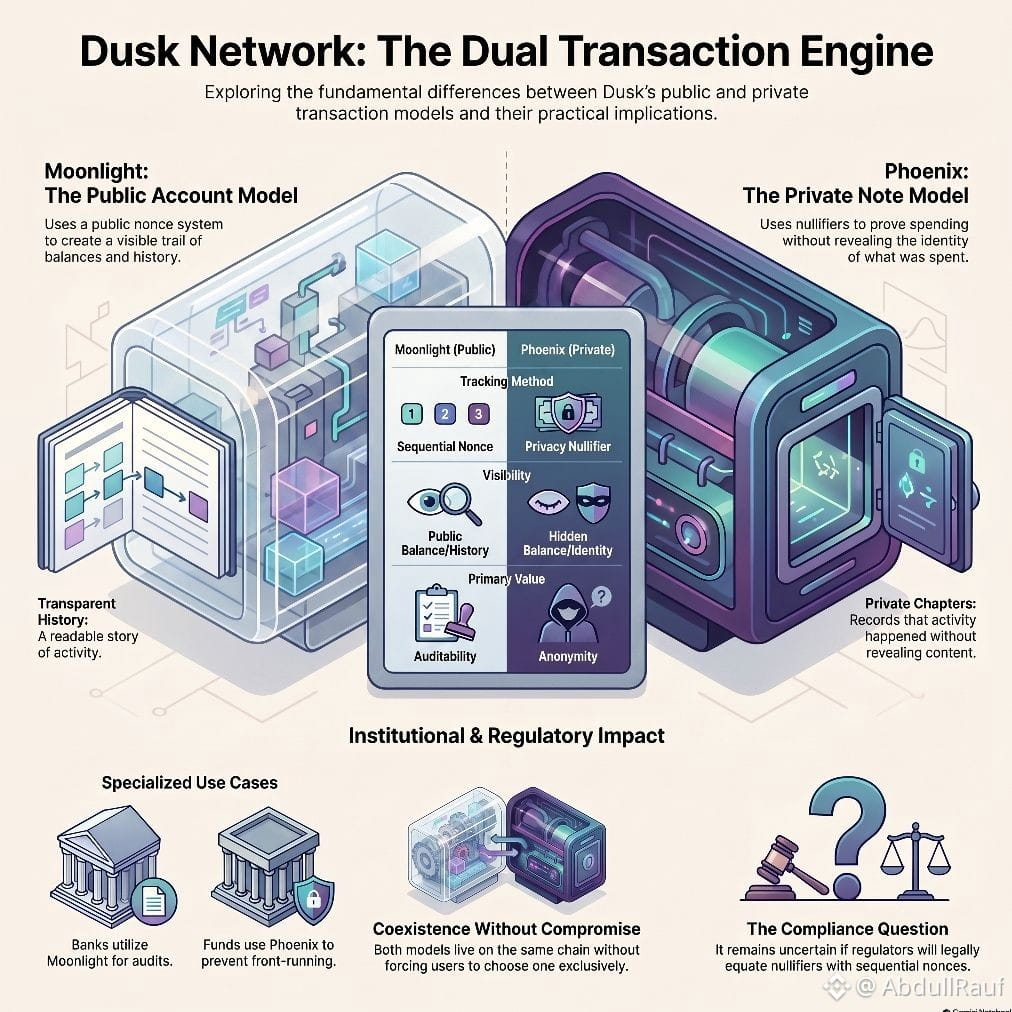
Moonlight works like Ethereum. Your account has a nonce. Every transaction increments it publicly. Anyone can see your balance, your history, your sequence. The nonce is a counter. It is also a trail.
Phoenix works differently. There is no account. No visible balance. No sequential counter. Instead, when you spend a note, you produce a nullifier. The network records that nullifier and knows the note is gone. But it cannot link the nullifier back to the note it came from. The spending is provable. The identity of what was spent is not.
That distinction matters more than it sounds. In Moonlight, your transaction history is a readable story. In Phoenix, the network knows chapters are being written without knowing what they say.
What I keep thinking about is which institutions actually want which model. A bank processing a settlement might need Moonlight for audit trails. A fund executing a strategy might need Phoenix to avoid front-running. Both can live on the same chain. Neither forces the other to compromise.
What I cannot find in the documentation is how regulators treat nullifiers as evidence. A nonce proves sequence. A nullifier proves spending without revealing the note. Are those legally equivalent in a compliance context?
What do you think — when a regulator asks for proof of transaction, does a nullifier satisfy the requirement or does it just raise a harder question?
#dusk $DUSK @Dusk
The actual difference runs deeper than that.
Moonlight works like Ethereum. Your account has a nonce. Every transaction increments it publicly. Anyone can see your balance, your history, your sequence. The nonce is a counter. It is also a trail.
Phoenix works differently. There is no account. No visible balance. No sequential counter. Instead, when you spend a note, you produce a nullifier. The network records that nullifier and knows the note is gone. But it cannot link the nullifier back to the note it came from. The spending is provable. The identity of what was spent is not.
That distinction matters more than it sounds. In Moonlight, your transaction history is a readable story. In Phoenix, the network knows chapters are being written without knowing what they say.
What I keep thinking about is which institutions actually want which model. A bank processing a settlement might need Moonlight for audit trails. A fund executing a strategy might need Phoenix to avoid front-running. Both can live on the same chain. Neither forces the other to compromise.
What I cannot find in the documentation is how regulators treat nullifiers as evidence. A nonce proves sequence. A nullifier proves spending without revealing the note. Are those legally equivalent in a compliance context?
What do you think — when a regulator asks for proof of transaction, does a nullifier satisfy the requirement or does it just raise a harder question?
#dusk $DUSK @Dusk
Privacy bolted onto EVM is not the same as privacy built in from day one.#dusk
AbdullRauf
·
--
At first I assumed adding privacy to an EVM environment was the same as building privacy from the start. From the outside the two look similar. On the inside they are not.
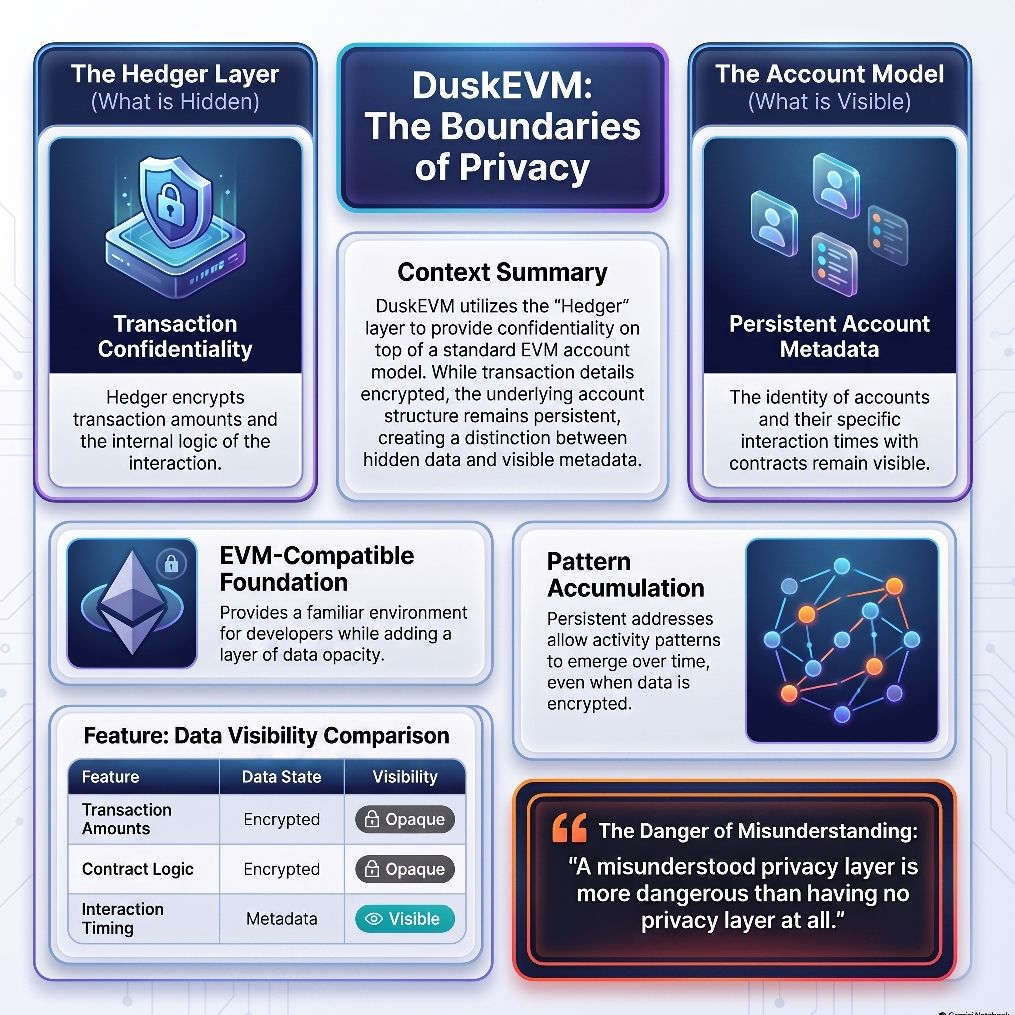
The EVM account model carries a structural assumption. Addresses persist. Activity accumulates. Even when individual transactions are encrypted, the account itself becomes a pattern over time. Hedger adds confidentiality on top of that model. Transaction data can become opaque. The account structure remains visible.
So the real question is narrower. When Hedger encrypts a transaction, what exactly is hidden and what is not? Amounts and internal logic may stay private. The fact that this account interacted with this contract at this time is often still visible. In regulated finance, who traded with whom and when can matter as much as what they traded.
This is not a flaw in the design. Account-based EVM is practical for developers. Hedger is a real privacy layer. The risk is misunderstanding. A privacy layer that people overestimate can be more dangerous than no privacy layer at all.
Does transaction-level confidentiality give institutions enough protection, or does the account model underneath quietly limit the whole promise?
#dusk $DUSK @Dusk
The EVM account model carries a structural assumption. Addresses persist. Activity accumulates. Even when individual transactions are encrypted, the account itself becomes a pattern over time. Hedger adds confidentiality on top of that model. Transaction data can become opaque. The account structure remains visible.
So the real question is narrower. When Hedger encrypts a transaction, what exactly is hidden and what is not? Amounts and internal logic may stay private. The fact that this account interacted with this contract at this time is often still visible. In regulated finance, who traded with whom and when can matter as much as what they traded.
This is not a flaw in the design. Account-based EVM is practical for developers. Hedger is a real privacy layer. The risk is misunderstanding. A privacy layer that people overestimate can be more dangerous than no privacy layer at all.
Does transaction-level confidentiality give institutions enough protection, or does the account model underneath quietly limit the whole promise?
#dusk $DUSK @Dusk
Vérifié
I used to look at a new consensus design and ask one question first. How does an attacker break this?
Studying Dusk changed that habit. With Succinct Attestation, a different scenario appears. Imagine you are already selected to generate a block in a later iteration. You are also voting on the current one. Do you help the current block succeed and take the voter reward, or stay quiet so the iteration fails and your future generator position improves?
That is the Future Generator Incentive Problem. It does not come from outside. It comes from the incentives available to a legitimate participant.
Dusk’s response was to reshape those incentives. Separate generator and voter rewards. Exclude the next-iteration generator from current voting. Limit how many iterations can run.
There is a trade-off. Every extra incentive rule adds another assumption that still needs to hold under pressure.
The real game underneath the cryptography is whether the most rational move stays the honest one.
#dusk $DUSK @Dusk
Studying Dusk changed that habit. With Succinct Attestation, a different scenario appears. Imagine you are already selected to generate a block in a later iteration. You are also voting on the current one. Do you help the current block succeed and take the voter reward, or stay quiet so the iteration fails and your future generator position improves?
That is the Future Generator Incentive Problem. It does not come from outside. It comes from the incentives available to a legitimate participant.
Dusk’s response was to reshape those incentives. Separate generator and voter rewards. Exclude the next-iteration generator from current voting. Limit how many iterations can run.
There is a trade-off. Every extra incentive rule adds another assumption that still needs to hold under pressure.
The real game underneath the cryptography is whether the most rational move stays the honest one.
#dusk $DUSK @Dusk

$DUSK Is Down 93%… Yet Holding Partnerships and a €200M+ Issuance Pipeline Most Protocols at This Price Don’t Have
AbdullRauf
·
--
Spent time trying to read two signals that point in different directions. The price is down ninety-three percent from its all-time high. The NPEX partnership is live. A confirmed issuance pipeline of over two hundred million euros exists. The Boreas upgrade shipped in May. Those two pictures do not belong to the same narrative. One suggests a project that failed to hold its launch momentum. The other suggests a project that kept building while the price declined. Infrastructure tokens have a timing problem that equity markets do not. A company's stock price and its revenue usually move in the same direction over time. A protocol's token price and its actual usage can diverge for years. The price reflects what traders think today. The usage reflects what institutions decided months ago. What I cannot reconcile is the gap between the confirmed issuance number and the daily trading volume. Two hundred million euros in pipeline against three and a half million in daily volume is a wide distance. Either the issuance has not reached the chain yet or volume is not the right measure. @Dusk has partnerships that most protocols at this price would not. Whether that eventually shows up in the price or just in the history books is the question price charts were never designed to answer. When price and adoption diverge this far, which one is lying?
#dusk $DUSK @Dusk
#dusk $DUSK @Dusk
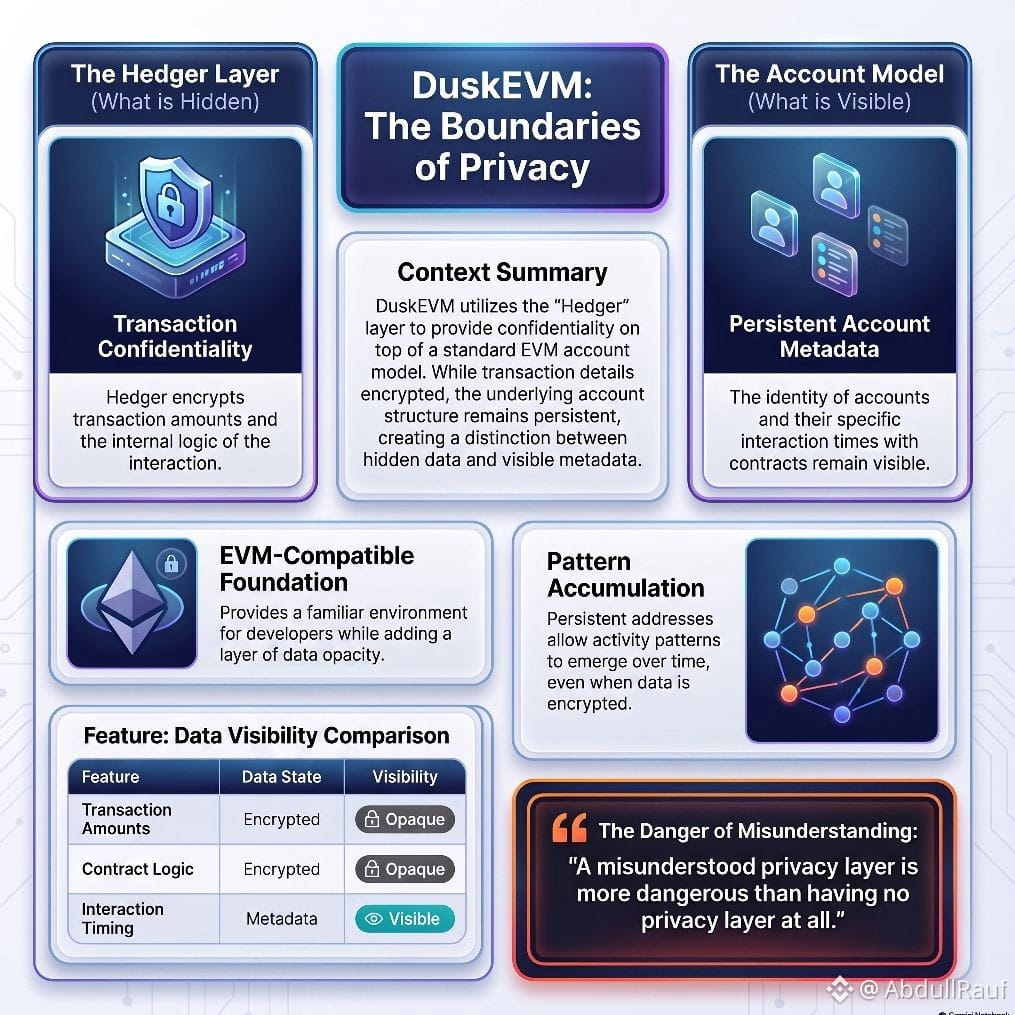
At first I assumed adding privacy to an EVM environment was the same as building privacy from the start. From the outside the two look similar. On the inside they are not.
The EVM account model carries a structural assumption. Addresses persist. Activity accumulates. Even when individual transactions are encrypted, the account itself becomes a pattern over time. Hedger adds confidentiality on top of that model. Transaction data can become opaque. The account structure remains visible.
So the real question is narrower. When Hedger encrypts a transaction, what exactly is hidden and what is not? Amounts and internal logic may stay private. The fact that this account interacted with this contract at this time is often still visible. In regulated finance, who traded with whom and when can matter as much as what they traded.
This is not a flaw in the design. Account-based EVM is practical for developers. Hedger is a real privacy layer. The risk is misunderstanding. A privacy layer that people overestimate can be more dangerous than no privacy layer at all.
Does transaction-level confidentiality give institutions enough protection, or does the account model underneath quietly limit the whole promise?
#dusk $DUSK @Dusk
The EVM account model carries a structural assumption. Addresses persist. Activity accumulates. Even when individual transactions are encrypted, the account itself becomes a pattern over time. Hedger adds confidentiality on top of that model. Transaction data can become opaque. The account structure remains visible.
So the real question is narrower. When Hedger encrypts a transaction, what exactly is hidden and what is not? Amounts and internal logic may stay private. The fact that this account interacted with this contract at this time is often still visible. In regulated finance, who traded with whom and when can matter as much as what they traded.
This is not a flaw in the design. Account-based EVM is practical for developers. Hedger is a real privacy layer. The risk is misunderstanding. A privacy layer that people overestimate can be more dangerous than no privacy layer at all.
Does transaction-level confidentiality give institutions enough protection, or does the account model underneath quietly limit the whole promise?
#dusk $DUSK @Dusk
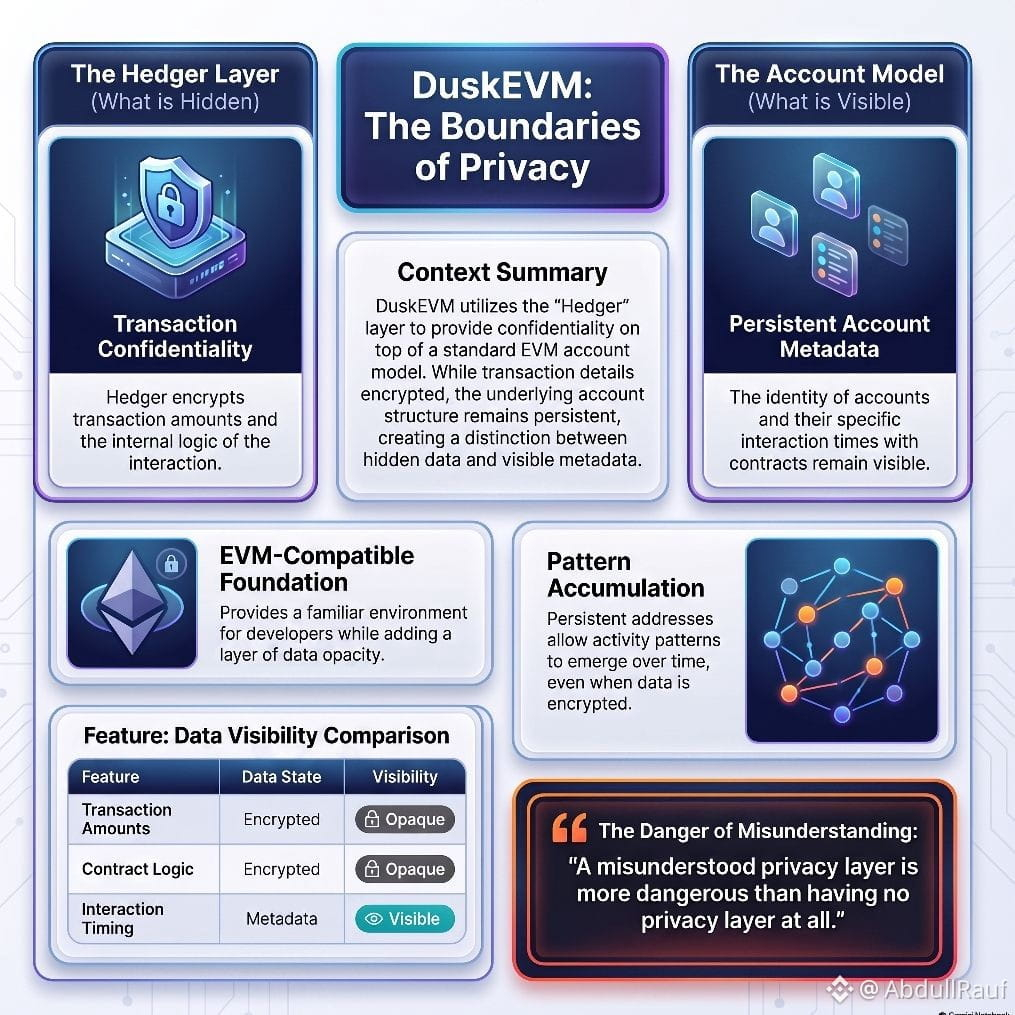
At first I assumed adding privacy to an EVM environment was the same as building privacy from the start. From the outside the two look similar. On the inside they are not.
The EVM account model carries a structural assumption. Addresses persist. Activity accumulates. Even when individual transactions are encrypted, the account itself becomes a pattern over time. Hedger adds confidentiality on top of that model. Transaction data can become opaque. The account structure remains visible.
So the real question is narrower. When Hedger encrypts a transaction, what exactly is hidden and what is not? Amounts and internal logic may stay private. The fact that this account interacted with this contract at this time is often still visible. In regulated finance, who traded with whom and when can matter as much as what they traded.
This is not a flaw in the design. Account-based EVM is practical for developers. Hedger is a real privacy layer. The risk is misunderstanding. A privacy layer that people overestimate can be more dangerous than no privacy layer at all.
Does transaction-level confidentiality give institutions enough protection, or does the account model underneath quietly limit the whole promise?
#dusk $DUSK @Dusk
The EVM account model carries a structural assumption. Addresses persist. Activity accumulates. Even when individual transactions are encrypted, the account itself becomes a pattern over time. Hedger adds confidentiality on top of that model. Transaction data can become opaque. The account structure remains visible.
So the real question is narrower. When Hedger encrypts a transaction, what exactly is hidden and what is not? Amounts and internal logic may stay private. The fact that this account interacted with this contract at this time is often still visible. In regulated finance, who traded with whom and when can matter as much as what they traded.
This is not a flaw in the design. Account-based EVM is practical for developers. Hedger is a real privacy layer. The risk is misunderstanding. A privacy layer that people overestimate can be more dangerous than no privacy layer at all.
Does transaction-level confidentiality give institutions enough protection, or does the account model underneath quietly limit the whole promise?
#dusk $DUSK @Dusk
Connectez-vous pour découvrir plus de contenu