
AbdullRauf
8.2k Publications

AbdullRauf
 Binance Square Vérifié
Hi Guys i am Spot trader specialist in Intra Daytrade, DCA and Swing trade. Follow me tostay updated about market and Binance reward Campaigns.
Ouvert au trading
Trade fréquemment
1.3 an(s)
1.1K+ Suivis
30.6K+ Abonnés
27.5K+ J’aime
Publications
Portefeuille
Tous
Citations
Vidéos
Direct
PINNED
YOUR SUPPORT = OUR THANKS. 2000 GIFTS, GO! 🚀🎁💐
Square Family, you rock! 🧧 To celebrate YOU, we’re giving away 2000 GIFTS. Let’s go!
How to enter:
👉 Follow us
👉 Share this post
👉 Comment “666”
Random draws. Huge wins. Enter now!
Square Family, you rock! 🧧 To celebrate YOU, we’re giving away 2000 GIFTS. Let’s go!
How to enter:
👉 Follow us
👉 Share this post
👉 Comment “666”
Random draws. Huge wins. Enter now!

Tahir

Tahir 塔希尔
·
--
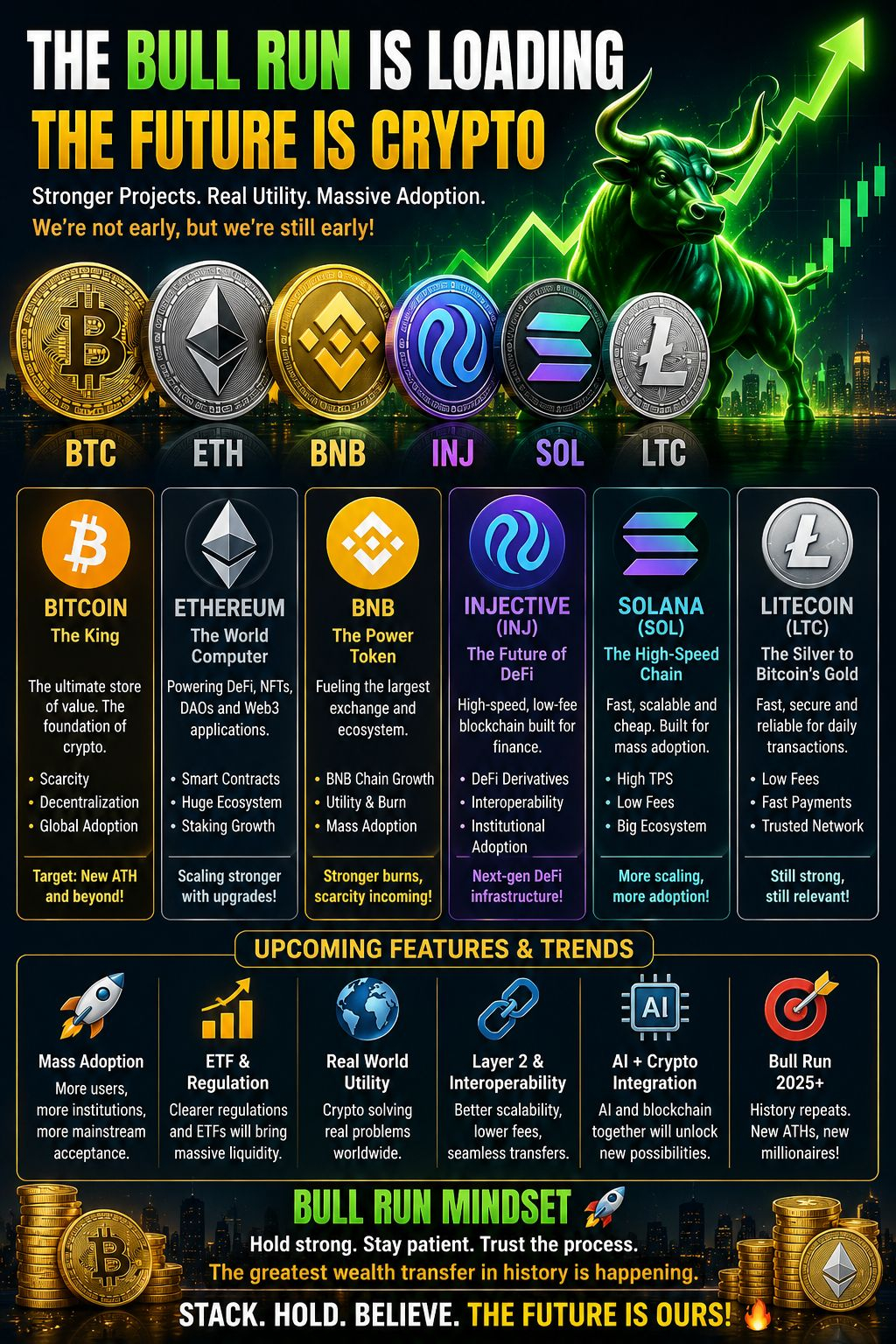
🚀 CRYPTO BULL RUN: THE NEXT BIG MOVE? 🐂🔥
The crypto market is evolving fast — and the next cycle may be driven by utility, adoption, institutions, and real on-chain finance, not just hype.
₿ BTC — The King
Digital scarcity + institutional adoption + ETF demand. Bitcoin remains the foundation of the entire market.
♦️ ETH — The World Computer
Ethereum continues pushing scalability and ecosystem growth, with major upgrades focused on making the network faster and more efficient.
🟡 BNB — The Ecosystem Engine
BNB Chain continues expanding its DeFi, Web3 and application ecosystem while BNB benefits from network utility and token economics.
🔵 INJ — Finance on-chain
Injective is building toward a finance-native blockchain with EVM + WASM, tokenized assets, stablecoin settlement, institutional access and an expanding RWA ecosystem.
🌈 SOL — Speed + Adoption
Solana continues pushing performance, while Alpenglow is one of the major protocol upgrades to watch in 2026, targeting dramatically faster finality.
⚡ LTC — The Veteran
Litecoin remains focused on fast, reliable payments, while upcoming developments include programmable functionality and its next halving cycle.
🔥 WHAT COULD DRIVE THE NEXT BULL RUN?
✅ Institutional capital
✅ ETF adoption
✅ Clearer crypto regulation
✅ Real-world asset tokenization
✅ Stablecoin growth
✅ DeFi expansion
✅ AI + blockchain
✅ Faster & cheaper networks
✅ Mass adoption
✅ New all-time highs
Bitcoin recently moved back above $80K, while ETH and SOL also posted strong gains — but a rally does not automatically guarantee a full bull market.
The real question isn't:
“Will crypto survive?”
It's:
“How big can the next adoption wave become?” 🌎🚀
BTC. ETH. BNB. INJ. SOL. LTC.
Different narratives.
Different technology.
One massive ecosystem.
🐂 The bull may be waking up.
#Bitcoin #Ethereum #BNB #Injective #Solana #Litecoin #Crypto #BullRun #DeFi #RWA #Web3 #Blockchain
The crypto market is evolving fast — and the next cycle may be driven by utility, adoption, institutions, and real on-chain finance, not just hype.
₿ BTC — The King
Digital scarcity + institutional adoption + ETF demand. Bitcoin remains the foundation of the entire market.
♦️ ETH — The World Computer
Ethereum continues pushing scalability and ecosystem growth, with major upgrades focused on making the network faster and more efficient.
🟡 BNB — The Ecosystem Engine
BNB Chain continues expanding its DeFi, Web3 and application ecosystem while BNB benefits from network utility and token economics.
🔵 INJ — Finance on-chain
Injective is building toward a finance-native blockchain with EVM + WASM, tokenized assets, stablecoin settlement, institutional access and an expanding RWA ecosystem.
🌈 SOL — Speed + Adoption
Solana continues pushing performance, while Alpenglow is one of the major protocol upgrades to watch in 2026, targeting dramatically faster finality.
⚡ LTC — The Veteran
Litecoin remains focused on fast, reliable payments, while upcoming developments include programmable functionality and its next halving cycle.
🔥 WHAT COULD DRIVE THE NEXT BULL RUN?
✅ Institutional capital
✅ ETF adoption
✅ Clearer crypto regulation
✅ Real-world asset tokenization
✅ Stablecoin growth
✅ DeFi expansion
✅ AI + blockchain
✅ Faster & cheaper networks
✅ Mass adoption
✅ New all-time highs
Bitcoin recently moved back above $80K, while ETH and SOL also posted strong gains — but a rally does not automatically guarantee a full bull market.
The real question isn't:
“Will crypto survive?”
It's:
“How big can the next adoption wave become?” 🌎🚀
BTC. ETH. BNB. INJ. SOL. LTC.
Different narratives.
Different technology.
One massive ecosystem.
🐂 The bull may be waking up.
#Bitcoin #Ethereum #BNB #Injective #Solana #Litecoin #Crypto #BullRun #DeFi #RWA #Web3 #Blockchain
Ayesha

AYESHA ABID 阿伊莎 阿比德
·
--
Haussier$SOL — Levels That Matter Right Now 👀
$SOL around $195 is sitting at a key decision point.
📈 Break & Hold: $198
🎯 Upside: $202 → $208 → $215
🟢 Major Support: $190
🔻 Breakdown: Below $190
🎯 Downside: $185 → $180
The setup is simple:
$198 reclaimed = buyers gain control
$190 lost = sellers gain control
No need to chase the candle. Let the level confirm the move.
$SOL
Are you watching $215 or $180 first?
#SOL #Solana
$SOL around $195 is sitting at a key decision point.
📈 Break & Hold: $198
🎯 Upside: $202 → $208 → $215
🟢 Major Support: $190
🔻 Breakdown: Below $190
🎯 Downside: $185 → $180
The setup is simple:
$198 reclaimed = buyers gain control
$190 lost = sellers gain control
No need to chase the candle. Let the level confirm the move.
$SOL
Are you watching $215 or $180 first?
#SOL #Solana
go
白鲨观点合约账户
·
--
Chỉ số tham lam của $BTC BTC đã leo lên 79 rồi, lệnh kêu gọi của Trump vẫn ngầu quá mức rồi😂😂😂
Fatima

Fatima 5
·
--
#XRPLeadsCryptoPullbackDropsNearly7%
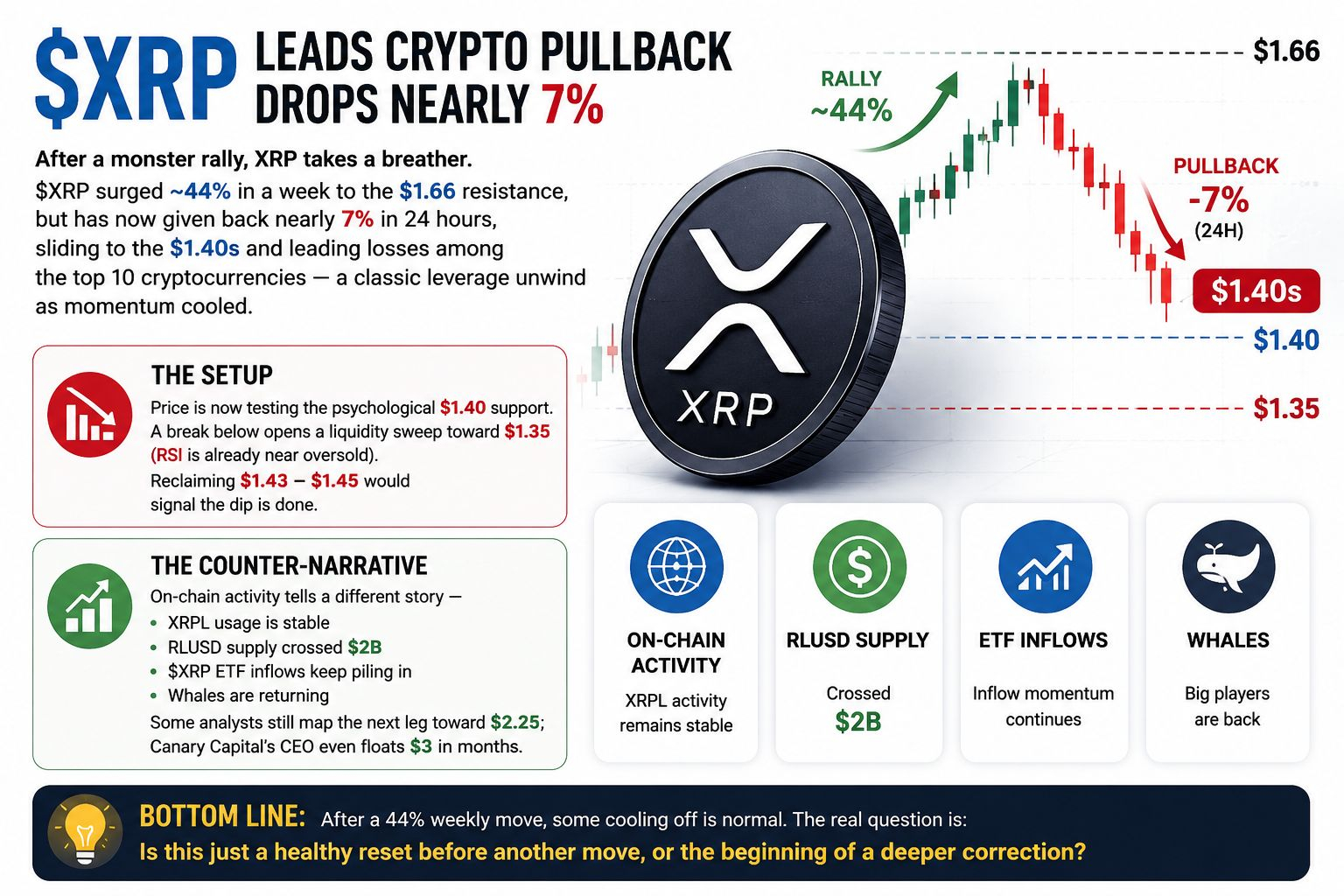
$XRP’s sharp pullback does not automatically change the bigger picture.
After a powerful weekly rally XRP pushed into resistance near $1.66 before momentum cooled and price slipped toward the $1.40 area. That kind of move can happen when traders start taking profit and leveraged positions unwind.
For me the key zone now is $1.40. Holding it could give buyers room to rebuild momentum, while losing it may expose $1.35 next. A move back above $1.43–$1.45 would improve the short-term structure.
What makes this pullback interesting is that the broader XRP story has not suddenly disappeared. XRPL activity remains relevant RLUSD has continued growing, ETF demand is being watched closely and larger holders appear active.
So I’m not looking at this dip as simply “XRP is falling.” I am watching whether support holds and whether real demand returns.
After a 44% weekly move, some cooling off is normal.
The real question is: is this just a healthy reset before another move or the beginning of a deeper correction?
#ChinaOpposesUSProposed7.5%Tariff
#NvidiaRises4%OnRevenueBeat
$XRP’s sharp pullback does not automatically change the bigger picture.
After a powerful weekly rally XRP pushed into resistance near $1.66 before momentum cooled and price slipped toward the $1.40 area. That kind of move can happen when traders start taking profit and leveraged positions unwind.
For me the key zone now is $1.40. Holding it could give buyers room to rebuild momentum, while losing it may expose $1.35 next. A move back above $1.43–$1.45 would improve the short-term structure.
What makes this pullback interesting is that the broader XRP story has not suddenly disappeared. XRPL activity remains relevant RLUSD has continued growing, ETF demand is being watched closely and larger holders appear active.
So I’m not looking at this dip as simply “XRP is falling.” I am watching whether support holds and whether real demand returns.
After a 44% weekly move, some cooling off is normal.
The real question is: is this just a healthy reset before another move or the beginning of a deeper correction?
#ChinaOpposesUSProposed7.5%Tariff
#NvidiaRises4%OnRevenueBeat
111

阿波罗1111
·
--
不是所有机遇都需要喧哗,
真正的价值自有声量。
Not every opportunity needs noise;
true value carries its own voice.
真正的价值自有声量。
Not every opportunity needs noise;
true value carries its own voice.

crypto wolf

Crypto Wolf Official
·
--
Bought $XRP back in 2024. 📈
The price dropped, but I never sold it yet.
I still believe $XRP has more potential, so I’m holding patiently until it reaches my target price. 💎
Let’s see where this journey takes me. I Don't know what will happen. 🚀
#XRP #Ripple #Crypto #HODL
The price dropped, but I never sold it yet.
I still believe $XRP has more potential, so I’m holding patiently until it reaches my target price. 💎
Let’s see where this journey takes me. I Don't know what will happen. 🚀
#XRP #Ripple #Crypto #HODL

najaf

NAJAF_加密 143
·
--
Solana (SOL): The High-Speed Crypto Engine 🚀
Solana is one of the top cryptocurrencies, currently trading around $85 with a massive market cap placing it firmly among the top layer-1 networks.
Why It Matters:
⚡ Blazing Speed: Processes thousands of transactions per second via its unique Proof-of-History mechanism.
💸 Micro Fees: Average transactions cost fractions of a cent, making micro-payments practical.
🌐 Ecosystem Hub: Powers DeFi, NFTs, and Web3 apps at scale.
Solana solves crypto’s scaling problem, combining speed, affordability, and utility.
#Solana #Crypto #SOL
#ClaimNow #BinanceSquareFamily
Solana is one of the top cryptocurrencies, currently trading around $85 with a massive market cap placing it firmly among the top layer-1 networks.
Why It Matters:
⚡ Blazing Speed: Processes thousands of transactions per second via its unique Proof-of-History mechanism.
💸 Micro Fees: Average transactions cost fractions of a cent, making micro-payments practical.
🌐 Ecosystem Hub: Powers DeFi, NFTs, and Web3 apps at scale.
Solana solves crypto’s scaling problem, combining speed, affordability, and utility.
#Solana #Crypto #SOL
#ClaimNow #BinanceSquareFamily

Ahli

Ahli Hidaya Doka hy Sab Kuch
·
--
Haussier✨ 10K FOLLOWERS — THANK YOU! 🤍
Alhamdulillah, we’ve reached 10,000 followers! 🥹✨
This milestone wouldn’t have been possible without the incredible support, encouragement, and trust from each one of you. 🙏🏻❤️
Every follow, like, comment, repost, and kind message has meant more than you know. 🫶🏻
I’m truly grateful to everyone who has been part of this journey — whether you’ve been here from the beginning or just joined recently. 🌸
10K is a milestone, but the real achievement is the community we’re building together. 🤝🏻✨
Thank you for believing in my content and for being here. 💫
Grateful for 10K. Excited for what’s next. 🚀❤️
#10KFollowers #Grateful #BinanceSquare #CryptoCommunity #ThankYou
Alhamdulillah, we’ve reached 10,000 followers! 🥹✨
This milestone wouldn’t have been possible without the incredible support, encouragement, and trust from each one of you. 🙏🏻❤️
Every follow, like, comment, repost, and kind message has meant more than you know. 🫶🏻
I’m truly grateful to everyone who has been part of this journey — whether you’ve been here from the beginning or just joined recently. 🌸
10K is a milestone, but the real achievement is the community we’re building together. 🤝🏻✨
Thank you for believing in my content and for being here. 💫
Grateful for 10K. Excited for what’s next. 🚀❤️
#10KFollowers #Grateful #BinanceSquare #CryptoCommunity #ThankYou

Leo

Leo - F0
·
--
Haussier🔥🧧🧧GREETINGS TO MY FAMILY FROM DUBAİ WITH A RED GIFT PACKAGE.🧧🧧🔥
"Shed your worries under the palm tree shade. Chasing the paradise your dreams have made." 🏝️🍹🛥️
$BTC 🔥🔥🧧🧧 #Dubai_Crypto_Group
#金价升破4400美元创两月高
$BNB $ETH
#1688家族family 💚 @周周1688
#xrp #Binance
"Shed your worries under the palm tree shade. Chasing the paradise your dreams have made." 🏝️🍹🛥️
$BTC 🔥🔥🧧🧧 #Dubai_Crypto_Group
#金价升破4400美元创两月高
$BNB $ETH
#1688家族family 💚 @周周1688
#xrp #Binance

go
AbdullRauf
·
--
YOUR SUPPORT = OUR THANKS. 2000 GIFTS, GO! 🚀🎁💐
Square Family, you rock! 🧧 To celebrate YOU, we’re giving away 2000 GIFTS. Let’s go!
How to enter:
👉 Follow us
👉 Share this post
👉 Comment “666”
Random draws. Huge wins. Enter now!
Square Family, you rock! 🧧 To celebrate YOU, we’re giving away 2000 GIFTS. Let’s go!
How to enter:
👉 Follow us
👉 Share this post
👉 Comment “666”
Random draws. Huge wins. Enter now!

Vérifié
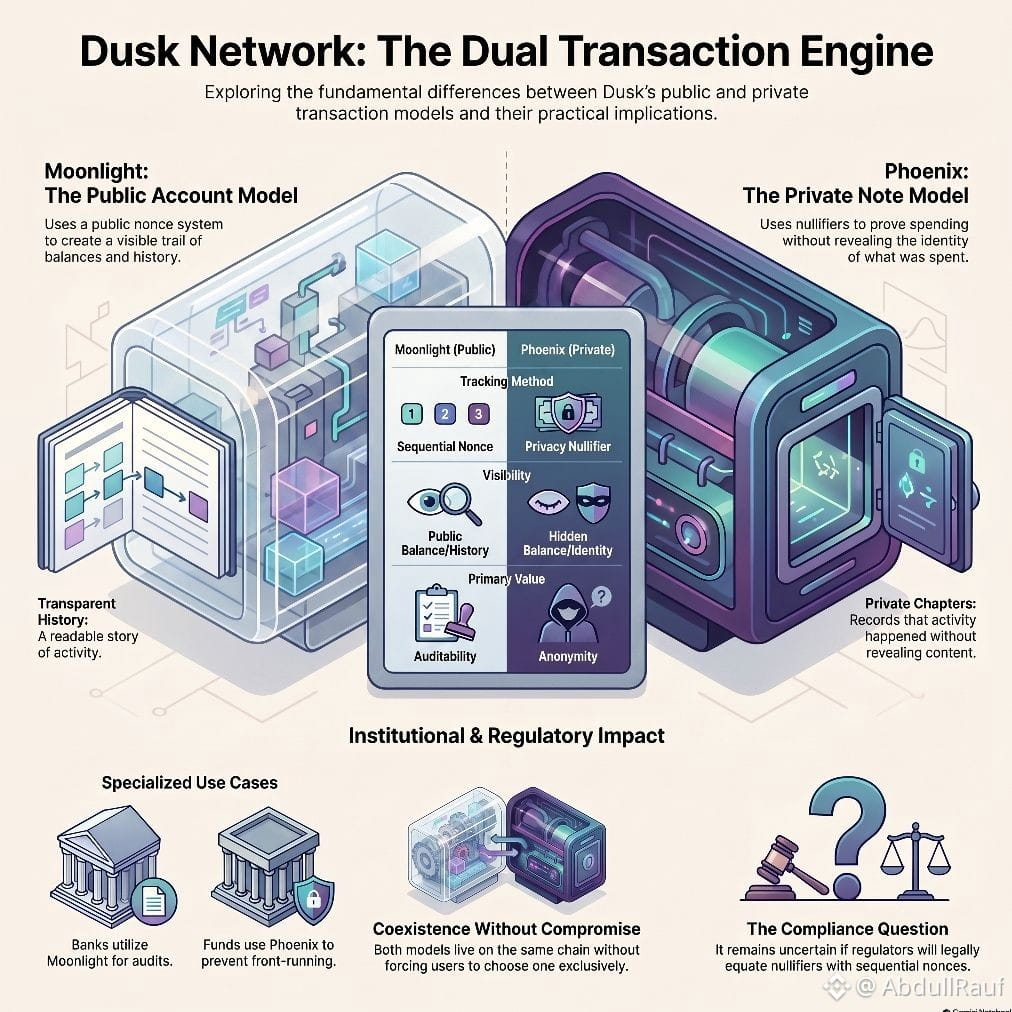
At first I assumed the two transaction models on Dusk were just a privacy toggle. Public or private. One switch. Simple choice.
The actual difference runs deeper than that.
Moonlight works like Ethereum. Your account has a nonce. Every transaction increments it publicly. Anyone can see your balance, your history, your sequence. The nonce is a counter. It is also a trail.
Phoenix works differently. There is no account. No visible balance. No sequential counter. Instead, when you spend a note, you produce a nullifier. The network records that nullifier and knows the note is gone. But it cannot link the nullifier back to the note it came from. The spending is provable. The identity of what was spent is not.
That distinction matters more than it sounds. In Moonlight, your transaction history is a readable story. In Phoenix, the network knows chapters are being written without knowing what they say.
What I keep thinking about is which institutions actually want which model. A bank processing a settlement might need Moonlight for audit trails. A fund executing a strategy might need Phoenix to avoid front-running. Both can live on the same chain. Neither forces the other to compromise.
What I cannot find in the documentation is how regulators treat nullifiers as evidence. A nonce proves sequence. A nullifier proves spending without revealing the note. Are those legally equivalent in a compliance context?
What do you think — when a regulator asks for proof of transaction, does a nullifier satisfy the requirement or does it just raise a harder question?
#dusk $DUSK @Dusk
The actual difference runs deeper than that.
Moonlight works like Ethereum. Your account has a nonce. Every transaction increments it publicly. Anyone can see your balance, your history, your sequence. The nonce is a counter. It is also a trail.
Phoenix works differently. There is no account. No visible balance. No sequential counter. Instead, when you spend a note, you produce a nullifier. The network records that nullifier and knows the note is gone. But it cannot link the nullifier back to the note it came from. The spending is provable. The identity of what was spent is not.
That distinction matters more than it sounds. In Moonlight, your transaction history is a readable story. In Phoenix, the network knows chapters are being written without knowing what they say.
What I keep thinking about is which institutions actually want which model. A bank processing a settlement might need Moonlight for audit trails. A fund executing a strategy might need Phoenix to avoid front-running. Both can live on the same chain. Neither forces the other to compromise.
What I cannot find in the documentation is how regulators treat nullifiers as evidence. A nonce proves sequence. A nullifier proves spending without revealing the note. Are those legally equivalent in a compliance context?
What do you think — when a regulator asks for proof of transaction, does a nullifier satisfy the requirement or does it just raise a harder question?
#dusk $DUSK @Dusk
Privacy bolted onto EVM is not the same as privacy built in from day one.#dusk
AbdullRauf
·
--
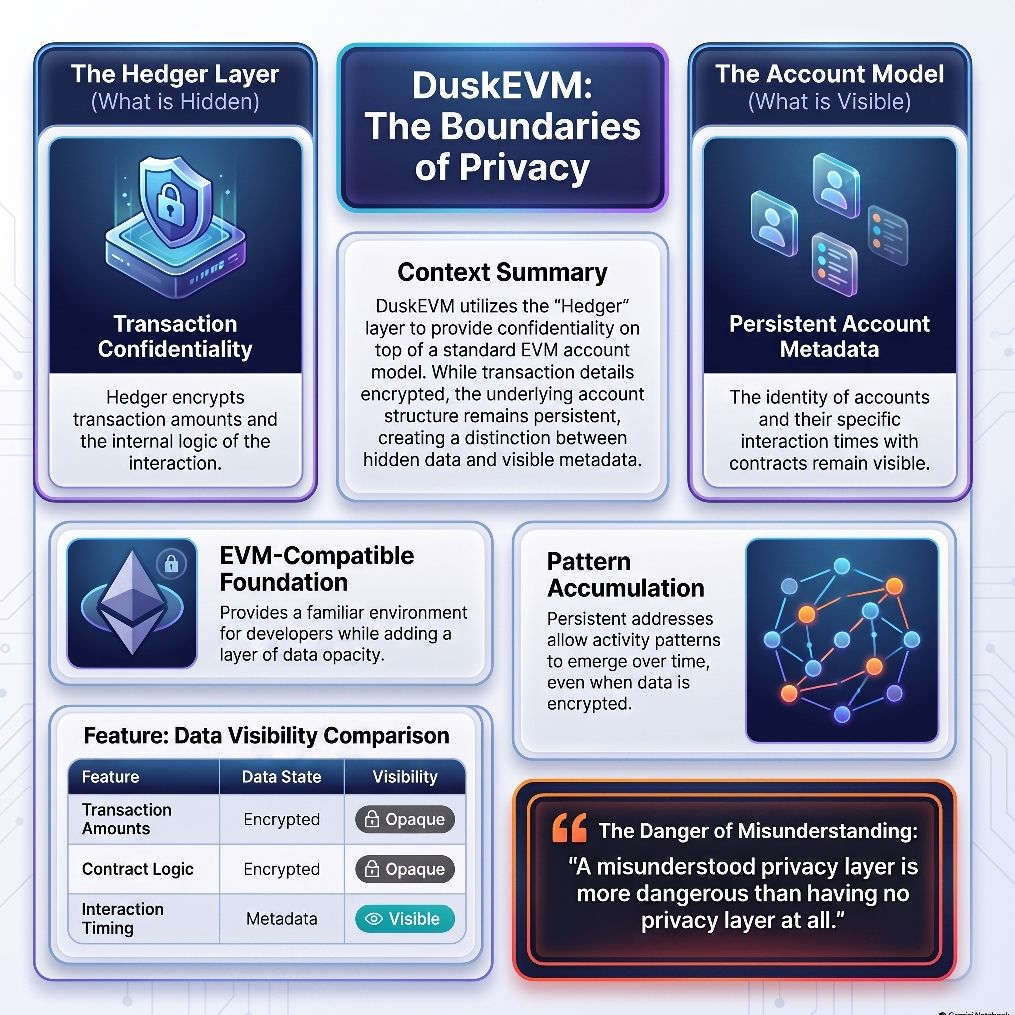
At first I assumed adding privacy to an EVM environment was the same as building privacy from the start. From the outside the two look similar. On the inside they are not.
The EVM account model carries a structural assumption. Addresses persist. Activity accumulates. Even when individual transactions are encrypted, the account itself becomes a pattern over time. Hedger adds confidentiality on top of that model. Transaction data can become opaque. The account structure remains visible.
So the real question is narrower. When Hedger encrypts a transaction, what exactly is hidden and what is not? Amounts and internal logic may stay private. The fact that this account interacted with this contract at this time is often still visible. In regulated finance, who traded with whom and when can matter as much as what they traded.
This is not a flaw in the design. Account-based EVM is practical for developers. Hedger is a real privacy layer. The risk is misunderstanding. A privacy layer that people overestimate can be more dangerous than no privacy layer at all.
Does transaction-level confidentiality give institutions enough protection, or does the account model underneath quietly limit the whole promise?
#dusk $DUSK @Dusk
The EVM account model carries a structural assumption. Addresses persist. Activity accumulates. Even when individual transactions are encrypted, the account itself becomes a pattern over time. Hedger adds confidentiality on top of that model. Transaction data can become opaque. The account structure remains visible.
So the real question is narrower. When Hedger encrypts a transaction, what exactly is hidden and what is not? Amounts and internal logic may stay private. The fact that this account interacted with this contract at this time is often still visible. In regulated finance, who traded with whom and when can matter as much as what they traded.
This is not a flaw in the design. Account-based EVM is practical for developers. Hedger is a real privacy layer. The risk is misunderstanding. A privacy layer that people overestimate can be more dangerous than no privacy layer at all.
Does transaction-level confidentiality give institutions enough protection, or does the account model underneath quietly limit the whole promise?
#dusk $DUSK @Dusk
Vérifié
I used to look at a new consensus design and ask one question first. How does an attacker break this?
Studying Dusk changed that habit. With Succinct Attestation, a different scenario appears. Imagine you are already selected to generate a block in a later iteration. You are also voting on the current one. Do you help the current block succeed and take the voter reward, or stay quiet so the iteration fails and your future generator position improves?
That is the Future Generator Incentive Problem. It does not come from outside. It comes from the incentives available to a legitimate participant.
Dusk’s response was to reshape those incentives. Separate generator and voter rewards. Exclude the next-iteration generator from current voting. Limit how many iterations can run.
There is a trade-off. Every extra incentive rule adds another assumption that still needs to hold under pressure.
The real game underneath the cryptography is whether the most rational move stays the honest one.
#dusk $DUSK @Dusk
Studying Dusk changed that habit. With Succinct Attestation, a different scenario appears. Imagine you are already selected to generate a block in a later iteration. You are also voting on the current one. Do you help the current block succeed and take the voter reward, or stay quiet so the iteration fails and your future generator position improves?
That is the Future Generator Incentive Problem. It does not come from outside. It comes from the incentives available to a legitimate participant.
Dusk’s response was to reshape those incentives. Separate generator and voter rewards. Exclude the next-iteration generator from current voting. Limit how many iterations can run.
There is a trade-off. Every extra incentive rule adds another assumption that still needs to hold under pressure.
The real game underneath the cryptography is whether the most rational move stays the honest one.
#dusk $DUSK @Dusk

$DUSK Is Down 93%… Yet Holding Partnerships and a €200M+ Issuance Pipeline Most Protocols at This Price Don’t Have
AbdullRauf
·
--
Spent time trying to read two signals that point in different directions. The price is down ninety-three percent from its all-time high. The NPEX partnership is live. A confirmed issuance pipeline of over two hundred million euros exists. The Boreas upgrade shipped in May. Those two pictures do not belong to the same narrative. One suggests a project that failed to hold its launch momentum. The other suggests a project that kept building while the price declined. Infrastructure tokens have a timing problem that equity markets do not. A company's stock price and its revenue usually move in the same direction over time. A protocol's token price and its actual usage can diverge for years. The price reflects what traders think today. The usage reflects what institutions decided months ago. What I cannot reconcile is the gap between the confirmed issuance number and the daily trading volume. Two hundred million euros in pipeline against three and a half million in daily volume is a wide distance. Either the issuance has not reached the chain yet or volume is not the right measure. @Dusk has partnerships that most protocols at this price would not. Whether that eventually shows up in the price or just in the history books is the question price charts were never designed to answer. When price and adoption diverge this far, which one is lying?
#dusk $DUSK @Dusk
#dusk $DUSK @Dusk
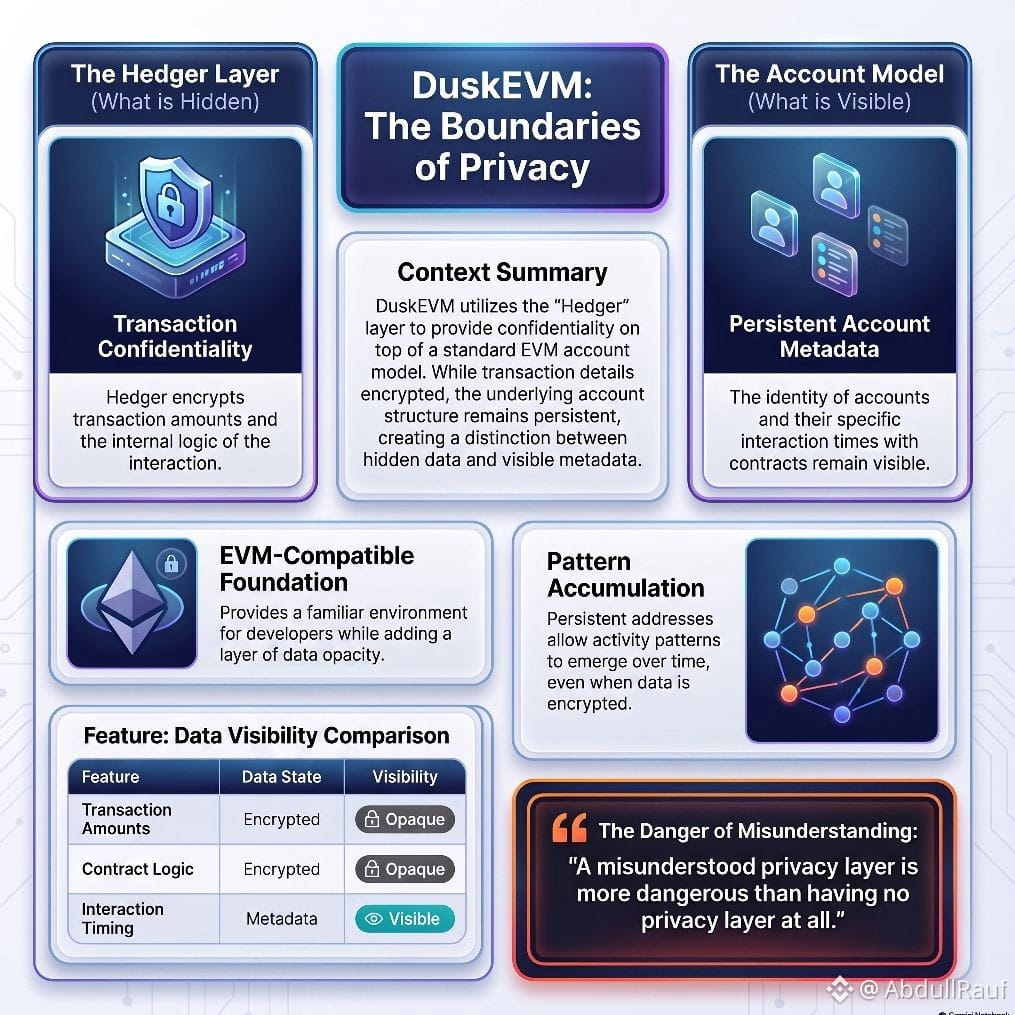
At first I assumed adding privacy to an EVM environment was the same as building privacy from the start. From the outside the two look similar. On the inside they are not.
The EVM account model carries a structural assumption. Addresses persist. Activity accumulates. Even when individual transactions are encrypted, the account itself becomes a pattern over time. Hedger adds confidentiality on top of that model. Transaction data can become opaque. The account structure remains visible.
So the real question is narrower. When Hedger encrypts a transaction, what exactly is hidden and what is not? Amounts and internal logic may stay private. The fact that this account interacted with this contract at this time is often still visible. In regulated finance, who traded with whom and when can matter as much as what they traded.
This is not a flaw in the design. Account-based EVM is practical for developers. Hedger is a real privacy layer. The risk is misunderstanding. A privacy layer that people overestimate can be more dangerous than no privacy layer at all.
Does transaction-level confidentiality give institutions enough protection, or does the account model underneath quietly limit the whole promise?
#dusk $DUSK @Dusk
The EVM account model carries a structural assumption. Addresses persist. Activity accumulates. Even when individual transactions are encrypted, the account itself becomes a pattern over time. Hedger adds confidentiality on top of that model. Transaction data can become opaque. The account structure remains visible.
So the real question is narrower. When Hedger encrypts a transaction, what exactly is hidden and what is not? Amounts and internal logic may stay private. The fact that this account interacted with this contract at this time is often still visible. In regulated finance, who traded with whom and when can matter as much as what they traded.
This is not a flaw in the design. Account-based EVM is practical for developers. Hedger is a real privacy layer. The risk is misunderstanding. A privacy layer that people overestimate can be more dangerous than no privacy layer at all.
Does transaction-level confidentiality give institutions enough protection, or does the account model underneath quietly limit the whole promise?
#dusk $DUSK @Dusk
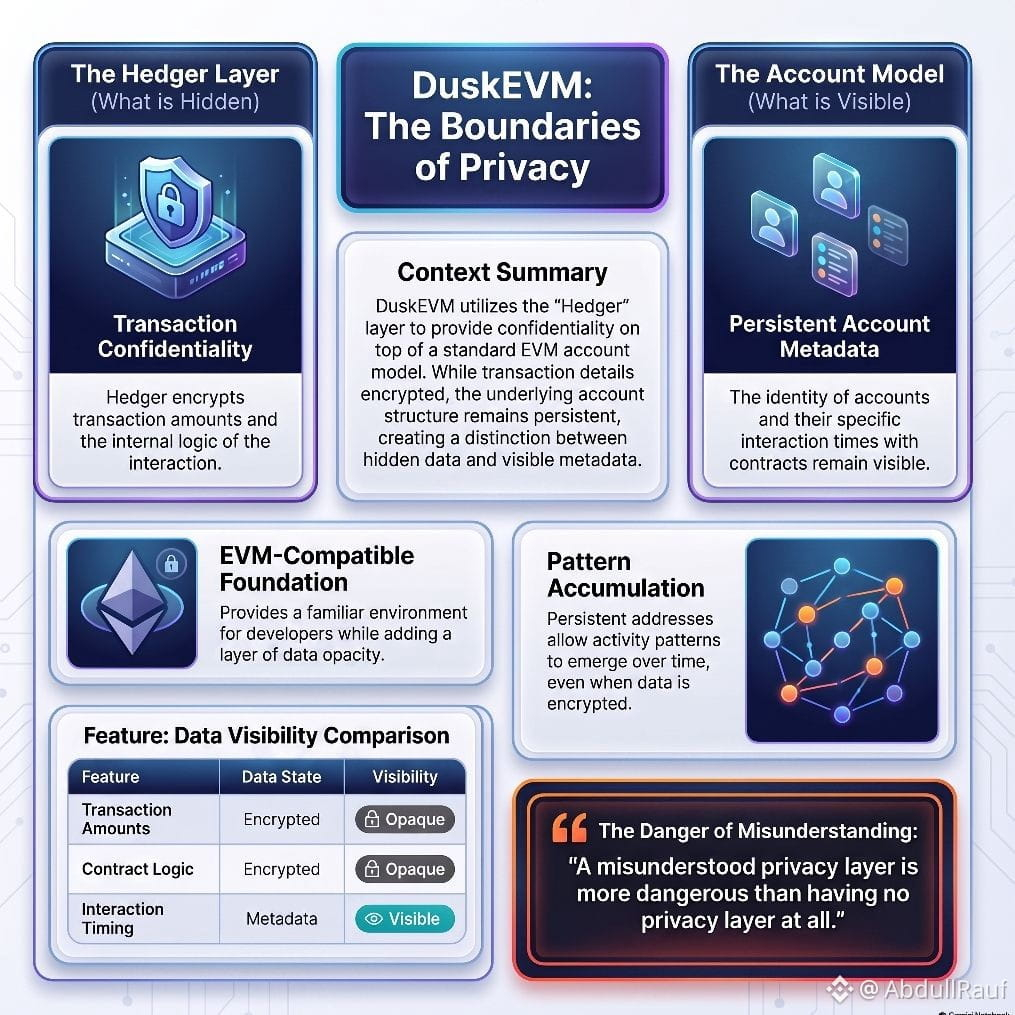
At first I assumed adding privacy to an EVM environment was the same as building privacy from the start. From the outside the two look similar. On the inside they are not.
The EVM account model carries a structural assumption. Addresses persist. Activity accumulates. Even when individual transactions are encrypted, the account itself becomes a pattern over time. Hedger adds confidentiality on top of that model. Transaction data can become opaque. The account structure remains visible.
So the real question is narrower. When Hedger encrypts a transaction, what exactly is hidden and what is not? Amounts and internal logic may stay private. The fact that this account interacted with this contract at this time is often still visible. In regulated finance, who traded with whom and when can matter as much as what they traded.
This is not a flaw in the design. Account-based EVM is practical for developers. Hedger is a real privacy layer. The risk is misunderstanding. A privacy layer that people overestimate can be more dangerous than no privacy layer at all.
Does transaction-level confidentiality give institutions enough protection, or does the account model underneath quietly limit the whole promise?
#dusk $DUSK @Dusk
The EVM account model carries a structural assumption. Addresses persist. Activity accumulates. Even when individual transactions are encrypted, the account itself becomes a pattern over time. Hedger adds confidentiality on top of that model. Transaction data can become opaque. The account structure remains visible.
So the real question is narrower. When Hedger encrypts a transaction, what exactly is hidden and what is not? Amounts and internal logic may stay private. The fact that this account interacted with this contract at this time is often still visible. In regulated finance, who traded with whom and when can matter as much as what they traded.
This is not a flaw in the design. Account-based EVM is practical for developers. Hedger is a real privacy layer. The risk is misunderstanding. A privacy layer that people overestimate can be more dangerous than no privacy layer at all.
Does transaction-level confidentiality give institutions enough protection, or does the account model underneath quietly limit the whole promise?
#dusk $DUSK @Dusk
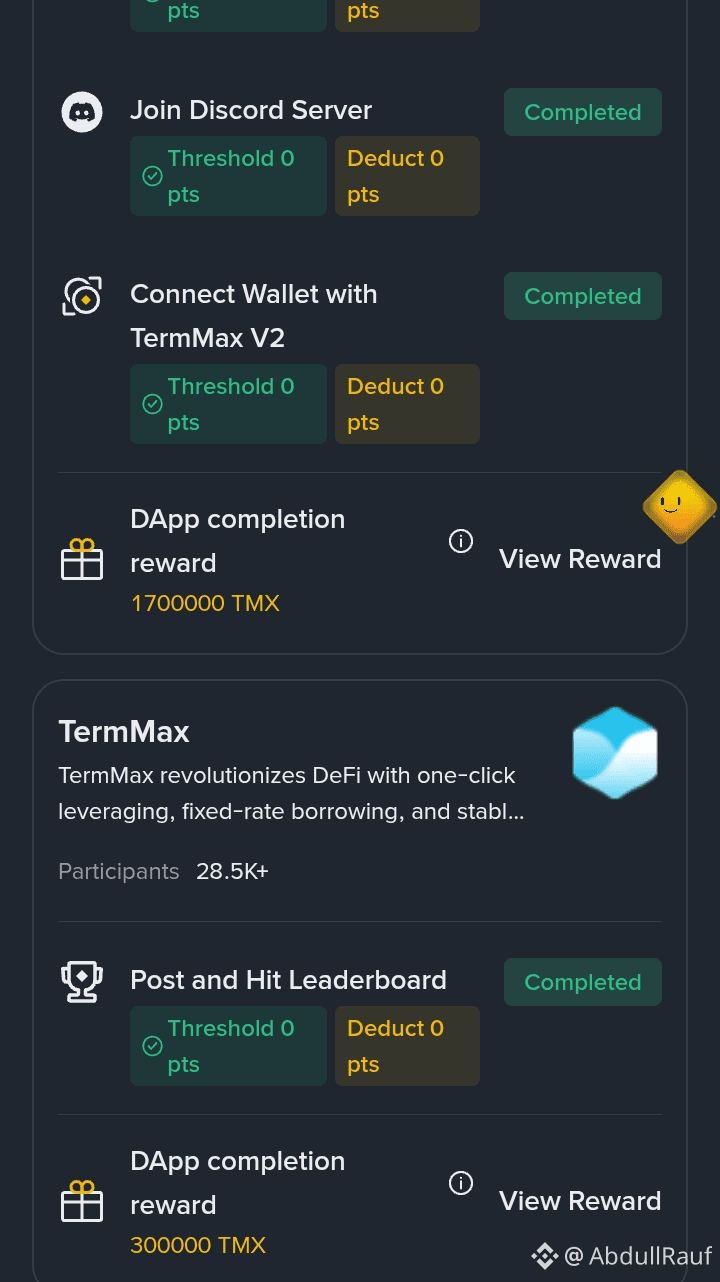
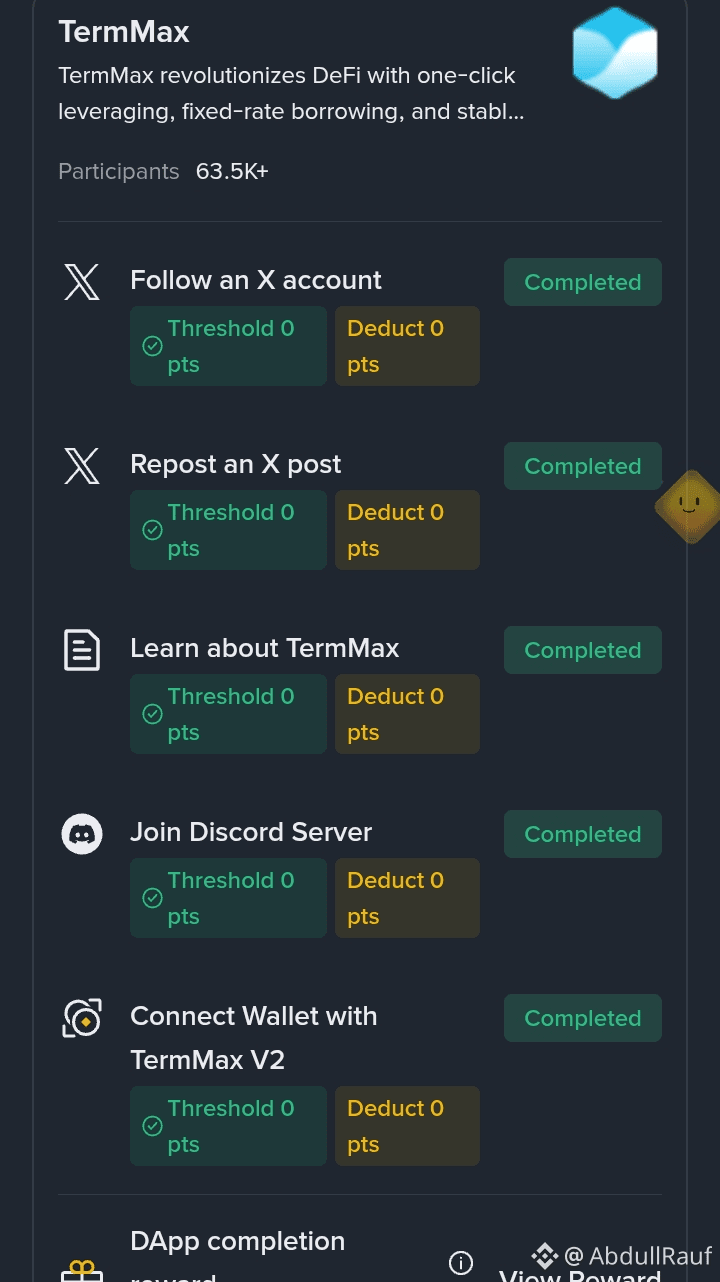
At first I assumed appearing on the leaderboard was enough.
Spent time checking the rules and realized verification is the real gate.
Today is the only window.
Binance Wallet → Discover → Booster → TermMax → Square task → Complete & Verify.
Miss this step and the ranking means nothing
The quiet work of confirming still decides who actually gets paid.
@TermMax
#TermMax
Spent time checking the rules and realized verification is the real gate.
Today is the only window.
Binance Wallet → Discover → Booster → TermMax → Square task → Complete & Verify.
Miss this step and the ranking means nothing
The quiet work of confirming still decides who actually gets paid.
@TermMax
#TermMax
Vérifié
Spent time trying to read two signals that point in different directions. The price is down ninety-three percent from its all-time high. The NPEX partnership is live. A confirmed issuance pipeline of over two hundred million euros exists. The Boreas upgrade shipped in May. Those two pictures do not belong to the same narrative. One suggests a project that failed to hold its launch momentum. The other suggests a project that kept building while the price declined. Infrastructure tokens have a timing problem that equity markets do not. A company's stock price and its revenue usually move in the same direction over time. A protocol's token price and its actual usage can diverge for years. The price reflects what traders think today. The usage reflects what institutions decided months ago. What I cannot reconcile is the gap between the confirmed issuance number and the daily trading volume. Two hundred million euros in pipeline against three and a half million in daily volume is a wide distance. Either the issuance has not reached the chain yet or volume is not the right measure. @Dusk has partnerships that most protocols at this price would not. Whether that eventually shows up in the price or just in the history books is the question price charts were never designed to answer. When price and adoption diverge this far, which one is lying?
#dusk $DUSK @Dusk
#dusk $DUSK @Dusk
Vérifié
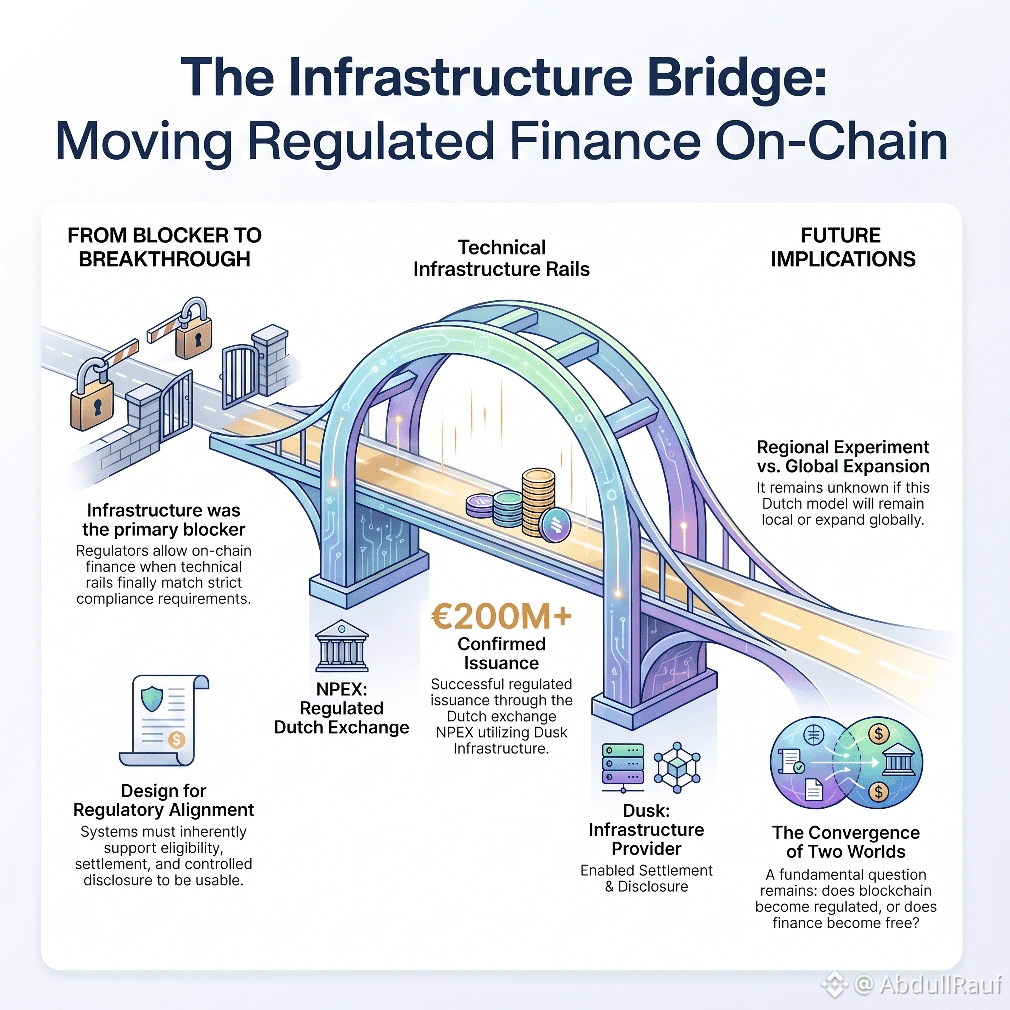
At first I assumed regulated finance could not move on-chain because regulators would never allow it. The rules were too strict. The systems were too closed. Blockchain was too open.
Then the numbers appeared. More than €200 million in confirmed issuance through NPEX, a regulated Dutch exchange working with Dusk. That did not look like resistance. It looked like the opposite.
What held me was the quieter realization underneath. Regulators were not the main blocker. Infrastructure was. When the rails could support eligibility, settlement, and controlled disclosure, the regulatory path became usable. The permission was not granted after the fact. It became possible because the design finally matched the requirements.
What I still cannot settle is how far this stays local. NPEX is a Dutch venue. Whether this model expands beyond Europe or remains a regional experiment is still open.
When regulated finance moves on-chain, does blockchain become more regulated, or does finance become more free?
#dusk $DUSK @Dusk
Then the numbers appeared. More than €200 million in confirmed issuance through NPEX, a regulated Dutch exchange working with Dusk. That did not look like resistance. It looked like the opposite.
What held me was the quieter realization underneath. Regulators were not the main blocker. Infrastructure was. When the rails could support eligibility, settlement, and controlled disclosure, the regulatory path became usable. The permission was not granted after the fact. It became possible because the design finally matched the requirements.
What I still cannot settle is how far this stays local. NPEX is a Dutch venue. Whether this model expands beyond Europe or remains a regional experiment is still open.
When regulated finance moves on-chain, does blockchain become more regulated, or does finance become more free?
#dusk $DUSK @Dusk
Connectez-vous pour découvrir plus de contenu