

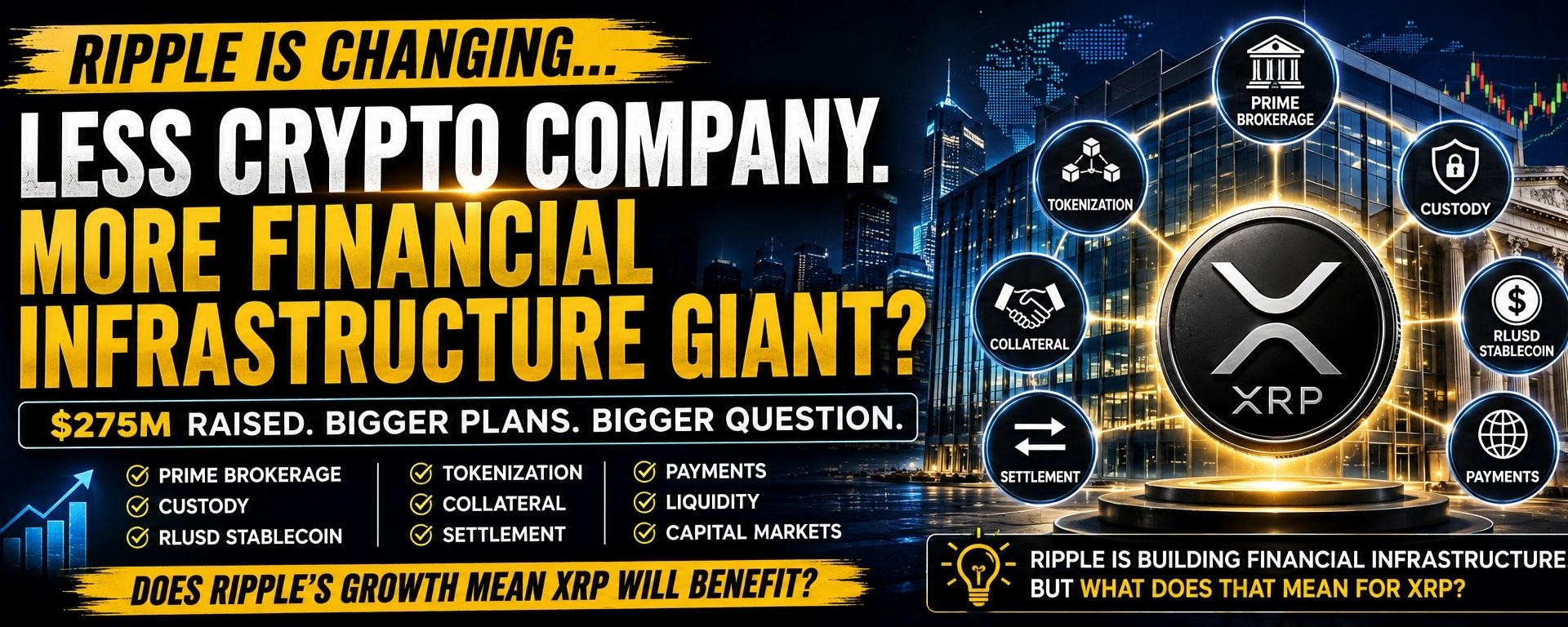

Ripple is starting to look less like a crypto company…
…and more like a financial infrastructure giant.
Prime brokerage.
Stablecoins.
Custody.
Tokenization.
Payments.
Capital markets.
Institutional liquidity.
And now…
$275 MILLION in institutional debt financing for Ripple Prime.
But here’s the question XRP holders should be asking:
👇
Does Ripple’s growth actually mean XRP will benefit?
Because the answer isn’t as simple as “Ripple bullish = XRP bullish.”
🏦 THE $275M MOVE IS BIGGER THAN IT LOOKS
Ripple Prime recently raised $275 million through senior unsecured notes.
And the money is being used to expand its U.S. prime brokerage business.
Think about what that means.
This isn’t just about moving crypto from one wallet to another.
Prime brokerage can involve:
• Trading access
• Financing
• Credit
• Clearing
• Liquidity
• Collateral
• Settlement
• Institutional infrastructure
Ripple is moving deeper into the machinery of traditional finance.
That’s a BIG change.
🧩 RIPPLE IS BUILDING A FINANCIAL STACK
Ripple isn’t just focused on payments anymore.
It is building multiple pieces of the financial system.
Payments → Move money globally.
Custody → Hold digital assets for institutions.
RLUSD → Provide a digital dollar.
Prime Brokerage → Trading + liquidity + financing.
Tokenization → Put real-world assets on-chain.
Collateral → Make those assets useful in financial markets.
Settlement → Move assets and cash more efficiently.
Look at the bigger picture.
This starts looking less like a crypto startup…
…and more like a financial technology platform.
🔗 TOKENIZATION ISN’T THE END GAME
Crypto loves saying:
“Another $500M asset has been tokenized!”
Okay.
But then what?
Can it trade?
Can it settle?
Can institutions custody it?
Can it be used as collateral?
Can investors access it?
Can it move between counterparties?
Can you borrow against it?
That’s where the real opportunity is.
Tokenization without liquidity and infrastructure is basically…
a PowerPoint presentation on a blockchain. 😂
Ripple appears to be trying to build the infrastructure around the tokenized assets too.
And that is much more interesting.
💵 AND THEN THERE’S RLUSD…
This could become one of the most important pieces of Ripple’s strategy.
RLUSD is Ripple’s dollar-backed stablecoin.
And Ripple is increasingly positioning it for:
💵 Payments
💵 Settlement
💵 Liquidity
💵 Institutional finance
But here’s something XRP holders NEED to understand:
RLUSD growth ≠ automatic XRP growth.
If RLUSD becomes huge but most of its activity happens without XRP…
then RLUSD could become a massive success for Ripple without creating massive direct demand for XRP.
That’s why we need to watch where RLUSD is actually being used.
⚠️ RIPPLE ≠ XRP ≠ XRPL ≠ RLUSD
This distinction is incredibly important.
Ripple = the company.
XRPL = the blockchain.
XRP = the native asset of XRPL.
RLUSD = Ripple’s stablecoin.
They are connected.
But they are NOT the same thing.
A Ripple partnership doesn’t automatically mean XRP is being purchased.
A Ripple acquisition doesn’t automatically create XRP demand.
A new RLUSD integration doesn’t automatically make XRP more valuable.
We need to look for the actual economic connection.
🚀 HERE’S WHERE XRP COULD BECOME VERY INTERESTING
Imagine Ripple successfully brings more institutional finance onto XRPL.
Then we could see:
🔥 More tokenized assets
🔥 More RLUSD activity
🔥 More institutional settlement
🔥 More trading
🔥 More liquidity
🔥 More collateral
🔥 More financial applications
And potentially…
greater utility for XRP.
That is the bridge I’m watching.
Because if Ripple simply becomes a giant financial company…
that’s great for Ripple.
But if Ripple’s growth also drives meaningful activity onto XRPL…
that’s a completely different XRP story.
🐂 THE BULL CASE FOR XRP
Imagine this scenario:
Ripple becomes a major global financial infrastructure provider.
Banks use Ripple Payments.
Institutions use Ripple Custody.
RLUSD becomes widely used.
Asset managers tokenize funds.
Ripple Prime attracts institutional capital.
Tokenized assets begin moving through XRPL.
XRPL liquidity grows.
And XRP becomes increasingly useful for liquidity, settlement and other financial applications.
Now you have an XRP thesis based on:
REAL USAGE.
Not hype.
Not tweets.
Not partnership screenshots.
Not “XRP TO $1000 TOMORROW.”
Actual financial infrastructure.
🐻 BUT THERE’S ANOTHER POSSIBILITY
Ripple could become enormously successful…
while XRP doesn’t capture much of that value.
Think about it.
Ripple Prime grows.
RLUSD grows.
Custody grows.
Payments grow.
Tokenization grows.
Institutional clients increase.
Ripple makes more money.
But if most of that activity doesn’t require XRP…
then Ripple could win much more than XRP holders do.
And we have to admit that possibility.
Because:
A successful company does not automatically make its associated token more valuable.
🚨 STOP COUNTING PARTNERSHIPS
This is where I think many XRP investors make a mistake.
They see:
Ripple signs bank → 🚀 XRP
Ripple gets licence → 🚀 XRP
Ripple buys company → 🚀 XRP
Ripple raises money → 🚀 XRP
RLUSD grows → 🚀 XRP
Maybe.
But that isn’t enough.
The better question is:
DOES THIS CREATE REAL DEMAND FOR XRP?
That is the question.
Every.
Single.
Time.
👀 5 THINGS XRP HOLDERS SHOULD WATCH
1️⃣ XRPL Institutional Usage
Are institutions actually using XRPL?
Not announcements.
Transactions.
2️⃣ RLUSD on XRPL
How much RLUSD is being issued and moved on XRPL?
And WHY?
Payments?
Trading?
Settlement?
Collateral?
3️⃣ Tokenized Assets
Are tokenized assets actually gaining liquidity and real users?
Or are they just being announced?
4️⃣ XRP’s Role
Is XRP actually required?
Or is it simply optional?
Is RLUSD doing most of the work?
This distinction could be HUGE.
5️⃣ Real Revenue + Volume
Forget the hype.
Watch:
Customers.
Volume.
Assets.
Transactions.
Institutional usage.
That’s where the real story will appear.
🔥 MY TAKE
I think Ripple is becoming much more interesting.
But ironically…
I’m not saying every Ripple announcement is bullish for XRP.
I’m saying something more important.
Ripple appears to be building a much larger financial infrastructure business than it had a few years ago.
Payments were just the beginning.
Now we’re talking about:
🏦 Prime brokerage
💵 Stablecoins
🔐 Custody
🔗 Tokenization
🌎 Cross-border payments
💰 Institutional liquidity
📊 Capital markets
🧱 Collateral infrastructure
And that changes the question for XRP investors.
The question is no longer:
“How many banks partnered with Ripple?”
The better question is:
“How much of Ripple’s growing financial ecosystem actually flows through XRPL and XRP?”
Because THAT is what could determine whether Ripple’s expansion becomes a major XRP catalyst…
or simply makes Ripple a bigger company.
For me, the most important metric is simple:
USAGE.
Not headlines.
Not hype.
Not promises.
Usage.
If Ripple brings real institutional financial activity onto XRPL…
and XRP becomes increasingly useful within that ecosystem…
🔥 the XRP thesis gets very interesting.
If Ripple grows massively while XRP remains mostly on the sidelines…
then XRP holders need to be honest about that too.
Either way, one thing is becoming harder to ignore:
🏦 RIPPLE ISN’T JUST BUILDING A CRYPTO COMPANY ANYMORE.
It looks like it’s trying to build financial infrastructure.
And XRP holders should start watching the infrastructure — not just the headlines.
👇
Do you think Ripple’s expansion will eventually create major demand for XRP, or can Ripple succeed without XRP capturing most of the value?
#xrp #CryptoNews #BestBuyQ2RevenueTopsEstimatesLiftsOutlook #DigitalAssets
Trade here 👇 👇 👇


