


Crypto’s next major growth story might not be another meme coin or new Layer-1 blockchain.
It could be real-world assets (RWAs).
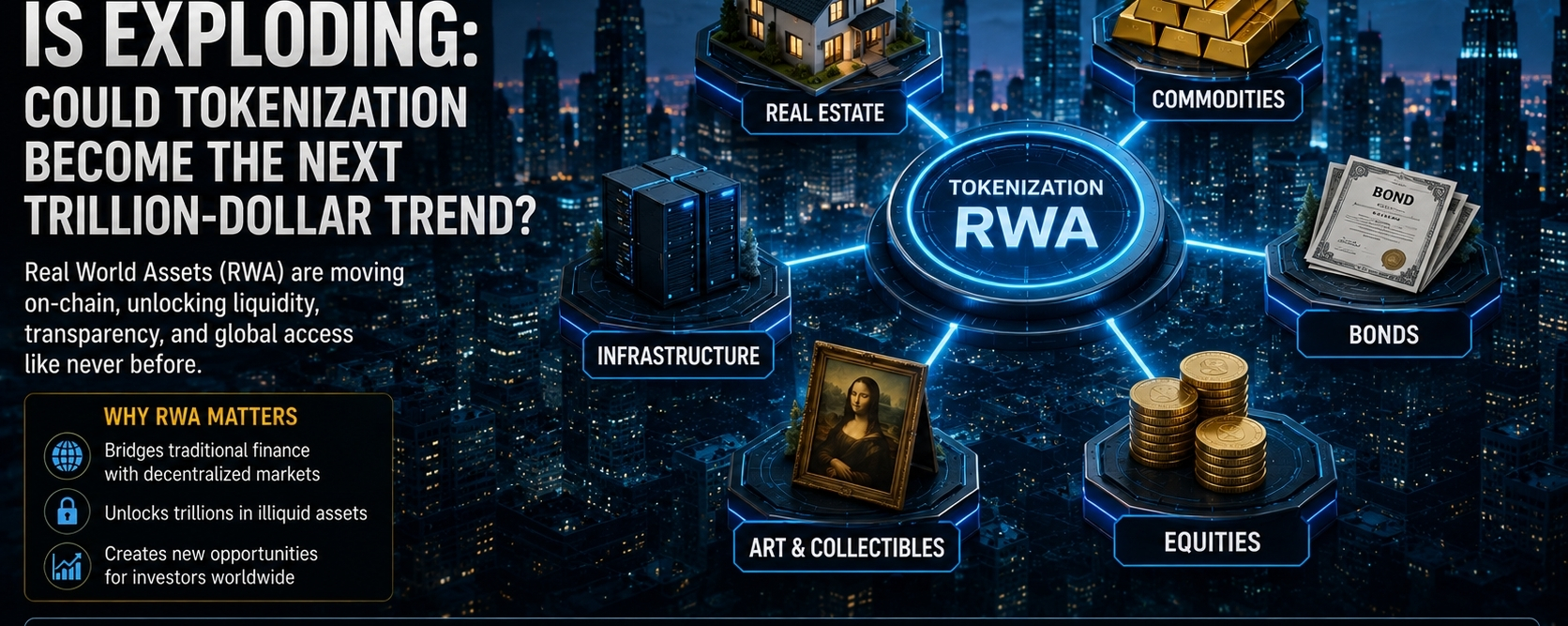
Tokenization is bringing traditional assets such as government bonds, funds, stocks, commodities and private credit onto blockchain networks. And in 2026, that trend is accelerating quickly.
So could RWA tokenization eventually become a trillion-dollar industry?
RWA Growth Is Accelerating
The numbers show how quickly the sector has expanded.
CoinGecko reported that tokenized RWAs grew from about $5.4 billion at the beginning of 2025 to $19.3 billion by the end of Q1 2026, an increase of more than 250%.
More recent measurements vary depending on which assets and networks are included. An August 2026 tokenization report placed distributed RWA value at roughly $38.3 billion, while academic research has estimated around $46 billion when additional private-credit assets are included.
The exact figure depends on methodology, but the direction is clear: more traditional financial assets are moving on-chain.
Wall Street Is Taking Tokenization Seriously
This isn't purely a crypto-native trend.
Large financial institutions are experimenting with tokenized funds, bonds and other financial products. Franklin Templeton, for example, launched a tokenized money-market fund as far back as 2021, and its Benji platform has since grown to nearly $1.5 billion in assets under management.
That matters because institutional participation could turn tokenization from an experimental blockchain use case into part of mainstream financial infrastructure.
Instead of blockchain competing with traditional finance, the two systems may increasingly begin connecting.
Tokenized Treasuries Are Leading the Charge
Government debt has become one of the strongest early use cases.
By the end of Q1 2026, tokenized Treasuries accounted for roughly 67% of the tracked tokenized RWA market in CoinGecko's dataset. Commodities were the second-largest category.
There is a simple reason for this.
Tokenization can potentially make traditional financial products easier to transfer, settle and integrate with blockchain-based applications.
And once investors become comfortable holding tokenized Treasuries, expanding the model toward stocks, funds, credit and other assets becomes much easier to imagine.
Tokenized Stocks Could Be the Next Big Battle
Stocks are another area worth watching closely.
Tokenized equities grew rapidly during 2025 and early 2026, reaching around $1.2 billion in active market capitalization according to DeFiLlama Research.
The bigger opportunity isn't simply putting a stock symbol on a blockchain.
The long-term vision involves financial markets where ownership, settlement and potentially collateral management can operate through blockchain infrastructure.
That could dramatically expand the addressable market for RWAs.
RWAs Are Entering DeFi
Perhaps the most important development is that tokenized assets aren't simply sitting inside wallets.
They're increasingly being used.
Deposits of tokenized RWAs into lending platforms and decentralized exchanges increased from approximately $2.3 billion in Q2 2025 to $7.4 billion in Q2 2026, according to research cited by The Block.
That could become a major turning point.
If tokenized Treasuries, funds and other traditional assets can increasingly function as collateral inside blockchain applications, RWAs become part of crypto's financial infrastructure rather than just digital representations of offline assets.
Ethereum Currently Holds a Major Lead
Several blockchains are competing for this market.
Ethereum remains the largest network for distributed tokenized RWAs. RWA.xyz data earlier in 2026 showed Ethereum holding more than half of tracked distributed RWA value, followed by networks including BNB Chain, Solana, Stellar and others.
That competition could become increasingly important.
If trillions of dollars eventually move on-chain, the networks providing settlement, liquidity, interoperability and infrastructure could potentially capture substantial activity.
Could RWA Really Become a Trillion-Dollar Market?
A trillion dollars sounds enormous compared with today's market.
But compared with global stocks, bonds, real estate and other traditional assets, it would still represent only a small fraction of the potential market.
Long-term forecasts vary dramatically. Research cited by Binance has previously discussed projections of roughly $16 trillion in tokenized assets by 2030, although such forecasts include broader definitions of tokenization and should not be treated as guaranteed outcomes.
More recent academic research similarly notes industry projections reaching as high as $18 trillion by 2033.
The important takeaway isn't whether those exact numbers will be reached.
It's the scale of the opportunity if even a small percentage of traditional finance moves onto blockchain infrastructure.
The RWA Trend Still Has Risks
Tokenization isn't guaranteed to grow smoothly.
Regulation, liquidity fragmentation, smart-contract risks, custody, legal ownership and differences between blockchain tokens and claims on underlying assets all remain important challenges.
Not every project carrying an “RWA” label will succeed either.
As with previous crypto narratives, hype could eventually run ahead of actual adoption.
The Bigger Picture
Bitcoin introduced digital scarcity. Ethereum introduced programmable finance.
Tokenization could become the bridge connecting blockchain with trillions of dollars of traditional assets.
The RWA market is still tiny compared with global finance, but its rapid growth and increasing institutional participation make it one of the most important crypto narratives to watch.
The trillion-dollar milestone may still be far away, but if tokenized funds, Treasuries, stocks, commodities and private credit continue expanding, the question could eventually change from “Will traditional assets move on-chain?” to “How much of traditional finance will remain off-chain?”
Could RWA become crypto's next trillion-dollar sector, or is the market getting ahead of itself?
This article is for informational purposes only and is not financial advice.