
Aria Bloom 阿莉娅
504 Publications
Aria Bloom 阿莉娅
Aria Bloom | Learning, growing, and exploring crypto with patience and purpose. Every step is progress 💞
Ouvert au trading
Trade fréquemment
1.5 an(s)
293 Suivis
8.6K+ Abonnés
3.4K+ J’aime
Publications
Portefeuille
Tous
Citations
PINNED
The journey isn’t always about numbers, markets, and targets. Sometimes, it’s about stepping away for a moment, enjoying the beauty of nature, and appreciating the peaceful moments that make life meaningful. ✨
A beautiful view, calm waters, and my little companion by my side. 🐱🤍
Simple moments, unforgettable memories.
Keep moving forward, stay positive, and enjoy every part of the journey. 🚀✨
$BTR $GIGGLE $SOL
A beautiful view, calm waters, and my little companion by my side. 🐱🤍
Simple moments, unforgettable memories.
Keep moving forward, stay positive, and enjoy every part of the journey. 🚀✨
$BTR $GIGGLE $SOL

😍

Ayan -X
·
--
🔥 Engage & Claim Your Reward!
Like ❤️ Comment 💬 Repost 🔄
Complete the tasks and claim your reward 🎁
Don’t miss out. Let’s support each other and grow together! 🚀
Like ❤️ Comment 💬 Repost 🔄
Complete the tasks and claim your reward 🎁
Don’t miss out. Let’s support each other and grow together! 🚀
😇

唯一 BRUCE
·
--
Haussier$TUT
$MELANIA
$ZEC #BankOfKoreaHikesRatesTo3%
#DollarPostsBiggestGainInNearlyFourWeeks
#NvidiaRises4%OnRevenueBeat
#XRPRallies44%InAWeek
#CryptoFearGreedIndexHits74
$MELANIA
$ZEC #BankOfKoreaHikesRatesTo3%
#DollarPostsBiggestGainInNearlyFourWeeks
#NvidiaRises4%OnRevenueBeat
#XRPRallies44%InAWeek
#CryptoFearGreedIndexHits74


😍

橙子Joyce
·
--
英偉達徹底化身「AI界央行」?
截至7月底,英偉達這家芯片製造商持有的上市公司和未上市公司股權價值已達到956億美元,而2020年初這一數字還不到1億美元。英偉達表示,其股權投資總額目前約爲990億美元。①英偉達憑藉人工智能熱潮發家致富,而如今,它也正「居中」助力這一浪潮的下一階段發展……②相比周三亮眼的利潤表數字,一些業內人士認爲,英偉達更大的變化可能正出現在其資產負債表上。面對如此驚人的資本擴張,英偉達首席執行官黃仁勳週三非但沒有任何隱憂,反而顯得從容不迫:「如果說我有什麼遺憾的話,那就是當時沒有對這些AI實驗室投得更多、更早。」而這些巨額股權投資,或許還只是英偉達更宏大資本棋局中的冰山一角……$英偉達 (NVDA.US)$首席財務官克雷斯指出,前沿AI實驗室對算力的渴望「呈爆發式增長」,但其「擴張速度已遠遠超出了它們自身資產負債表和信貸資質所能承載的極限」。通俗地說,這些增長最迅猛的英偉達核心客戶,急需成規模的AI基礎設施,但它們自身的財務狀況卻根本無力負擔如此昂貴的賬單。而英偉達正填補上這一缺口。這項資本扶持策略,正逐漸演變爲英偉達核心業務中舉足輕重的一環。克雷斯透露,到了明年,那些依靠英偉達資產負債表背書的AI實驗室,預計將爲公司貢獻約四分之一的業務份額。「資產負債表即服務」模式過去幾個月,華爾街投資者已開始頻繁將英偉達戲稱爲「AI界的中央銀行」。英偉達主導的循環融資「資產負債表即服務」(Balance-Sheet-as-a-Service)模式——即憑藉英偉達雄厚的財務底氣,源源不斷地爲客戶「輸血」,以維持它們高昂的採購支出。這種模式甚至已衍生出行業內罕見的——允許部分大客戶最長延遲一年支付數據中心採購款項的情況。根據週三公佈的業績,$英偉達 (NVDA.US)$的應收賬款(即客戶未結清的欠款)已陡增至631億美元,平均賬期也從之前的45天延長至了60天。不僅如此,英偉達還在以更直接的方式爲客戶「保駕護航」。對於部分AI雲服務提供商,英偉達爲其設定了最低收入擔保以協助其順利融資;而一旦客戶的實際收益突破這一底線,英偉達便能從中抽取分成。「在這個模式下,我們並不單單是在發放貸款,」我们信心滿滿地坦言,「在這種模式下我們可以獲得雙重收益:既賺取了前端的硬件銷售利潤,又能獲得來自租賃收入的分成。」週三的$英偉達 (NVDA.US)$業績還披露了高達1085億美元的擔保額度。其中絕大部分——即1050億美元——均緊密綁定於爲 OpenAI打造的SB Energy數據中心建設工程。需要澄清的是,這筆巨資並非英偉達眼下需要直接掏出的現金。隨着2029財年前後9座數據中心相繼上線,該擔保責任將分階段生效,並隨着OpenAI後續逐步結清欠款而相應遞減。與此同時,$英偉達 (NVDA.US)$還在積極引導更多外部資本注入這一建設熱潮。該公司透露,目前已與多家大型投資機構達成初步協議,意圖募集超過5000億美元的社會資本投向AI基礎設施建設。其思路很簡單:英偉達不願獨自承擔這場熱潮的全部成本,而是希望幫助這些項目更輕鬆地獲得融資。這與英偉達自身將人工智能基礎設施描述爲「可投資資產類別」的觀點相吻合。這一戰略順應了英偉達上一季度便已露端倪的趨勢:彼時該公司龐大的「造血機」就已經在同時爲AI交易的供需兩端注資。而眼下,各大科技巨頭也正日益依賴債務融資來硬撐這場AI大建設計劃。無論如何,英偉達當前的投資組合規模已大到足以影響其利潤,而其資產負債表本身,也正在演變爲AI基礎設施不可或缺的底層支柱。定期投資$英偉達 (NVDA.US)股票是一個非常好的策略,Come!$NVDAB
😇

Sonu7856
·
--
Ethereum (ETH) is one of the most important cryptocurrencies because it powers smart contracts and decentralized applications (dApps). Unlike digital currencies used only for payments, Ethereum enables developers to build DeFi platforms, NFTs, blockchain games, and other innovative services. ETH is also used to pay network transaction fees and secure the blockchain through staking, making it a key part of the growing Web3 ecosystem.
#ClaimYourReward #claimRedPacket #Ethereum #BinanceSquareFamily
#ClaimYourReward #claimRedPacket #Ethereum #BinanceSquareFamily
😍
crypto-MS
·
--
🎁 Red Envelope Alert — $SOL 🎁
Reply today for your chance to claim the red envelope! 🔥
🌹 Follow me, share this post, and spread the word.
Let’s grow together and catch the next opportunity! 🚀
Good luck everyone! ❤️#Crypto_Jobs🎯
Reply today for your chance to claim the red envelope! 🔥
🌹 Follow me, share this post, and spread the word.
Let’s grow together and catch the next opportunity! 🚀
Good luck everyone! ❤️#Crypto_Jobs🎯

😇

燕寶Melissa
·
--
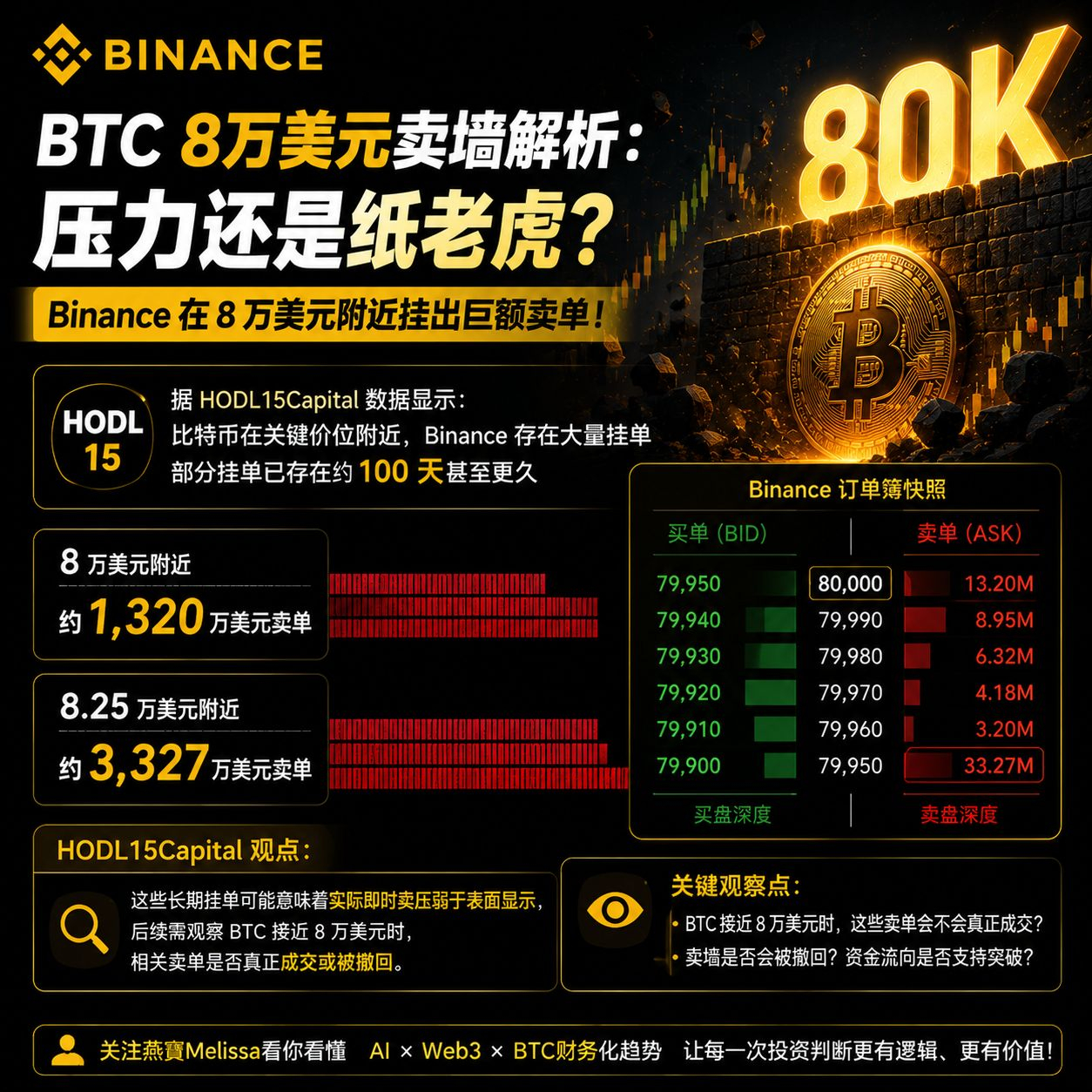
Baissier【BTC冲击8万美元关口,Binance卖墙藏着什么信号?】
比特币再次站在市场关注的关键位置。
据 HODL15Capital 数据显示:
📊 Binance 订单簿在 8万美元附近出现明显卖单压力:
🔸 8万美元附近:约 1320万美元卖单
🔸 8.25万美元附近:约 3327万美元卖单
更值得关注的是:
部分挂单已经存在 100天甚至更久。
这意味着什么?
表面看, 这些卖单像是一道“压力墙”。
但从另一个角度分析:
如果长期挂单始终没有成交, 它们也可能只是交易者设置的预期价位, 并不一定代表真实的即时抛压。
接下来市场重点观察:
📌 BTC接近8万美元时
这些卖单会不会真正成交?
📌 卖墙是否会被撤回?
📌 资金流向是否继续支持突破?
在加密市场中:
订单簿是情绪的体现, 成交量才是资金的选择。
真正的行情, 往往不是看哪里有墙, 而是看哪一方最终突破了墙。
8万美元, 可能不仅是价格关口, 更是市场多空力量的新博弈点。
#比特币64亿美元期权将到期
$BTC
$ETH
$BNB
比特币再次站在市场关注的关键位置。
据 HODL15Capital 数据显示:
📊 Binance 订单簿在 8万美元附近出现明显卖单压力:
🔸 8万美元附近:约 1320万美元卖单
🔸 8.25万美元附近:约 3327万美元卖单
更值得关注的是:
部分挂单已经存在 100天甚至更久。
这意味着什么?
表面看, 这些卖单像是一道“压力墙”。
但从另一个角度分析:
如果长期挂单始终没有成交, 它们也可能只是交易者设置的预期价位, 并不一定代表真实的即时抛压。
接下来市场重点观察:
📌 BTC接近8万美元时
这些卖单会不会真正成交?
📌 卖墙是否会被撤回?
📌 资金流向是否继续支持突破?
在加密市场中:
订单簿是情绪的体现, 成交量才是资金的选择。
真正的行情, 往往不是看哪里有墙, 而是看哪一方最终突破了墙。
8万美元, 可能不仅是价格关口, 更是市场多空力量的新博弈点。
#比特币64亿美元期权将到期
$BTC
$ETH
$BNB
😇

JANNAT BM_
·
--
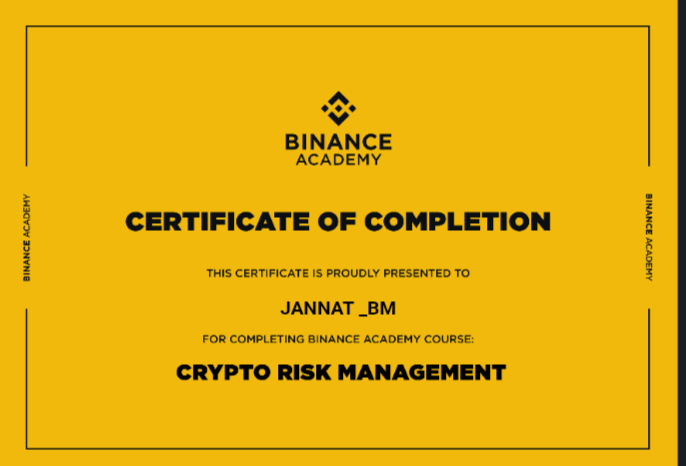
Thank you #Binance 💛
My first certificate form @Binance Academy 💛💛💛
My first certificate form @Binance Academy 💛💛💛
😍
CoinVision110
·
--
claim reward 🛄🛄🛄🥰😍😍😍😍
follow support
and please must repost and share among friends for support
#DollarPostsBiggestGainInNearlyFourWeeks
follow support
and please must repost and share among friends for support
#DollarPostsBiggestGainInNearlyFourWeeks
😍

Shaheen 69
·
--
🎁 A Little Red Packet Surprise for My Amazing Followers! 🧧
You’ve supported, liked, commented, and shared my content throughout the journey — and now it’s time to give something back! ❤️
I’m sending out a Red Packet Gift as a small thank-you to my amazing community. 🧧✨
Keep following, stay active, and don’t miss the drop — you never know when the next surprise will arrive! 👀🔥
Your support means more than numbers on a screen. Every follower is part of this journey, and I truly appreciate you. 🙏
Good luck everyone! 🍀 May your Red Packet bring you a little extra happiness today! 🚀🧧
Stay connected. Stay active. Stay winning! 💎
$TUT
$BEAMX
You’ve supported, liked, commented, and shared my content throughout the journey — and now it’s time to give something back! ❤️
I’m sending out a Red Packet Gift as a small thank-you to my amazing community. 🧧✨
Keep following, stay active, and don’t miss the drop — you never know when the next surprise will arrive! 👀🔥
Your support means more than numbers on a screen. Every follower is part of this journey, and I truly appreciate you. 🙏
Good luck everyone! 🍀 May your Red Packet bring you a little extra happiness today! 🚀🧧
Stay connected. Stay active. Stay winning! 💎
$TUT
$BEAMX

😍

NAJAF_加密 143
·
--
BNB is showing strong momentum as the broader crypto market turns bullish. BNB recently climbed to around $670, gaining more than 10% over just a few days. Bitcoin’s strong weekly rally and improving market sentiment are also supporting altcoins. BNB’s utility across the Binance ecosystem remains a key fundamental strength. The market still carries volatility, so traders should watch resistance near recent highs and manage risk carefully.
#BNB #Binance #Crypto #BNBChain #Bitcoin
#BNB #Binance #Crypto #BNBChain #Bitcoin

😍

⁰MR RAJ⁰
·
--
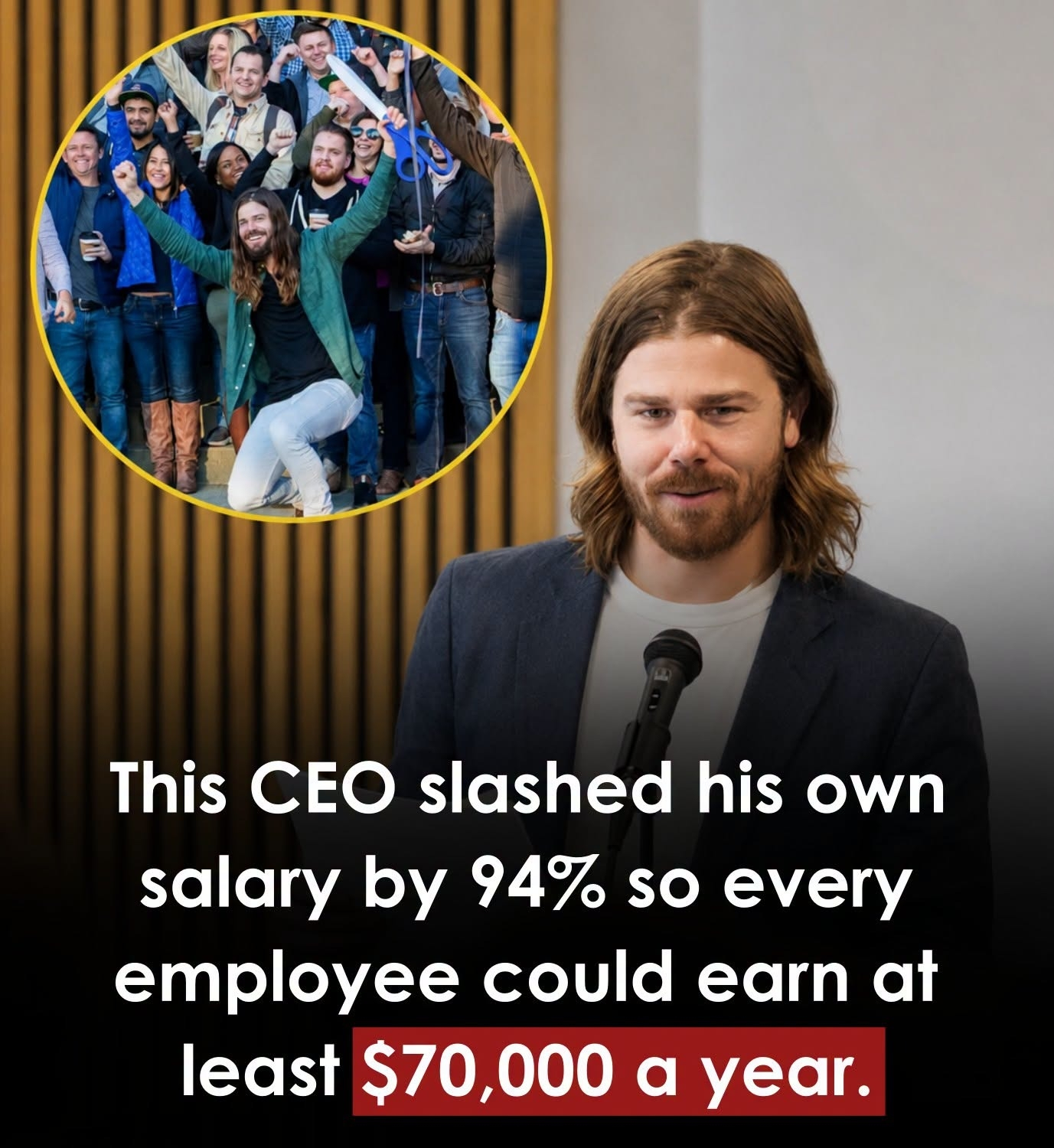
Haussier💰 In 2015, Gravity Payments CEO Dan Price made headlines by cutting his own salary from about $1 million to $70,000 — a roughly 94% reduction. He used the move to help raise the company’s minimum salary to $70,000 for employees.
❤️🏢 Price said the decision was about giving his Seattle-based team greater financial stability, after seeing employees struggle with rising living costs. The move sparked a huge debate about CEO pay and fair wages.
$DUSK $RIVER $POWER
#XRPRallies44%InAWeek #IranSaysHormuzOmanDealNotFinalized #SECSendsCryptoCustodyRuleToWhiteHouse #CryptoFearGreedIndexHits74 #USBitcoinETFsExtendInflowsToSixthDay
❤️🏢 Price said the decision was about giving his Seattle-based team greater financial stability, after seeing employees struggle with rising living costs. The move sparked a huge debate about CEO pay and fair wages.
$DUSK $RIVER $POWER
#XRPRallies44%InAWeek #IranSaysHormuzOmanDealNotFinalized #SECSendsCryptoCustodyRuleToWhiteHouse #CryptoFearGreedIndexHits74 #USBitcoinETFsExtendInflowsToSixthDay
😍

Sara_ k
·
--
click here 👈
.
.
$BNB $GIGGLE $AMZN
Join & claim web3 benefits 🌹👈
.
.
$BNB $GIGGLE $AMZN
Join & claim web3 benefits 🌹👈
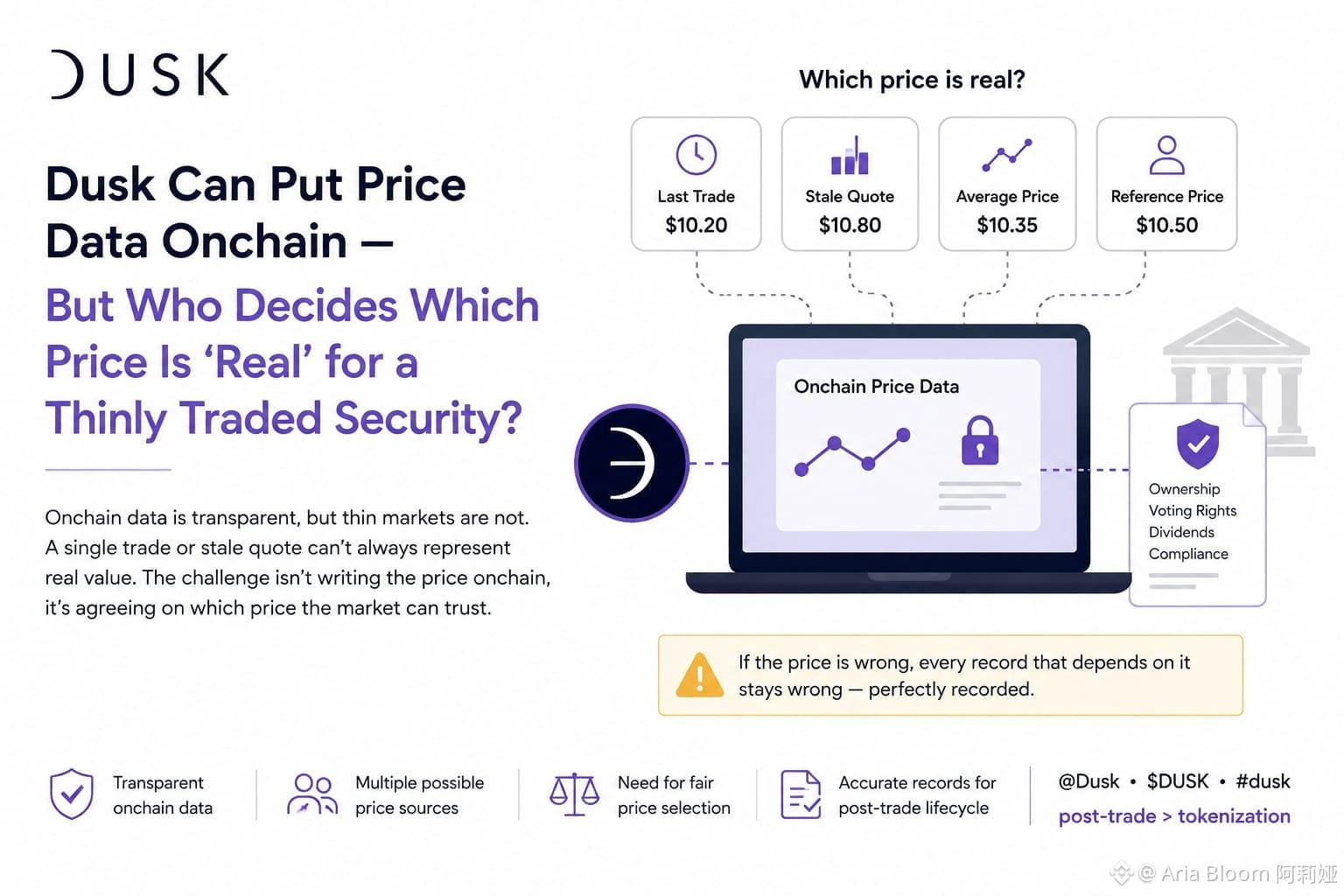
I’ve been thinking about Dusk’s onchain price data a bit differently lately. Putting a price onchain sounds straightforward until I imagine a security that barely trades. If it moves once every few days which price actually represents the market? The last trade? A stale quote? An average? Or some reference value agreed by the system?
That matters because tokenization doesn’t automatically make the underlying asset more measurable. The chain can preserve a number very accurately but it can’t decide by itself whether that number still reflects reality. For a thinly traded security a single small transaction could look meaningful even when it tells us very little about what another buyer would actually pay.
I think this is where Dusk’s post-trade focus gets more interesting to me. The source material makes the point that the hard part is keeping records correct after trading including rights payments and compliance. But there’s another dependency sitting underneath those records: the inputs have to be trustworthy in the first place. If eligibility or valuation eventually depends on price data.
bad inputs can stay perfectly recorded onchain.
I’d want to see how Dusk handles stale or disputed prices in practice. Who gets the final say when the market itself barely speaks?
#dusk $DUSK @Dusk
That matters because tokenization doesn’t automatically make the underlying asset more measurable. The chain can preserve a number very accurately but it can’t decide by itself whether that number still reflects reality. For a thinly traded security a single small transaction could look meaningful even when it tells us very little about what another buyer would actually pay.
I think this is where Dusk’s post-trade focus gets more interesting to me. The source material makes the point that the hard part is keeping records correct after trading including rights payments and compliance. But there’s another dependency sitting underneath those records: the inputs have to be trustworthy in the first place. If eligibility or valuation eventually depends on price data.
bad inputs can stay perfectly recorded onchain.
I’d want to see how Dusk handles stale or disputed prices in practice. Who gets the final say when the market itself barely speaks?
#dusk $DUSK @Dusk
#dusk $DUSK @Dusk
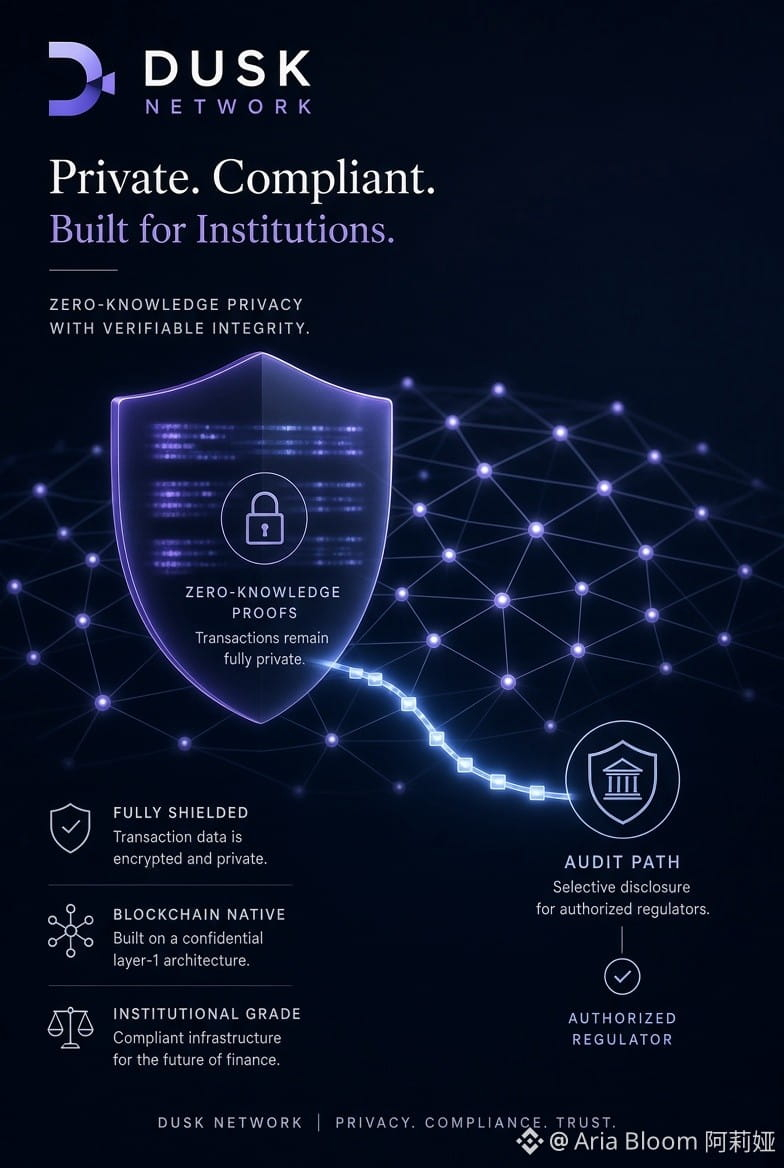
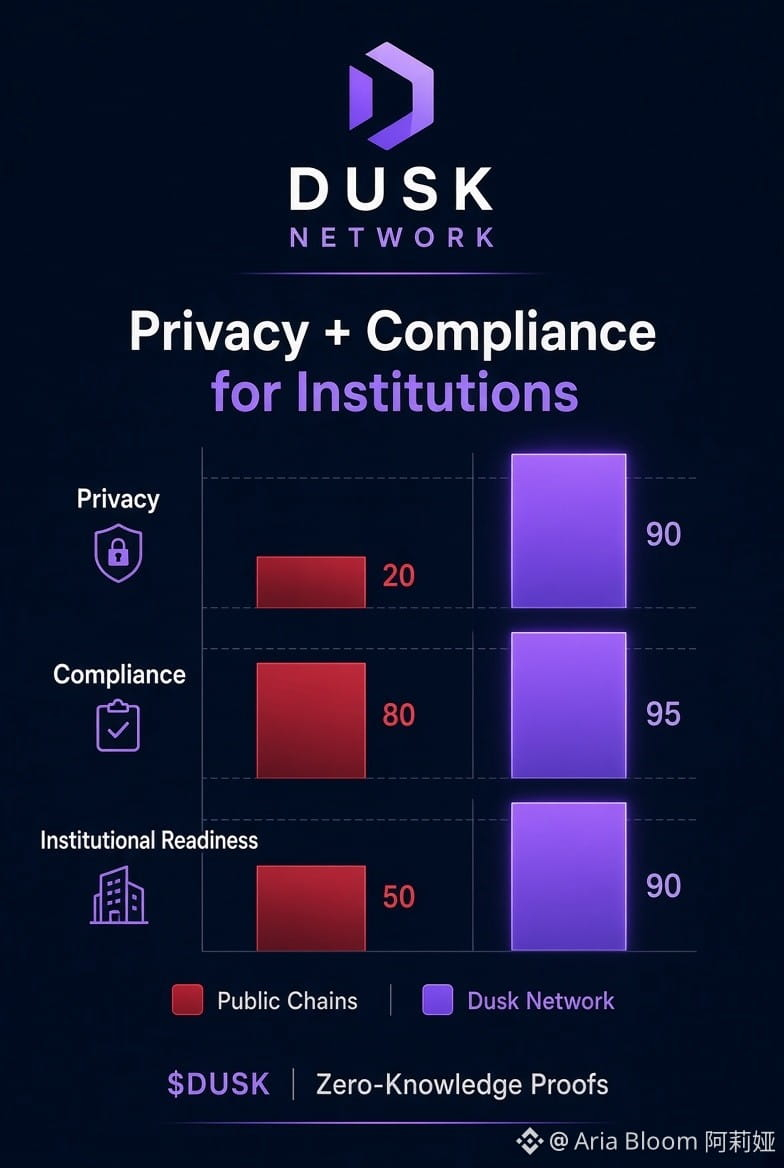
Dusk’s approach feels genuinely refreshing in crypto.
On most chains, every transaction is fully public amounts, parties, everything. Institutions hate this. They need privacy, yet regulators still demand full audit trails. It’s a hard conflict.
Dusk solves it cleanly. Their system separates transaction truth from transaction disclosure Using zero-knowledge proofs, the network can verify that a transaction is valid, rules were followed, and balances check out without revealing the actual details.
Only authorized parties and regulators can see the real data. Everyone else just sees confirmation that it’s legitimate.
That’s why Dusk is becoming a serious contender for real-world assets and regulated finance. Privacy and compliance finally work together.
For institutions, this removes a major barrier. Public chains no longer feel like such a risk.
They’re quietly building something that actually solves a real problem. Worth watching.
Dusk’s approach feels genuinely refreshing in crypto.
On most chains, every transaction is fully public amounts, parties, everything. Institutions hate this. They need privacy, yet regulators still demand full audit trails. It’s a hard conflict.
Dusk solves it cleanly. Their system separates transaction truth from transaction disclosure Using zero-knowledge proofs, the network can verify that a transaction is valid, rules were followed, and balances check out without revealing the actual details.
Only authorized parties and regulators can see the real data. Everyone else just sees confirmation that it’s legitimate.
That’s why Dusk is becoming a serious contender for real-world assets and regulated finance. Privacy and compliance finally work together.
For institutions, this removes a major barrier. Public chains no longer feel like such a risk.
They’re quietly building something that actually solves a real problem. Worth watching.
Night by the sea, soft lights, and a little peace in the air 🌊
Just me, the waves, and this quiet moment.
Ocean breeze, string lights, and a soft smile ✨
Sometimes the best nights are the quiet ones.
Sea, lights, aur thodi si sukoon 🌊
Bas yahi moment feel kar rahi hun.
Night vibes only 🌙🌊
Soft lights, soft smile.
Where the waves meet the lights and everything feels a little softer $DUSK #BTC
Just me, the waves, and this quiet moment.
Ocean breeze, string lights, and a soft smile ✨
Sometimes the best nights are the quiet ones.
Sea, lights, aur thodi si sukoon 🌊
Bas yahi moment feel kar rahi hun.
Night vibes only 🌙🌊
Soft lights, soft smile.
Where the waves meet the lights and everything feels a little softer $DUSK #BTC

Sometimes the best moments are the simplest ones ☕🌹✨
A peaceful moment, a warm cup of coffee, and a little beauty in the day. ❤️
$DUSK $BTC
A peaceful moment, a warm cup of coffee, and a little beauty in the day. ❤️
$DUSK $BTC

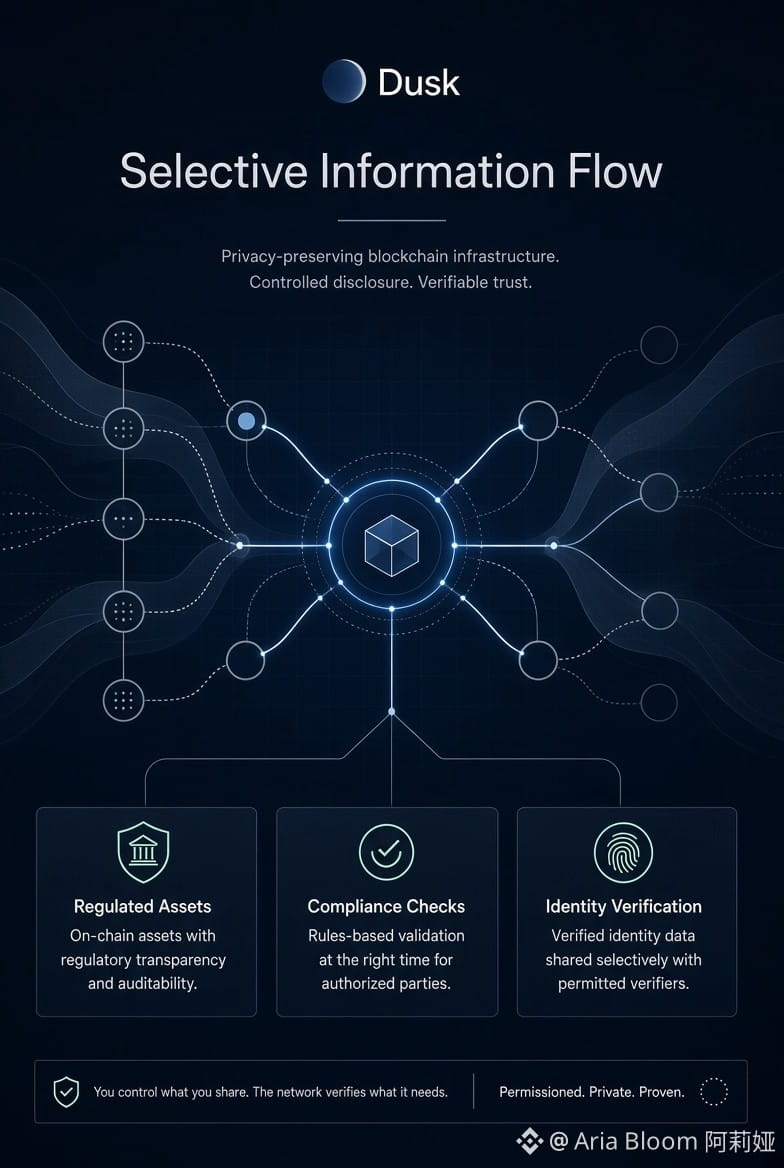
I’ve started thinking about Dusk’s privacy model less as hiding transactions and more as controlling how information moves.
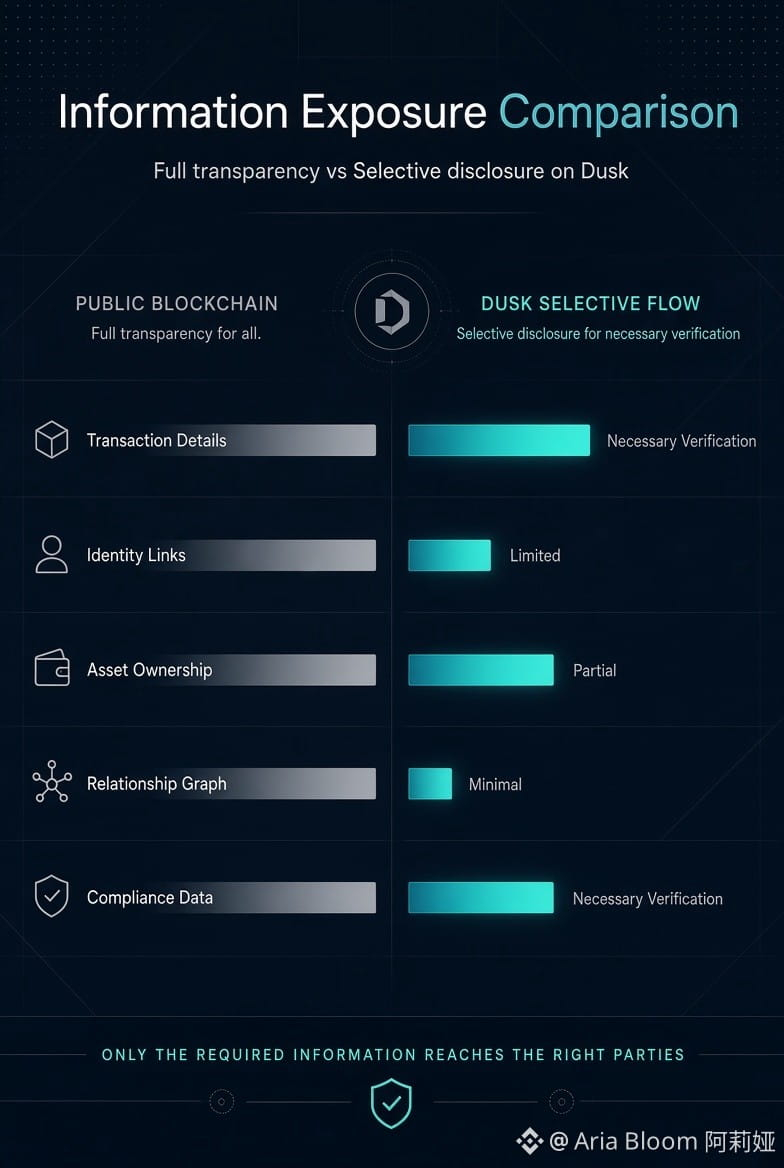
That distinction matters. On a public blockchain the problem isn’t only that data is visible. It’s that small pieces of visible information can be connected over time. A transaction an identity check, an asset transfer or a relationship between addresses can become part of a much larger picture.
What interests me about @Dusk is the idea that privacy can be designed around selective information flow instead. The goal isn’t necessarily to make everything invisible. It’s to let the network verify what actually needs to be verified without automatically exposing everything surrounding it.
That feels particularly important for regulated assets. Institutions may need to prove compliance, ownership, eligibility, or transaction validity, but that doesn’t mean every participant should receive the full underlying dataset.
The difficult part is getting the balance right. Too much transparency creates unnecessary exposure. Too much privacy can make verification and compliance harder.
For me, that’s where $DUSK becomes interesting. The real question isn’t simply whether a transaction is private. It’s who gets to learn what, when they learn it, and why that information is necessary.
That’s a much more useful way to think about blockchain privacy.
#dusk $DUSK @Dusk
That distinction matters. On a public blockchain the problem isn’t only that data is visible. It’s that small pieces of visible information can be connected over time. A transaction an identity check, an asset transfer or a relationship between addresses can become part of a much larger picture.
What interests me about @Dusk is the idea that privacy can be designed around selective information flow instead. The goal isn’t necessarily to make everything invisible. It’s to let the network verify what actually needs to be verified without automatically exposing everything surrounding it.
That feels particularly important for regulated assets. Institutions may need to prove compliance, ownership, eligibility, or transaction validity, but that doesn’t mean every participant should receive the full underlying dataset.
The difficult part is getting the balance right. Too much transparency creates unnecessary exposure. Too much privacy can make verification and compliance harder.
For me, that’s where $DUSK becomes interesting. The real question isn’t simply whether a transaction is private. It’s who gets to learn what, when they learn it, and why that information is necessary.
That’s a much more useful way to think about blockchain privacy.
#dusk $DUSK @Dusk
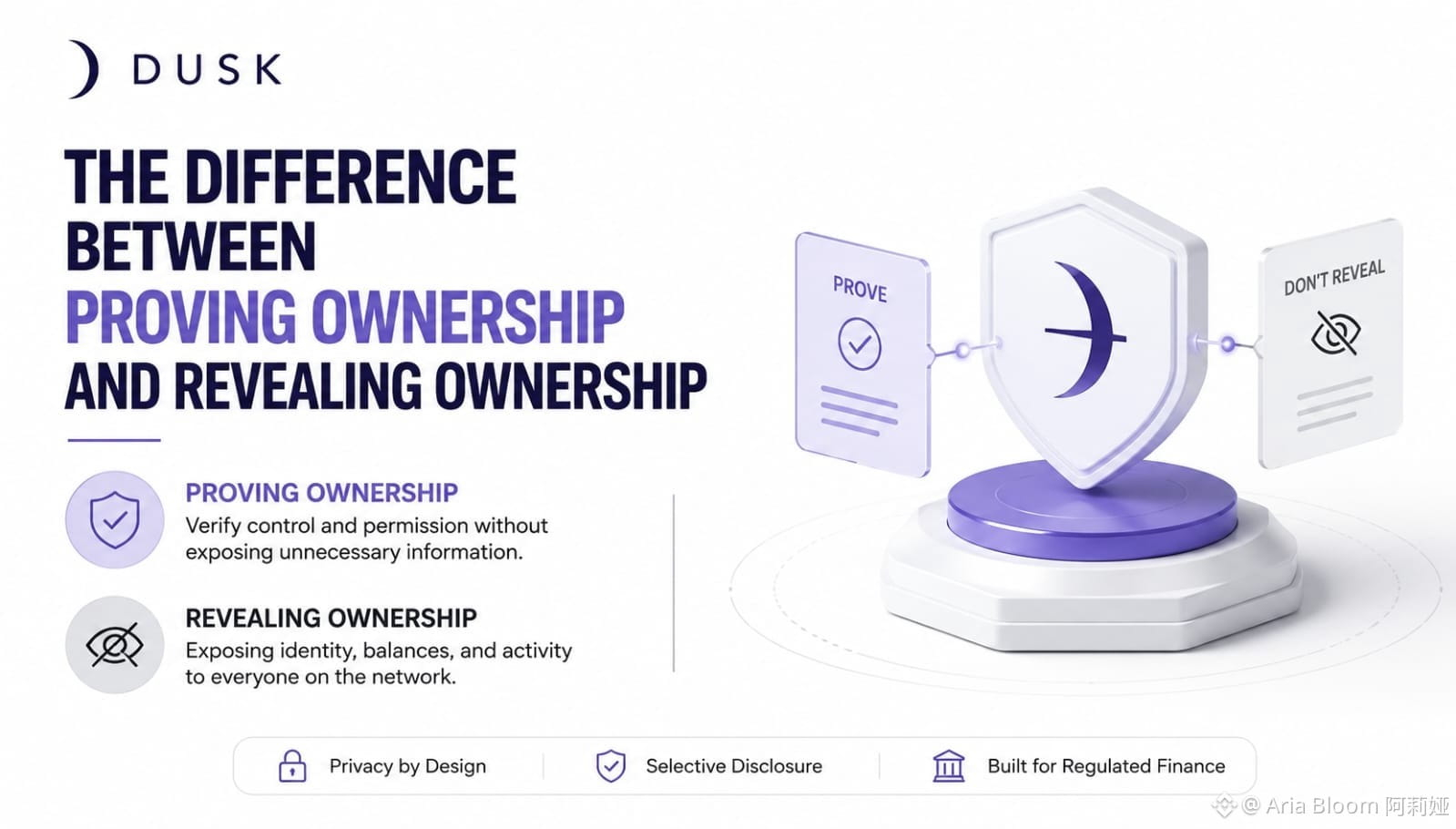
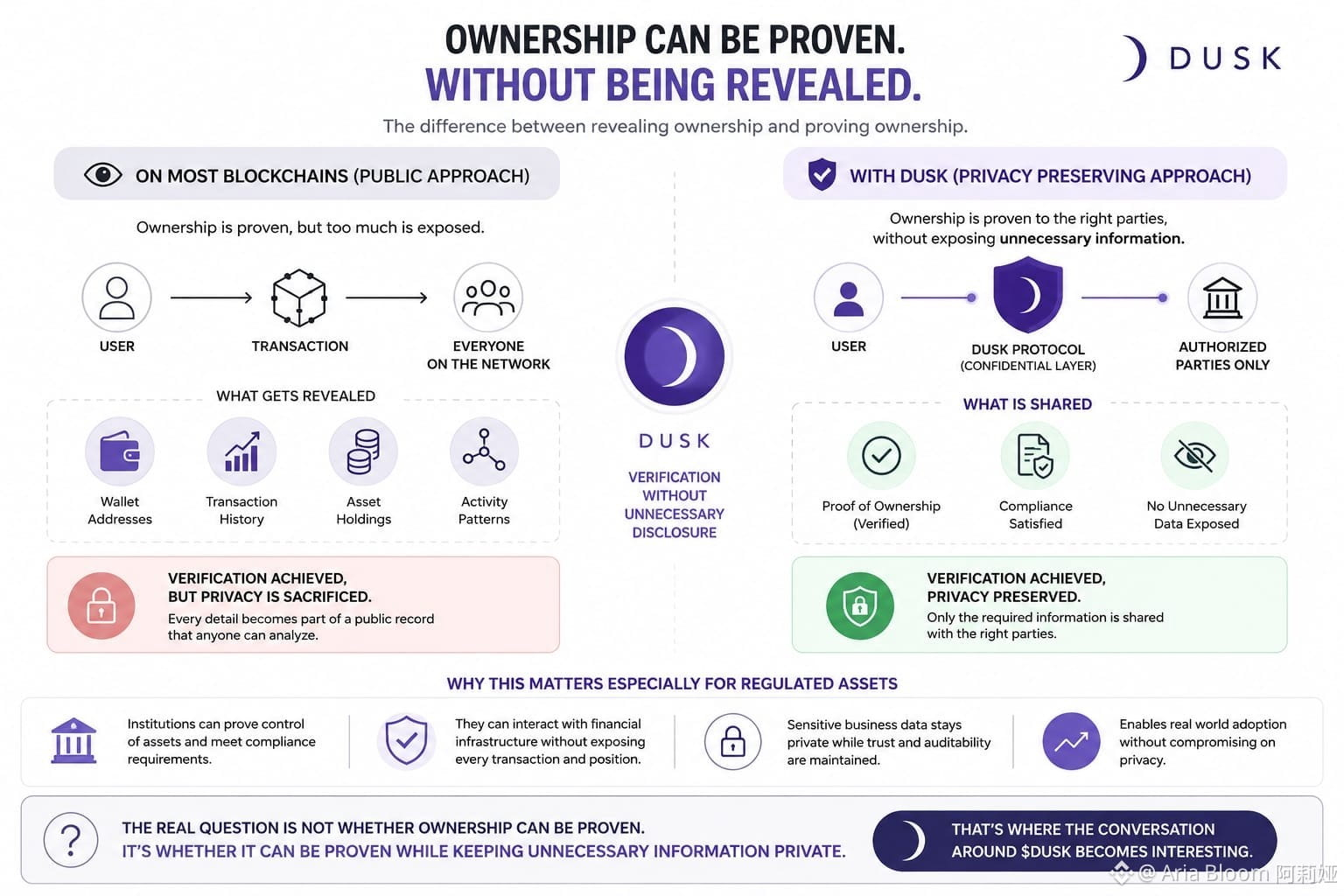
I think one of the biggest misconceptions in crypto is that ownership always has to be visible in order to be trusted.
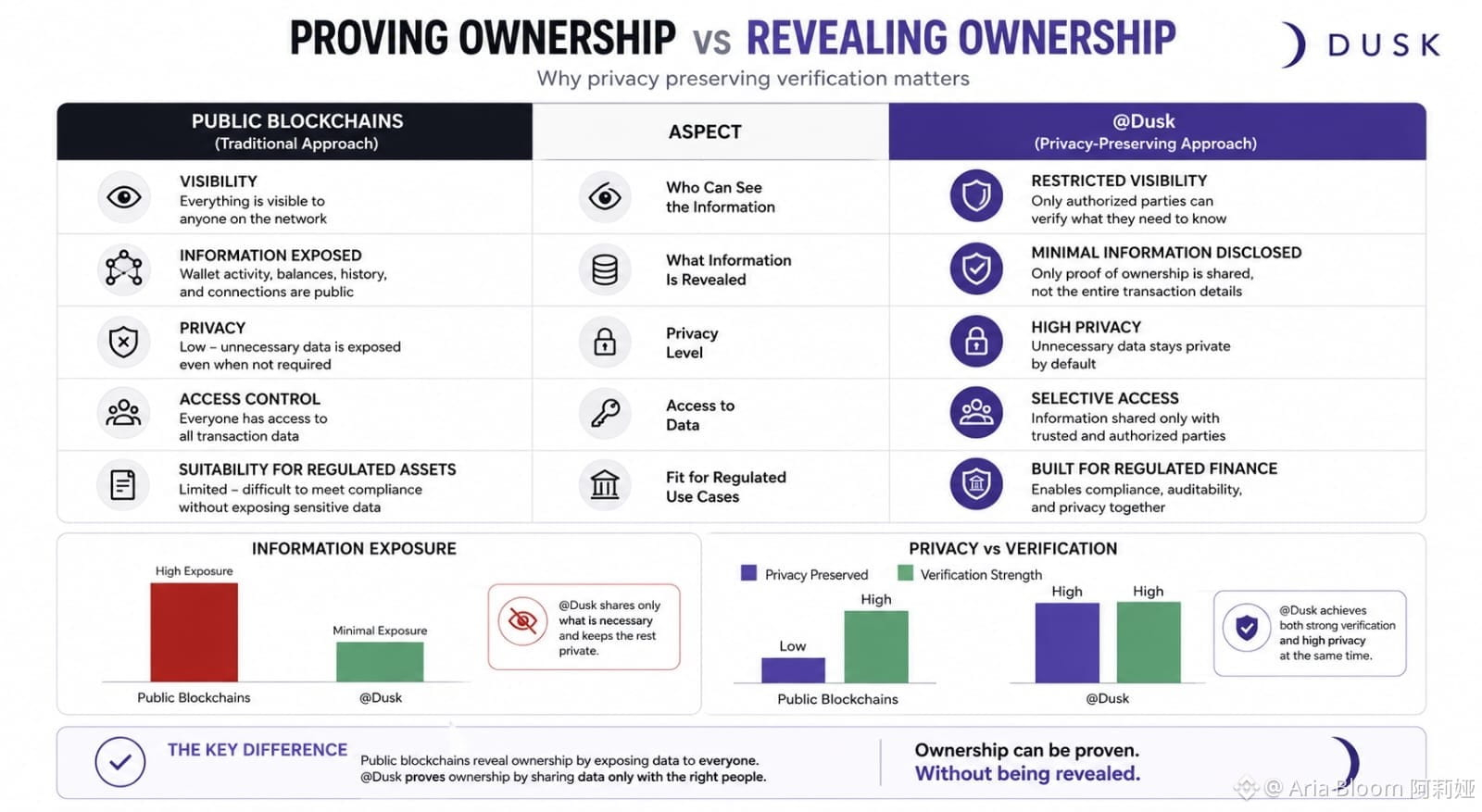
When someone proves ownership on most blockchains they often reveal much more than necessary. Wallet activity asset holdings and transaction history can become part of a public record that anyone can analyze. Verification is achieved but privacy is sacrificed along the way.
What caught my attention about @Dusk is the different approach. The goal is not to hide ownership from those who need to verify it. The goal is to allow verification without turning every detail into public information.
That distinction becomes more interesting when thinking about regulated assets. Businesses and institutions may need to prove control satisfy compliance requirements and interact with financial infrastructure but they may not want every movement and position exposed to the entire network.
To me the future question is not whether ownership can be proven. Blockchain already solved that. The more important question is whether ownership can be proven while keeping unnecessary information private.
That is where the conversation around becomes interesting.
#dusk $DUSK @Dusk
When someone proves ownership on most blockchains they often reveal much more than necessary. Wallet activity asset holdings and transaction history can become part of a public record that anyone can analyze. Verification is achieved but privacy is sacrificed along the way.
What caught my attention about @Dusk is the different approach. The goal is not to hide ownership from those who need to verify it. The goal is to allow verification without turning every detail into public information.
That distinction becomes more interesting when thinking about regulated assets. Businesses and institutions may need to prove control satisfy compliance requirements and interact with financial infrastructure but they may not want every movement and position exposed to the entire network.
To me the future question is not whether ownership can be proven. Blockchain already solved that. The more important question is whether ownership can be proven while keeping unnecessary information private.
That is where the conversation around becomes interesting.
#dusk $DUSK @Dusk
Vérifié
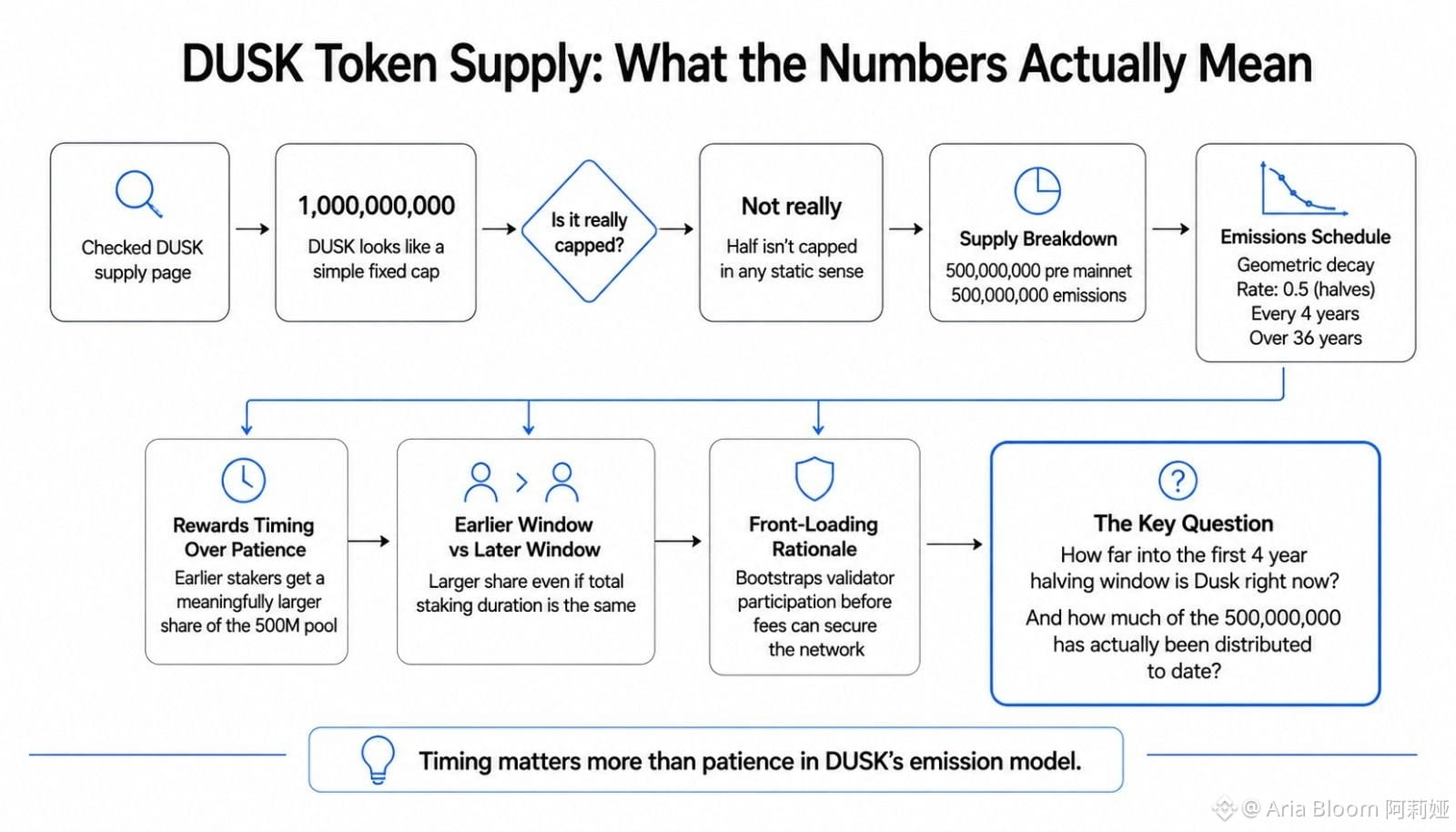
I checked DUSK's supply page expecting a simple fixed cap 1,000,000,000 DUSK looked like exactly that at first glance.
The figure alone is weak here since half of it isn't really capped in any static sense 500,000,000 DUSK already exists from the pre mainnet supply.The remaining 500,000,000 gets released through a geometric decay schedule with a reduction rate of 0.5.It halves every 4 years across a full 36 year emission window rather than arriving all at once.
That structure quietly rewards timing more than patience alone,a provisioner staking during an earlier 4 year window collects a meaningfully larger share of that 500,000,000 pool than one joining after several halvings have already passed.That holds even if both eventually stake for the same total number of years.
Front loading emissions this way is a reasonable design choicen it helps bootstrap validator participation before transaction fees alone could sustain network security.
Which raises a specific question nobody seems to track publicly how far into that first 4 year halving window is Dusk right now?And how much of the 500,000,000 has actually been distributed to date?
#dusk $DUSK @Dusk
The figure alone is weak here since half of it isn't really capped in any static sense 500,000,000 DUSK already exists from the pre mainnet supply.The remaining 500,000,000 gets released through a geometric decay schedule with a reduction rate of 0.5.It halves every 4 years across a full 36 year emission window rather than arriving all at once.
That structure quietly rewards timing more than patience alone,a provisioner staking during an earlier 4 year window collects a meaningfully larger share of that 500,000,000 pool than one joining after several halvings have already passed.That holds even if both eventually stake for the same total number of years.
Front loading emissions this way is a reasonable design choicen it helps bootstrap validator participation before transaction fees alone could sustain network security.
Which raises a specific question nobody seems to track publicly how far into that first 4 year halving window is Dusk right now?And how much of the 500,000,000 has actually been distributed to date?
#dusk $DUSK @Dusk
Connectez-vous pour découvrir plus de contenu