
#dusk @Dusk
I’ve been thinking about where finance is actually heading, and I don’t think the future will be completely private or completely public.
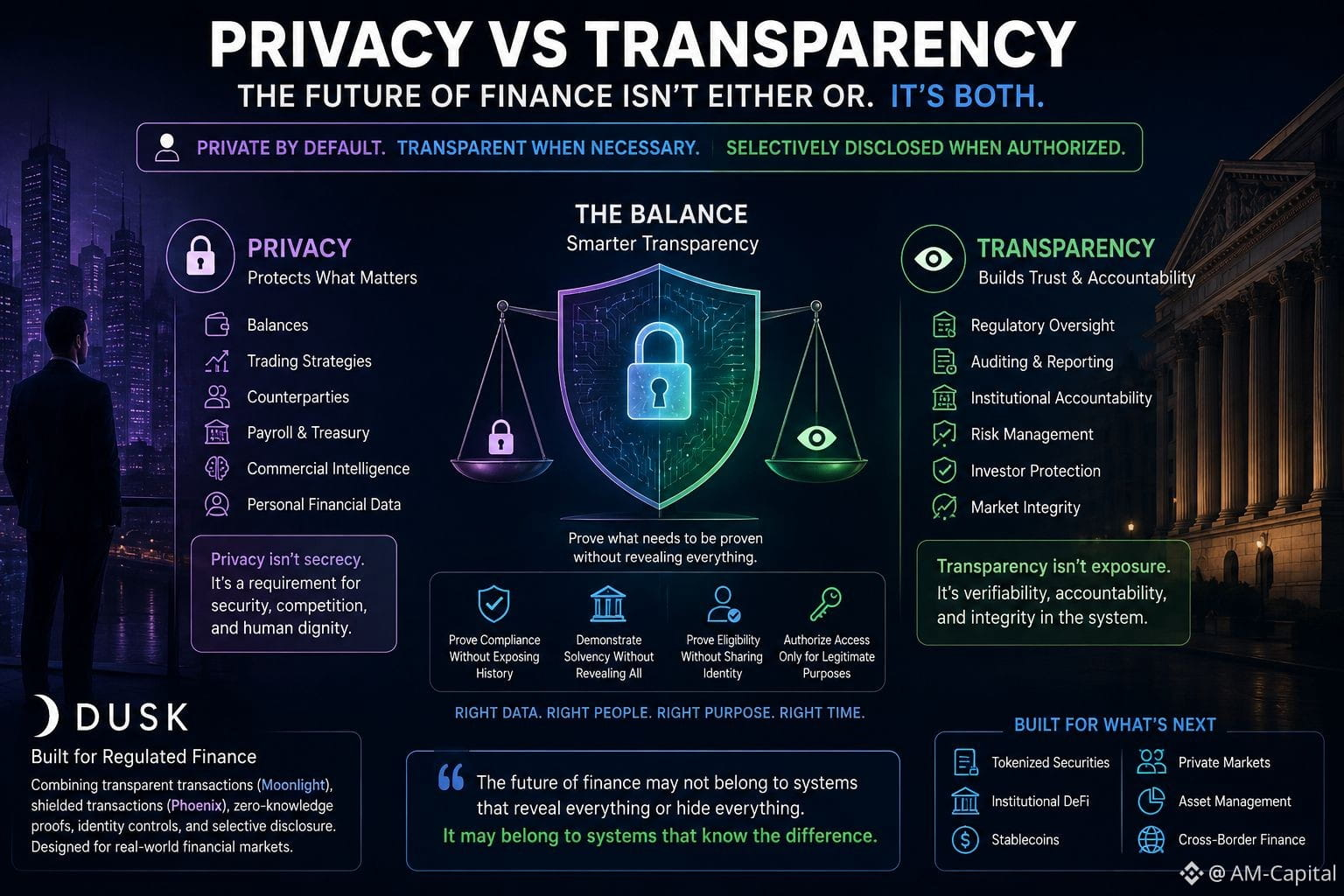
From what I’ve observed, real financial systems need both. Businesses need privacy around balances, strategies, counterparties, and sensitive transactions. At the same time, regulators, auditors, and investors need enough transparency to verify what’s happening.
That’s why I think the stronger model is private by default, transparent when necessary, and selectively disclosed when authorized.
What interests me about $DUSK is how its architecture reflects this idea. Instead of treating privacy and compliance as opposites, it combines transparent and shielded transactions with zero-knowledge technology and selective disclosure.
To me, that’s a more realistic direction for institutional finance.
The goal shouldn’t be to hide everything. It shouldn’t be to expose everything either.
It should be about proving what matters without unnecessarily revealing everything else.
I think that’s where blockchain gets more mature: moving from “show me everything” to “prove what I need to know.”
The future of finance may not be radical transparency.
It may be controlled, intelligent transparency.
I’ve been thinking about where finance is actually heading, and I don’t think the future will be completely private or completely public.
From what I’ve observed, real financial systems need both. Businesses need privacy around balances, strategies, counterparties, and sensitive transactions. At the same time, regulators, auditors, and investors need enough transparency to verify what’s happening.
That’s why I think the stronger model is private by default, transparent when necessary, and selectively disclosed when authorized.
What interests me about $DUSK is how its architecture reflects this idea. Instead of treating privacy and compliance as opposites, it combines transparent and shielded transactions with zero-knowledge technology and selective disclosure.
To me, that’s a more realistic direction for institutional finance.
The goal shouldn’t be to hide everything. It shouldn’t be to expose everything either.
It should be about proving what matters without unnecessarily revealing everything else.
I think that’s where blockchain gets more mature: moving from “show me everything” to “prove what I need to know.”
The future of finance may not be radical transparency.
It may be controlled, intelligent transparency.