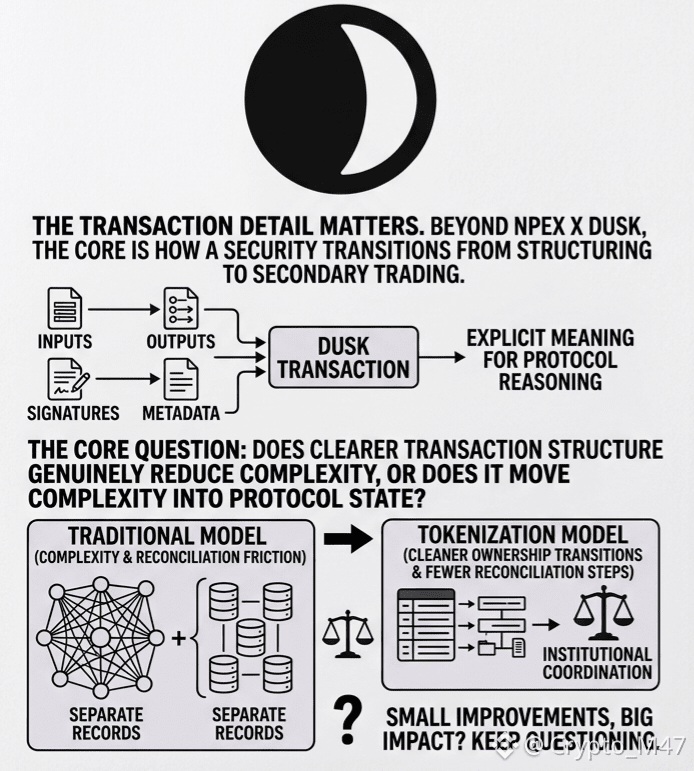

I’ve been digging into Dusk again😊, and I keep finding myself stuck on a detail that initially seemed almost boring: the transaction itself. I started with the bigger NPEX × Dusk picture, but eventually my attention moved to what happens underneath the headline. A security can pass through structuring, investor onboarding, issuance , settlement, servicing , and secondary trading, often across different systems. The more I think about it, the more I wonder whether the real friction is simply the repeated need to make separate records agree.
That’s where Dusk’s transaction design caught my attention. Inputs, outputs, signatures, metadata these aren’t just fields in a format. They define what the protocol can actually see and reason about. If the transaction carries its meaning explicitly, validation becomes easier to inspect. I like that idea, but I don’t want to stop there.
Because explicitness has a cost. Every additional piece of information becomes something the network must process, preserve, and keep consistent. So I keep asking myself: does clearer transaction structure genuinely reduce complexity, or does it sometimes move that complexity into protocol state?
The same question follows me back to NPEX. Tokenization alone doesn’t create liquidity, remove KYC, replace custodians, or make regulation disappear. Maybe the useful part is much less dramatic: fewer reconciliation steps, cleaner ownership transitions, and better coordination between institutions.
I’m still unsure whether those small improvements can compound into something meaningful. For me, that uncertainty is the interesting part and I’d rather keep questioning it than pretend I already know the answer.
#dusk $DUSK @Dusk
$BMT
$BTR
That’s where Dusk’s transaction design caught my attention. Inputs, outputs, signatures, metadata these aren’t just fields in a format. They define what the protocol can actually see and reason about. If the transaction carries its meaning explicitly, validation becomes easier to inspect. I like that idea, but I don’t want to stop there.
Because explicitness has a cost. Every additional piece of information becomes something the network must process, preserve, and keep consistent. So I keep asking myself: does clearer transaction structure genuinely reduce complexity, or does it sometimes move that complexity into protocol state?
The same question follows me back to NPEX. Tokenization alone doesn’t create liquidity, remove KYC, replace custodians, or make regulation disappear. Maybe the useful part is much less dramatic: fewer reconciliation steps, cleaner ownership transitions, and better coordination between institutions.
I’m still unsure whether those small improvements can compound into something meaningful. For me, that uncertainty is the interesting part and I’d rather keep questioning it than pretend I already know the answer.
#dusk $DUSK @Dusk
$BMT
$BTR