
#dusk $DUSK @Dusk ............ I expected wallet security issues to come from something complex. While researching Dusk, I kept finding the opposite: tiny details can create much bigger consequences.....
Think of a bridge memo like a delivery label. The transaction can succeed, but if the label is missing or points to the wrong BSC address, the bridge cannot route the DUSK correctly.
That's why Dusk's BEP20 flow caught my attention....
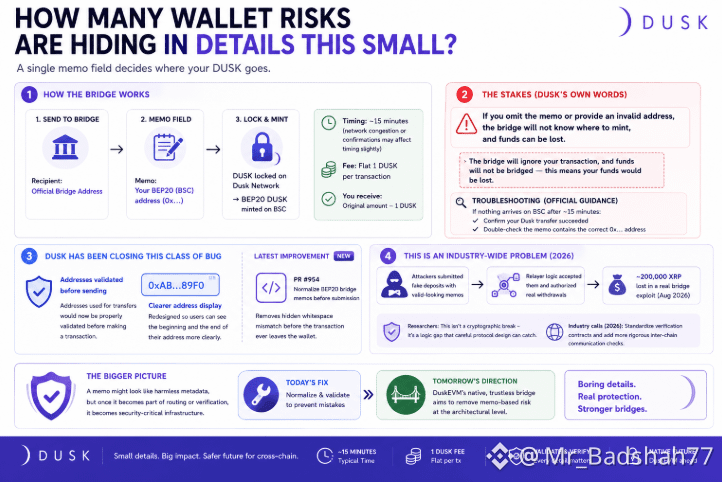
You send DUSK to the official bridge account, then place your BSC wallet address in the Memo field. The bridge deducts a flat 1 DUSK fee, and current official docs say processing normally takes around one hour.
It went deeper..................
Dusk explicitly warns that a missing or invalid memo can make a transfer unrecoverable. The wallet has also historically added address validation and redesigned address displays so users can better verify the beginning and end of an address.
And now the Web Wallet is going further....
Public GitHub activity shows PR #954, “Normalize BEP20 bridge memos before submission,” reaching ready_for_review. The goal is to remove whitespace-related mismatch before the bridge transaction is submitted.....
That last detail caught my attention..
This isn't only a Dusk problem. On August 9, another bridge lost nearly 200,000 XRP after relayer logic accepted fake deposits because it relied on memo data without properly verifying the destination..
Different bridge, different bug, same lesson....
A memo may look like harmless metadata, but once it becomes part of routing or verification, it becomes security-critical infrastructure.
For a network handling real-value settlement, how many “small” wallet details should be treated as security boundaries before users ever notice them?....
$BMT $EDEN
Think of a bridge memo like a delivery label. The transaction can succeed, but if the label is missing or points to the wrong BSC address, the bridge cannot route the DUSK correctly.
That's why Dusk's BEP20 flow caught my attention....
You send DUSK to the official bridge account, then place your BSC wallet address in the Memo field. The bridge deducts a flat 1 DUSK fee, and current official docs say processing normally takes around one hour.
It went deeper..................
Dusk explicitly warns that a missing or invalid memo can make a transfer unrecoverable. The wallet has also historically added address validation and redesigned address displays so users can better verify the beginning and end of an address.
And now the Web Wallet is going further....
Public GitHub activity shows PR #954, “Normalize BEP20 bridge memos before submission,” reaching ready_for_review. The goal is to remove whitespace-related mismatch before the bridge transaction is submitted.....
That last detail caught my attention..
This isn't only a Dusk problem. On August 9, another bridge lost nearly 200,000 XRP after relayer logic accepted fake deposits because it relied on memo data without properly verifying the destination..
Different bridge, different bug, same lesson....
A memo may look like harmless metadata, but once it becomes part of routing or verification, it becomes security-critical infrastructure.
For a network handling real-value settlement, how many “small” wallet details should be treated as security boundaries before users ever notice them?....
$BMT $EDEN