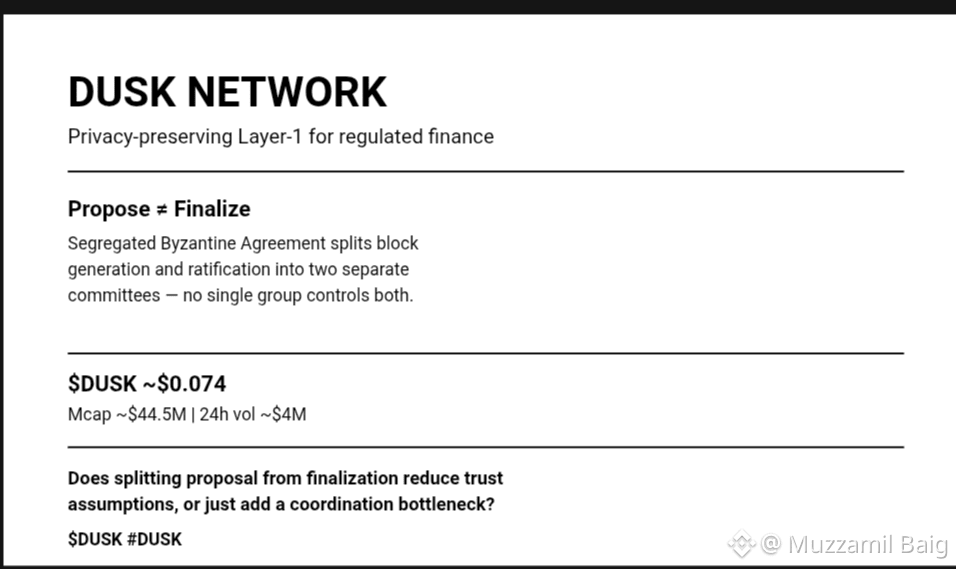
$DUSK is down about 5% today, trading near $0.074, with market cap around $44.5M and roughly $4M in 24h volume — small enough that a few large trades can move it more than you'd expect.
What's more interesting than the chart, though, is how Dusk actually reaches consensus. Most Layer-1s let the same group of validators both propose a block and finalize it. Dusk's Segregated Byzantine Agreement splits that into two separate steps — one committee generates the block, a different one ratifies it. No single group controls both ends of the process at once.
Why does that matter for a chain built on private, ZK-verified transactions? Because if the same validators who build a block could also approve it unilaterally, there's more room for that block to include something no one outside the group can verify. Separating the roles gives an extra check specifically suited to a chain where transaction contents aren't publicly visible by default.
The trade-off is coordination overhead — two committees agreeing takes more communication than one group voting alone, and that has to stay fast enough for actual settlement, not just a testnet demo.
@Dusk is betting that extra step is worth the latency cost for institutions that need auditability guarantees, not just speed.
Does splitting proposal from finalization actually reduce trust assumptions, or just add a coordination bottleneck dressed up as security?
$DUSK #dusk
What's more interesting than the chart, though, is how Dusk actually reaches consensus. Most Layer-1s let the same group of validators both propose a block and finalize it. Dusk's Segregated Byzantine Agreement splits that into two separate steps — one committee generates the block, a different one ratifies it. No single group controls both ends of the process at once.
Why does that matter for a chain built on private, ZK-verified transactions? Because if the same validators who build a block could also approve it unilaterally, there's more room for that block to include something no one outside the group can verify. Separating the roles gives an extra check specifically suited to a chain where transaction contents aren't publicly visible by default.
The trade-off is coordination overhead — two committees agreeing takes more communication than one group voting alone, and that has to stay fast enough for actual settlement, not just a testnet demo.
@Dusk is betting that extra step is worth the latency cost for institutions that need auditability guarantees, not just speed.
Does splitting proposal from finalization actually reduce trust assumptions, or just add a coordination bottleneck dressed up as security?
$DUSK #dusk