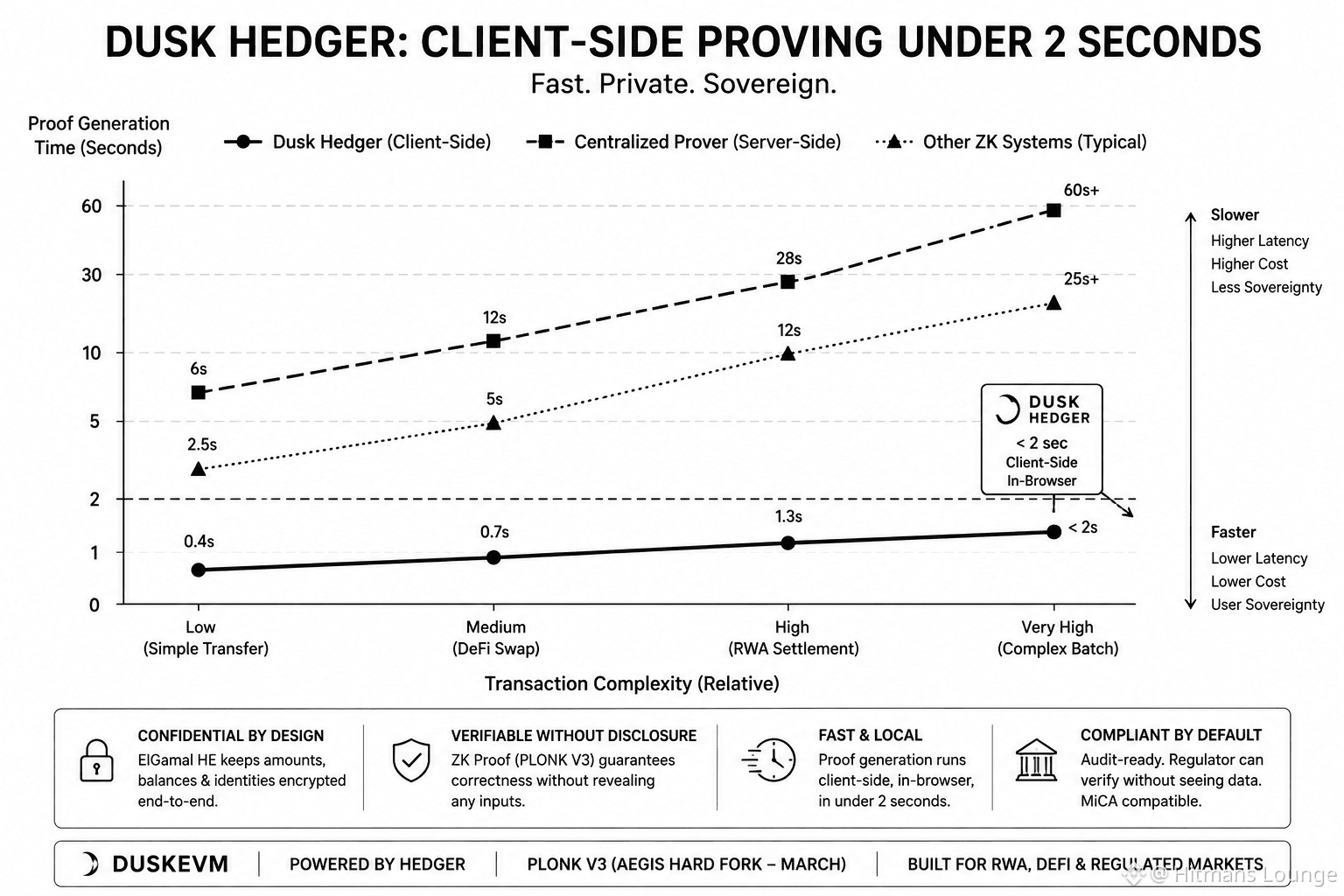
I noticed an important detail while reading @Dusk Hedger docs this week: the proof generation runs client-side, in-browser, in under two seconds.
That detail sat with me longer than expected.
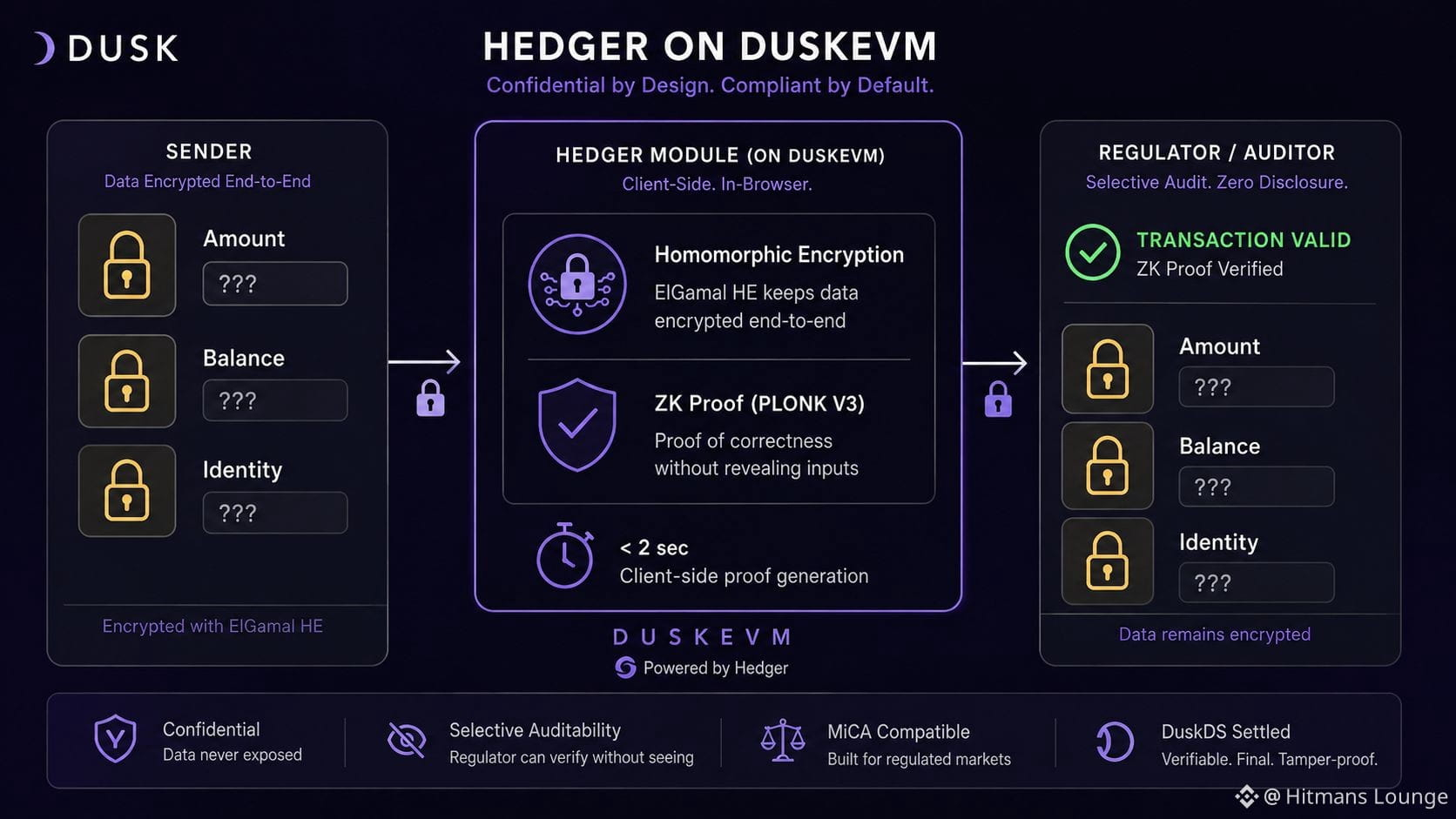
Most ZK systems either push computation to a centralized prover or sacrifice speed. $DUSK 's Hedger module — live on DuskEVM — does neither. It uses a hybrid of ElGamal homomorphic encryption and ZK proofs to keep amounts and balances encrypted end-to-end, while keeping the proving lightweight enough to run locally.
That's not a minor design choice. It's a deliberate trade-off that keeps sovereignty with the user, not with a proving service.
The compliance angle lands differently when you understand the mechanism. An institution can settle a confidential transaction that remains fully auditable by the regulator — not because the data is public, but because the ZK proof guarantees correctness without revealing inputs.
PLONK V3, wired in via the Aegis hard fork in March, is the proving system sitting underneath all of it.
What I can't fully model yet is how regulators in different jurisdictions will actually treat ZK-based auditability. MiCA compatibility is the claim. But regulatory acceptance of ZK proofs as sufficient audit evidence isn't settled law anywhere I know of.
That's the gap I'm watching before I get more convicted on the institutional thesis.
What specific regulatory framework — MiCA, SEC rule, or otherwise — would you need to see formally accommodate ZK-proof auditability for this compliance narrative to become real traction?
#Dusk #ZeroKnowledge #RWA #Hedger #DuskEVM
That detail sat with me longer than expected.
Most ZK systems either push computation to a centralized prover or sacrifice speed. $DUSK 's Hedger module — live on DuskEVM — does neither. It uses a hybrid of ElGamal homomorphic encryption and ZK proofs to keep amounts and balances encrypted end-to-end, while keeping the proving lightweight enough to run locally.
That's not a minor design choice. It's a deliberate trade-off that keeps sovereignty with the user, not with a proving service.
The compliance angle lands differently when you understand the mechanism. An institution can settle a confidential transaction that remains fully auditable by the regulator — not because the data is public, but because the ZK proof guarantees correctness without revealing inputs.
PLONK V3, wired in via the Aegis hard fork in March, is the proving system sitting underneath all of it.
What I can't fully model yet is how regulators in different jurisdictions will actually treat ZK-based auditability. MiCA compatibility is the claim. But regulatory acceptance of ZK proofs as sufficient audit evidence isn't settled law anywhere I know of.
That's the gap I'm watching before I get more convicted on the institutional thesis.
What specific regulatory framework — MiCA, SEC rule, or otherwise — would you need to see formally accommodate ZK-proof auditability for this compliance narrative to become real traction?
#Dusk #ZeroKnowledge #RWA #Hedger #DuskEVM