I started looking at Dusk's treasury differently after asking one simple question.
what happens when the asset funding your runway is also exposed to the market?
From the outside, it does not look like the foundation is heavily dependent on DUSK for day to day operating liquidity.
I do not have an official treasury breakdown so I am not calling that a fact. It's simply what the public picture seems to suggest.
The Jan 16 incident made me think about this differently. Someone gained unauthorized access to a signing wallet used by Dusk's Dusk-to-EVM bridge. Dusk paused the bridge, disabled and recycled the affected addresses added a Web Wallet blocklist and worked with exchanges during the response.
Dusk said user funds were not affected and that DuskDS consensus and the underlying protocol were not compromised.
What interests me is not the incident itself. Its the treasury risk around it.
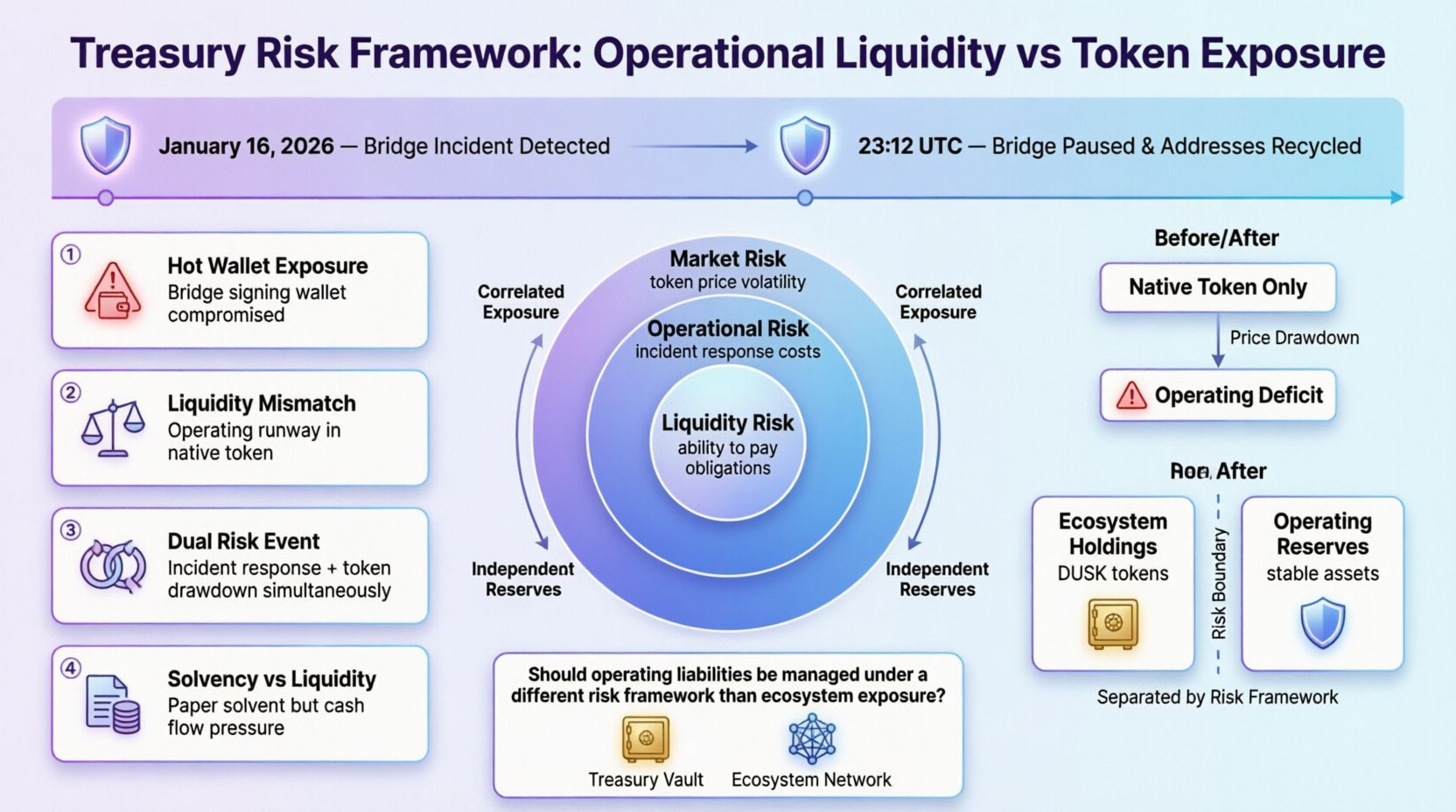
If your operating runway is heavily exposed to your own token a sharp drawdown can create two problems at once you are handling the incident while the market value of the asset funding your response is falling.
Thats liquidity risk even if the treasury remains solvent on paper.
You may still hold enough tokens but their value can move against the costs you need to pay. Selling into that drawdown can turn market volatility into a real operating expense.
Salaries infrastructure vendors and security costs still need to be paid on schedule.
Holding some reserves in more stable assets does not remove risk. It separates operational liquidity risk from native token market risk.
I am not saying this proves Dusk has a special treasury strategy. We do not have the official breakdown.
But it raises a bigger question
If your native token represents ecosystem exposure should the assets covering your operating liabilities be managed under a completely different risk framework?
@Dusk #DUSK $DUSK
what happens when the asset funding your runway is also exposed to the market?
From the outside, it does not look like the foundation is heavily dependent on DUSK for day to day operating liquidity.
I do not have an official treasury breakdown so I am not calling that a fact. It's simply what the public picture seems to suggest.
The Jan 16 incident made me think about this differently. Someone gained unauthorized access to a signing wallet used by Dusk's Dusk-to-EVM bridge. Dusk paused the bridge, disabled and recycled the affected addresses added a Web Wallet blocklist and worked with exchanges during the response.
Dusk said user funds were not affected and that DuskDS consensus and the underlying protocol were not compromised.
What interests me is not the incident itself. Its the treasury risk around it.
If your operating runway is heavily exposed to your own token a sharp drawdown can create two problems at once you are handling the incident while the market value of the asset funding your response is falling.
Thats liquidity risk even if the treasury remains solvent on paper.
You may still hold enough tokens but their value can move against the costs you need to pay. Selling into that drawdown can turn market volatility into a real operating expense.
Salaries infrastructure vendors and security costs still need to be paid on schedule.
Holding some reserves in more stable assets does not remove risk. It separates operational liquidity risk from native token market risk.
I am not saying this proves Dusk has a special treasury strategy. We do not have the official breakdown.
But it raises a bigger question
If your native token represents ecosystem exposure should the assets covering your operating liabilities be managed under a completely different risk framework?
@Dusk #DUSK $DUSK