
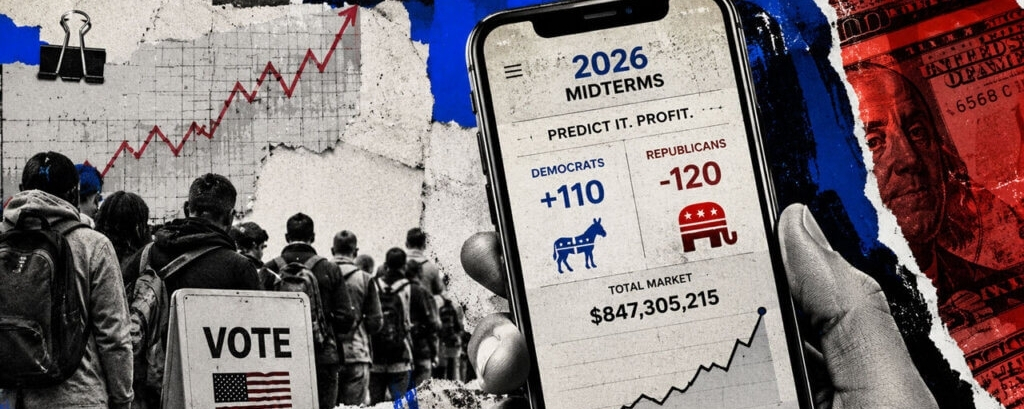

Election betting looks like a mass phenomenon until you count how few traders are actually responsible for most of the money.
he Nov. 3 midterm election is less than 11 weeks away, and its betting market had already surpassed the full 2024 congressional cycle in the latest comparable data.
Traders had placed at least $133 million across markets tied to House and Senate races by Aug. 10, compared with $92.4 million during all of 2024. The menu expanded from 464 comparable congressional markets to 7,466, covering primaries, vote shares, turnout, endorsements, candidate remarks, and winners.
The top-line volume makes election betting look huge, but the participation data shows something narrower. On Polymarket Global, the top 1% of wallets account for 68% of congressional volume. Ten wallets alone produce 17% and have traded contracts touching 426 of the 470 seats on the ballot.
Prediction markets are becoming part of how everyone from campaigns and donors to media outlets interpret elections before the people vote. They're reaching that role while a small pool of capital still sets much of the displayed probability, and enforcement expands one case at a time.
ACDC extended that work on Aug. 20 across 78,496 longshot bets from 12,355 wallets. It identified 152 highly specialized wallets active in military markets that had won more than $8 million. Those wallets won at least 75% of their longshot bets by the study's definition and earned an average return of 132%, compared with losses of 2% for high-volume traders and 1% for semi-automated accounts. More than half placed their first longshot within two days of account creation.
The wallet pattern does not establish who placed the trades or prove use of classified information. It does narrow the enforcement problem. A pseudonymous market can make an unusual trade public in real time while leaving the trader's identity hidden behind an exchange, routing wallet, or pooled account.
The same research found public-outcome markets such as elections at the low end of its insider-risk measures. That nuance is essential: a bet on who wins a statewide vote is different from a bet on whether a candidate drops out next week, secures an endorsement, or uses a specific phrase. The second group can be settled by decisions known to a small circle before the public sees them.
He also defended the agency's exclusive federal jurisdiction over designated contract markets and its proposal to define the public-interest criteria applied to war, terrorism, assassination, gaming and illegal-activity contracts.
Those rules could give regulated exchanges clearer duties around contract design and retail safeguards. They would not make a 68%-concentrated market representative or identify the person behind a global Polymarket wallet. Platforms still have to monitor thousands of thin contracts and explain why users should trust a probability heavily shaped by a few accounts.
By Election Day, the market may reach $1.6 billion or finish below ACDC's range. Either result will leave the core issue intact. Election betting already has enough scale to influence the public conversation, but its visible dollar volume overstates how many people create the odds. The midterms will test whether prediction markets can earn authority as political information before their participation and oversight match that role