
#dusk $DUSK @Dusk I went back through Dusk’s documentation last night, mainly trying to understand what its privacy design actually means rather than just repeating the usual “privacy blockchain” description.
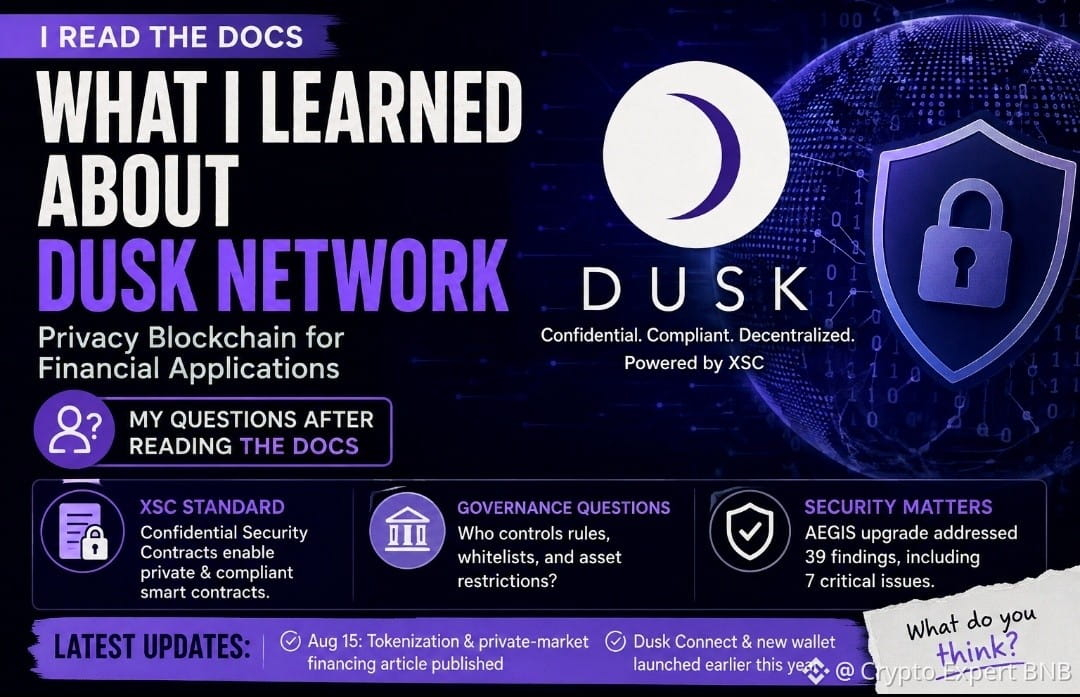
My first impression was that XSC, or Confidential Security Contracts, was mainly about hiding transaction details. Reading deeper, I started seeing a more complicated balance: Dusk is trying to support regulated financial assets while keeping certain information confidential. That raises a technical question for me: where exactly should privacy end when regulators, issuers, or eligible investors need selective visibility?
The XSC model also made me think differently about decentralization. If contracts can enforce things like whitelists or asset restrictions, who ultimately controls those rules, and how much authority remains with the issuer versus the network itself? I found references to mechanisms such as freezing or force-transferring assets, but I’d want to understand the governance assumptions around those powers more clearly.
Security is another area I’m watching. Dusk’s AEGIS upgrade addressed 39 findings, including seven classified as critical, which makes me more interested in how the protocol handles security review and upgrades over time rather than assuming privacy automatically means security.
The latest update I found is Dusk’s August 15 article on tokenization and private-market financing, while Dusk Connect and the new wallet were introduced earlier this year.
How decentralized should regulated privacy infrastructure actually be? Where should issuer control stop? And can Dusk maintain strong privacy without making compliance dependent on trusted intermediaries?
@DuskFoundation $DUSK #DUSK @Dusk
My first impression was that XSC, or Confidential Security Contracts, was mainly about hiding transaction details. Reading deeper, I started seeing a more complicated balance: Dusk is trying to support regulated financial assets while keeping certain information confidential. That raises a technical question for me: where exactly should privacy end when regulators, issuers, or eligible investors need selective visibility?
The XSC model also made me think differently about decentralization. If contracts can enforce things like whitelists or asset restrictions, who ultimately controls those rules, and how much authority remains with the issuer versus the network itself? I found references to mechanisms such as freezing or force-transferring assets, but I’d want to understand the governance assumptions around those powers more clearly.
Security is another area I’m watching. Dusk’s AEGIS upgrade addressed 39 findings, including seven classified as critical, which makes me more interested in how the protocol handles security review and upgrades over time rather than assuming privacy automatically means security.
The latest update I found is Dusk’s August 15 article on tokenization and private-market financing, while Dusk Connect and the new wallet were introduced earlier this year.
How decentralized should regulated privacy infrastructure actually be? Where should issuer control stop? And can Dusk maintain strong privacy without making compliance dependent on trusted intermediaries?
@DuskFoundation $DUSK #DUSK @Dusk