
I went back through Dusk’s documentation last night and focused on something I had overlooked before: who actually gets to participate in consensus, and how transactions prove they are valid.
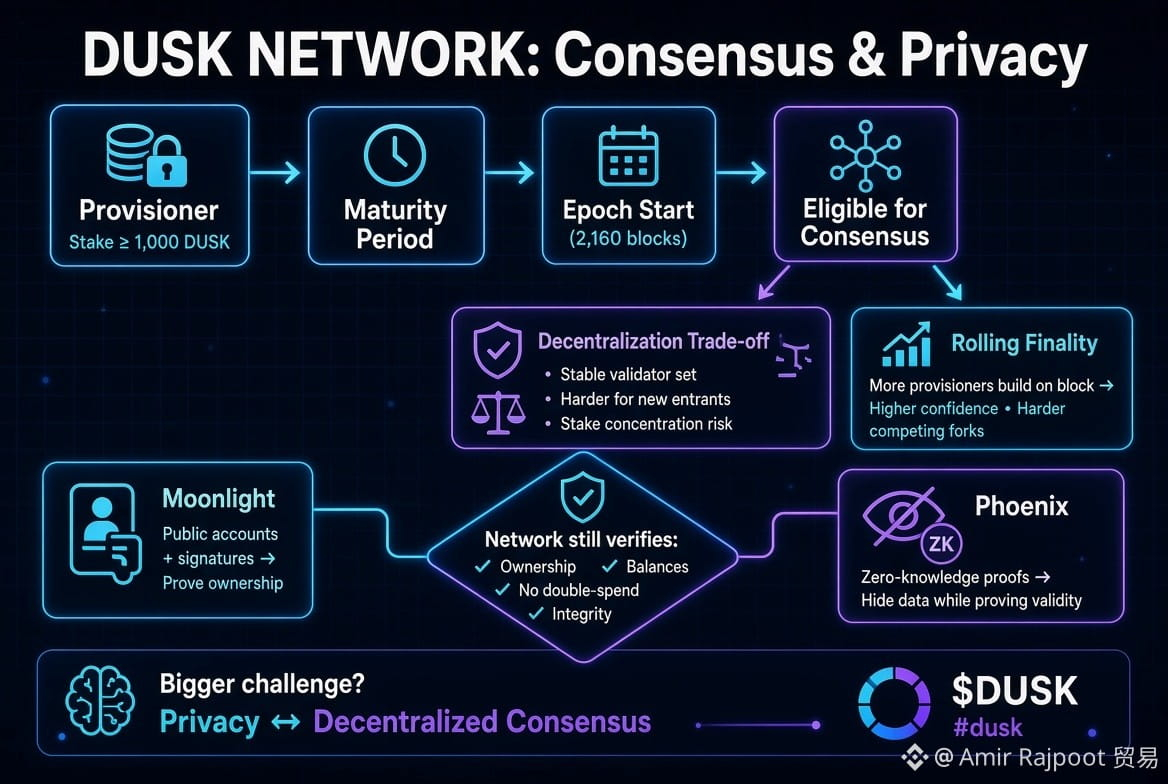
A provisioner is basically someone who locks DUSK as stake. The documentation currently describes a minimum of 1,000 DUSK, but staking does not make an account immediately eligible for consensus.
New stakes have to pass a maturity period and only become eligible at the beginning of an epoch. With epochs currently set at 2,160 blocks, this creates a deliberate delay before newly added stake can influence the consensus process.
That made me think about the decentralization trade-off.
Could this maturity period help reduce sudden changes in the active validator set, while also making it harder for new participants to immediately gain influence? And if stake becomes concentrated among larger holders, how does that affect the practical distribution of consensus power?
Then I looked at transaction validation.
Moonlight uses public account states and signatures to prove ownership, while Phoenix can use zero-knowledge proofs to hide transaction information while still proving that the required conditions are satisfied.
This is where my understanding shifted. Privacy here is not simply “hiding transactions.” The network still needs to verify ownership, balances, prevent double spending, and protect transaction integrity. The interesting question is how much information can be hidden without weakening those guarantees.
Rolling finality adds another layer. As more provisioners build on a block, confidence in that block increases, making a competing fork harder to progress.
But I’m still curious: how does this behave under heavy stake concentration or prolonged network disruption? And what does the community think is the bigger challenge for Dusk: preserving privacy, or preserving decentralized consensus as participation grows?
@Dusk $DUSK #dusk
#dusk $DUSK @Dusk
A provisioner is basically someone who locks DUSK as stake. The documentation currently describes a minimum of 1,000 DUSK, but staking does not make an account immediately eligible for consensus.
New stakes have to pass a maturity period and only become eligible at the beginning of an epoch. With epochs currently set at 2,160 blocks, this creates a deliberate delay before newly added stake can influence the consensus process.
That made me think about the decentralization trade-off.
Could this maturity period help reduce sudden changes in the active validator set, while also making it harder for new participants to immediately gain influence? And if stake becomes concentrated among larger holders, how does that affect the practical distribution of consensus power?
Then I looked at transaction validation.
Moonlight uses public account states and signatures to prove ownership, while Phoenix can use zero-knowledge proofs to hide transaction information while still proving that the required conditions are satisfied.
This is where my understanding shifted. Privacy here is not simply “hiding transactions.” The network still needs to verify ownership, balances, prevent double spending, and protect transaction integrity. The interesting question is how much information can be hidden without weakening those guarantees.
Rolling finality adds another layer. As more provisioners build on a block, confidence in that block increases, making a competing fork harder to progress.
But I’m still curious: how does this behave under heavy stake concentration or prolonged network disruption? And what does the community think is the bigger challenge for Dusk: preserving privacy, or preserving decentralized consensus as participation grows?
@Dusk $DUSK #dusk
#dusk $DUSK @Dusk