When I went to open a new bank account yesterday, the form asked me to choose between a savings or current account. Same bank, but different ways of using it.
It got me thinking about how we usually see blockchain transactions: either everything is public, or everything is private. No real middle ground.
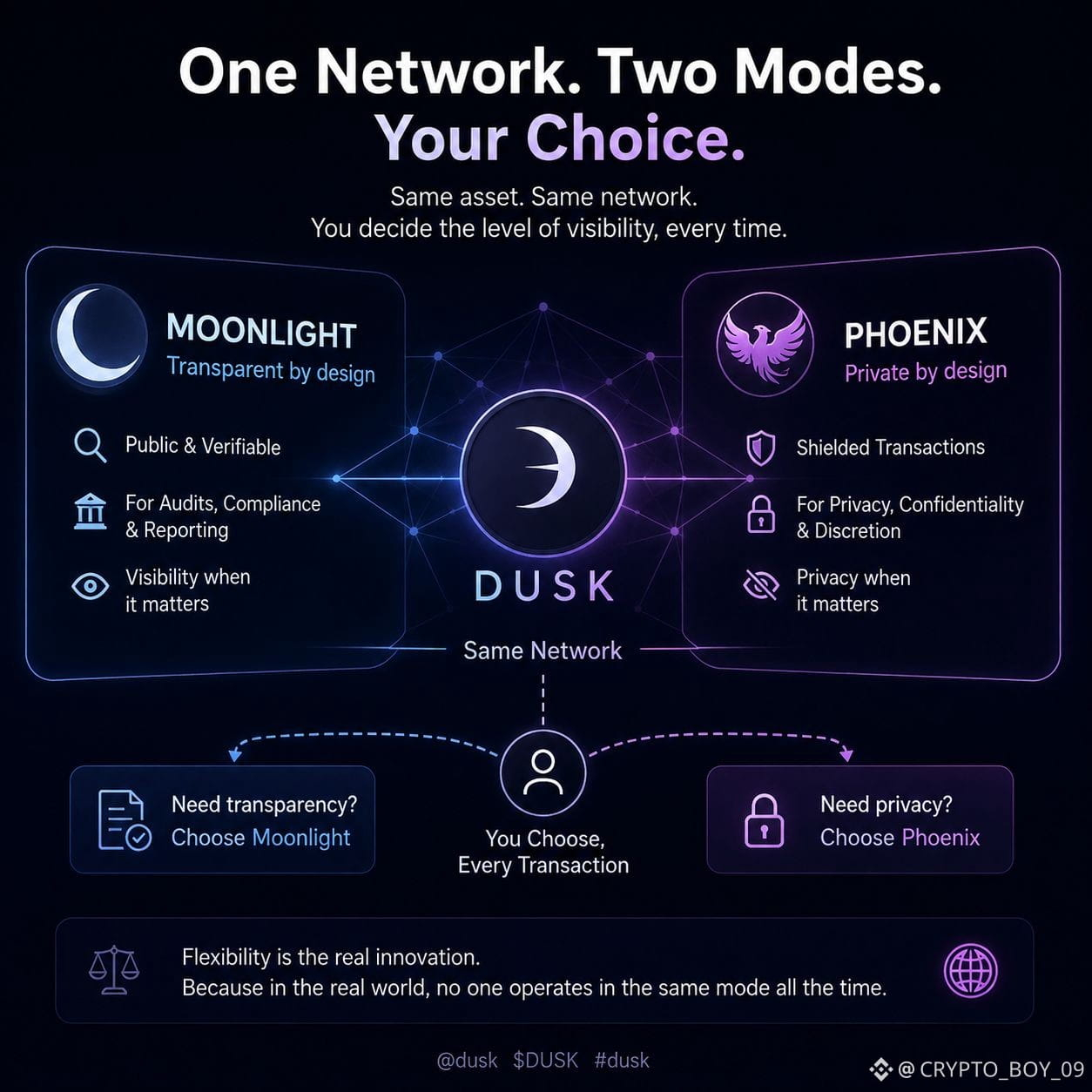
Dusk’s Moonlight and Phoenix setup made me look at it differently.
Moonlight is for public, transparent transactions where visibility matters — things like institutional reporting or audit trails.
Phoenix is shielded, for cases where the transaction details shouldn’t be exposed.
Both run on the same network, and the user can choose the mode on a transaction-by-transaction basis.
At first, it sounds like just two options for convenience.
But the bigger idea is flexibility.
Same asset. Same network. But privacy isn’t a permanent setting. You decide what level of visibility you need each time you transact.
That matters a lot for institutions, because in the real world, no entity operates in the same mode all the time. Sometimes transparency is necessary. Sometimes it isn’t.
It’s a small design choice, but it could be a big one for how privacy works on-chain.
The question is: will more chains move toward this kind of choice-based privacy, or will one default — fully public or fully private — ultimately win?
@Dusk $DUSK #dusk
It got me thinking about how we usually see blockchain transactions: either everything is public, or everything is private. No real middle ground.
Dusk’s Moonlight and Phoenix setup made me look at it differently.
Moonlight is for public, transparent transactions where visibility matters — things like institutional reporting or audit trails.
Phoenix is shielded, for cases where the transaction details shouldn’t be exposed.
Both run on the same network, and the user can choose the mode on a transaction-by-transaction basis.
At first, it sounds like just two options for convenience.
But the bigger idea is flexibility.
Same asset. Same network. But privacy isn’t a permanent setting. You decide what level of visibility you need each time you transact.
That matters a lot for institutions, because in the real world, no entity operates in the same mode all the time. Sometimes transparency is necessary. Sometimes it isn’t.
It’s a small design choice, but it could be a big one for how privacy works on-chain.
The question is: will more chains move toward this kind of choice-based privacy, or will one default — fully public or fully private — ultimately win?
@Dusk $DUSK #dusk