
I’ve been looking at @Dusk again this week, and I think I was looking at the wrong thing.
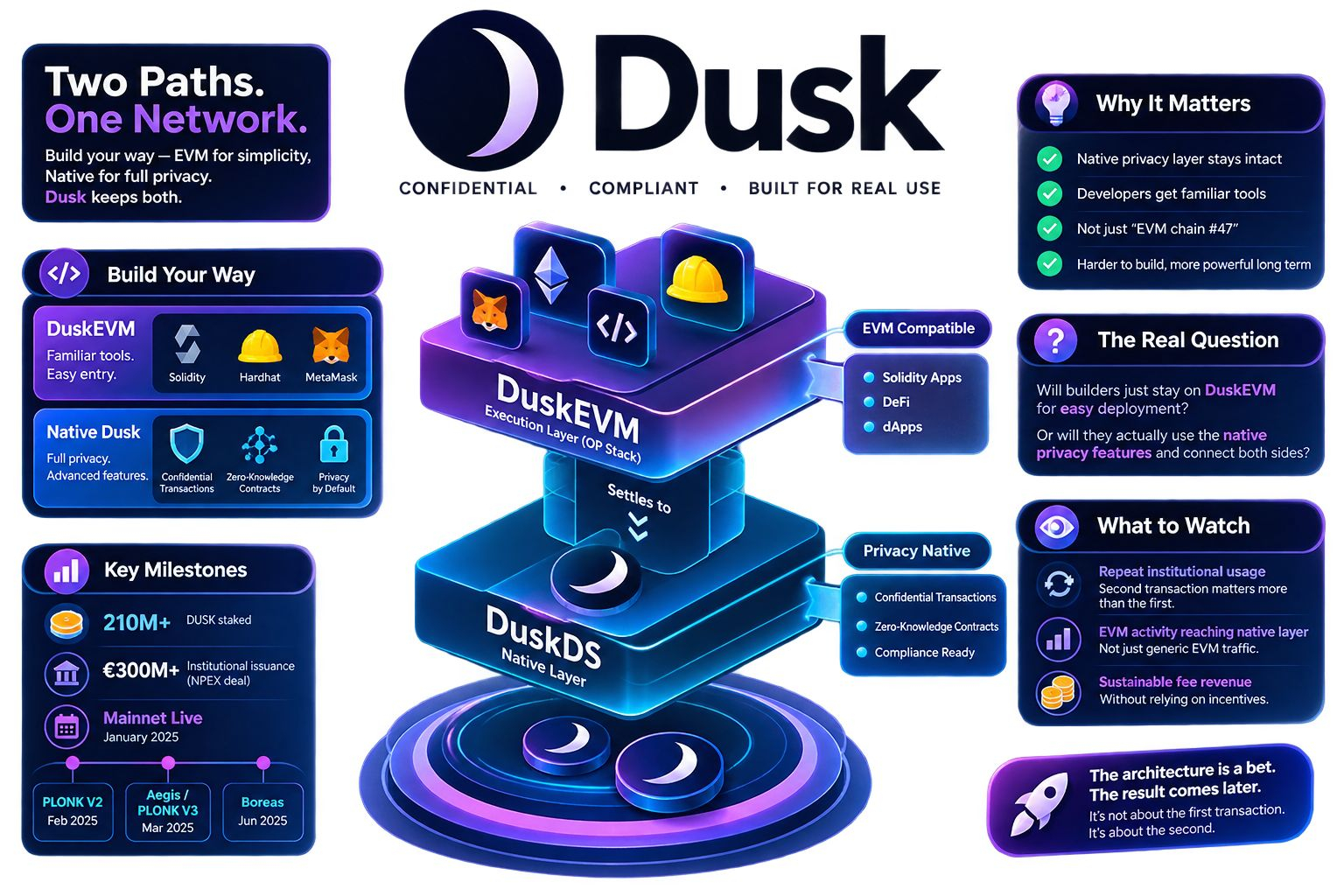
Dusk gets talked about mainly as a privacy-focused chain, but the part that caught my attention is how they’re handling the developer side. DuskEVM gives builders the Solidity, Hardhat and MetaMask setup they already know, while still settling back into Dusk’s native architecture.
That sounds simple on paper, but it’s actually a pretty difficult balance.
Most projects take the easy route: become EVM-compatible and move on. Dusk is trying to keep its native privacy and zero-knowledge capabilities intact while giving developers a familiar way in.
That makes Dusk more interesting to me than another chain chasing TVL or staking numbers.
The real question now is what people actually build with it.
If DuskEVM just becomes another place to deploy generic Solidity apps, then a lot of the native architecture loses its point. But if developers start using the EVM layer as the entry point and eventually tap into Dusk’s privacy features, that’s where the design starts to make sense.
I’m also less interested in the headline numbers than I am in repeat usage.
One institutional transaction is nice. Seeing the same participant come back because Dusk actually solved a problem for them is much stronger.
Dusk has built an interesting setup. Now it needs usage to prove why that setup matters.
That’s the part I’ll be watching.
#dusk $DUSK @Dusk
Dusk gets talked about mainly as a privacy-focused chain, but the part that caught my attention is how they’re handling the developer side. DuskEVM gives builders the Solidity, Hardhat and MetaMask setup they already know, while still settling back into Dusk’s native architecture.
That sounds simple on paper, but it’s actually a pretty difficult balance.
Most projects take the easy route: become EVM-compatible and move on. Dusk is trying to keep its native privacy and zero-knowledge capabilities intact while giving developers a familiar way in.
That makes Dusk more interesting to me than another chain chasing TVL or staking numbers.
The real question now is what people actually build with it.
If DuskEVM just becomes another place to deploy generic Solidity apps, then a lot of the native architecture loses its point. But if developers start using the EVM layer as the entry point and eventually tap into Dusk’s privacy features, that’s where the design starts to make sense.
I’m also less interested in the headline numbers than I am in repeat usage.
One institutional transaction is nice. Seeing the same participant come back because Dusk actually solved a problem for them is much stronger.
Dusk has built an interesting setup. Now it needs usage to prove why that setup matters.
That’s the part I’ll be watching.
#dusk $DUSK @Dusk