@Dusk
I keep noticing the same pattern in tokenomics discussions: people fixate on emission charts and burn percentages, but rarely ask the harder question — who's actually going to want the token, and why.
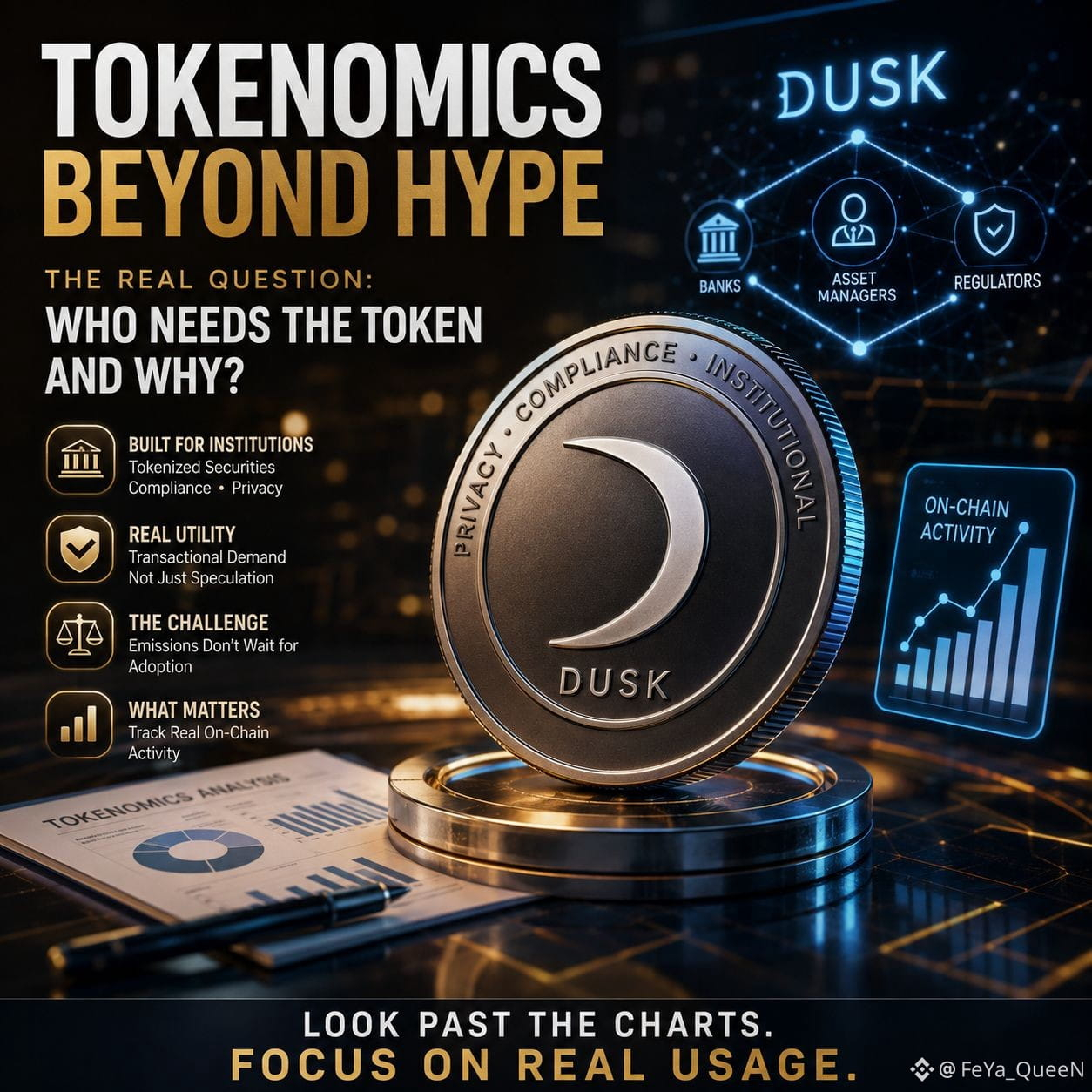
With DUSK, that question feels less abstract than usual. The project isn't just claiming "privacy" as a feature; it's building for tokenized securities, compliance workflows, and private smart-contract activity aimed at institutions operating under real regulatory oversight. That's a different kind of use case than most chains are chasing. If a bank or asset manager runs recurring activity through the network, that creates ongoing transactional demand for DUSK — not just speculative interest.
But staking emissions don't pause to wait for that demand to show up. New tokens keep entering circulation regardless of whether institutional usage grows at the same pace. So the real question isn't whether DUSK has utility — it clearly has a thought-out use case. It's whether organic demand from that use case can outpace the token supply hitting the market.
Here's where I stay cautious: the tech can be finished long before the institutions it's built for are ready to use it. Legal frameworks, compliance approval, onboarding — these move on timelines that have nothing to do with how fast a protocol ships. A working system and an adopted system aren't the same thing.
Instead of watching burn numbers or price charts, I'd rather track whether real activity is picking up on-chain. That tells you more than any roadmap.
Projects like this are a good reminder to slow down, read past the headlines, and keep asking what's actually being used versus what's just being promised. Still learning as I go, and that's kind of the point.
@Dusk #dusk $DUSK
I keep noticing the same pattern in tokenomics discussions: people fixate on emission charts and burn percentages, but rarely ask the harder question — who's actually going to want the token, and why.
With DUSK, that question feels less abstract than usual. The project isn't just claiming "privacy" as a feature; it's building for tokenized securities, compliance workflows, and private smart-contract activity aimed at institutions operating under real regulatory oversight. That's a different kind of use case than most chains are chasing. If a bank or asset manager runs recurring activity through the network, that creates ongoing transactional demand for DUSK — not just speculative interest.
But staking emissions don't pause to wait for that demand to show up. New tokens keep entering circulation regardless of whether institutional usage grows at the same pace. So the real question isn't whether DUSK has utility — it clearly has a thought-out use case. It's whether organic demand from that use case can outpace the token supply hitting the market.
Here's where I stay cautious: the tech can be finished long before the institutions it's built for are ready to use it. Legal frameworks, compliance approval, onboarding — these move on timelines that have nothing to do with how fast a protocol ships. A working system and an adopted system aren't the same thing.
Instead of watching burn numbers or price charts, I'd rather track whether real activity is picking up on-chain. That tells you more than any roadmap.
Projects like this are a good reminder to slow down, read past the headlines, and keep asking what's actually being used versus what's just being promised. Still learning as I go, and that's kind of the point.
@Dusk #dusk $DUSK