The real advantage of Dusk’s dual execution model is not EVM compatibility. It is architectural choice.
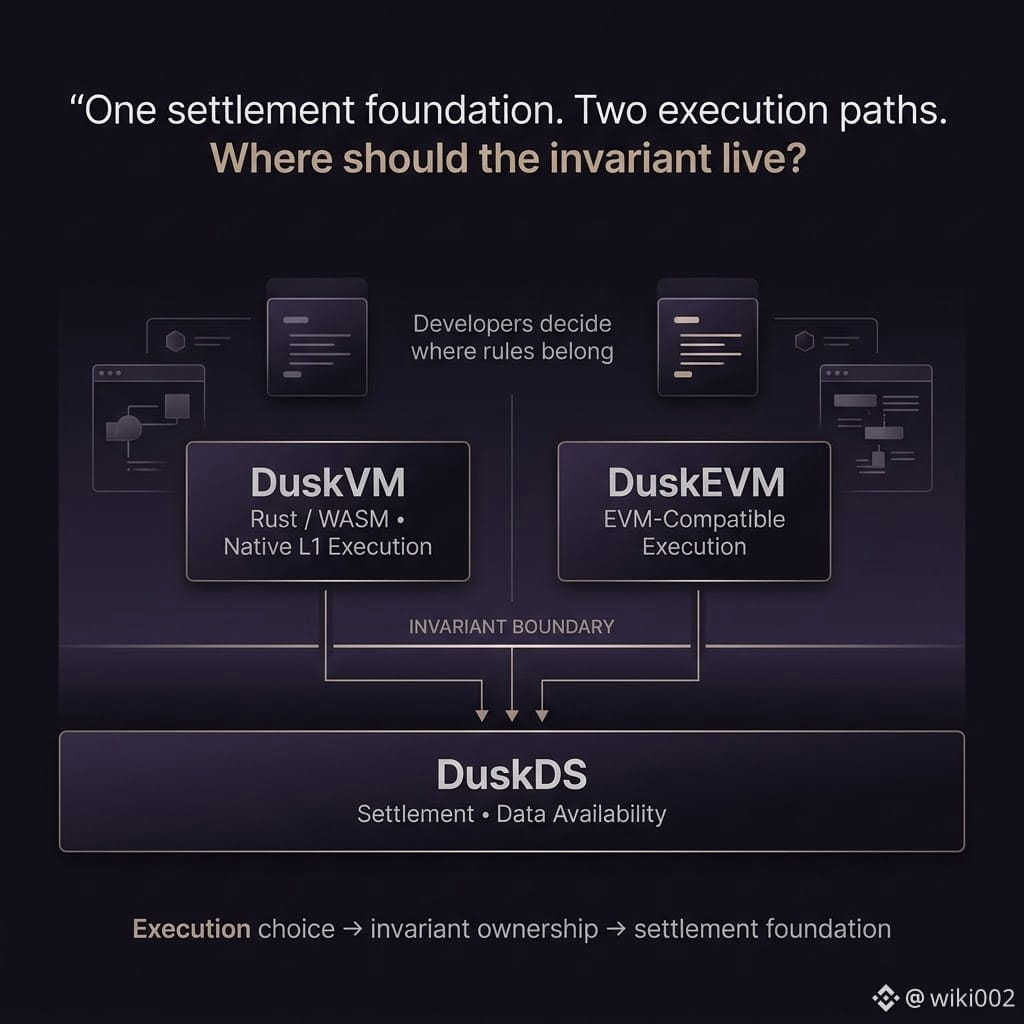
@Dusk separates settlement from execution: DuskVM runs Rust/WASM contracts directly on the Dusk L1, while DuskEVM provides EVM-compatible execution with settlement and data availability through DuskDS.
The deeper consequence is that developers can choose where application logic belongs instead of forcing every workload into one execution model.
If a contract needs direct L1 access to Dusk’s transaction models, privacy or zero-knowledge capabilities, DuskVM is the native path. If the priority is Solidity, existing wallets and Ethereum tooling, DuskEVM lowers the migration barrier. Dusk explicitly presents the two paths as choices based on application requirements.
But that flexibility raises an architectural question I find more interesting than compatibility:
Where should an invariant live?
In my view, rules tied only to one execution environment can remain local to that environment. Rules that span execution paths or depend on settlement need explicit ownership and coordination boundaries.
That distinction matters because Dusk’s layers are not interchangeable. DuskDS provides consensus, finality, settlement and data availability, while DuskVM and DuskEVM provide different execution environments.
The bridge makes the boundary concrete. In the documented DuskEVM Testnet withdrawal flow, a withdrawal is initiated on DuskEVM, then proved and finalized on Dusk L1. The workflow therefore crosses execution layers rather than behaving like one monolithic operation.
My takeaway is that modularity does not simply reduce complexity. It lets developers decide where complexity should live.
For financial applications, that can be a meaningful architectural advantage: keep execution-specific logic local while treating Cross-layer rules as explicit architectural constraints.
Which rules should stay inside an execution environment, and which are important enough to be enforced across the architecture?
$DUSK #dusk
@Dusk separates settlement from execution: DuskVM runs Rust/WASM contracts directly on the Dusk L1, while DuskEVM provides EVM-compatible execution with settlement and data availability through DuskDS.
The deeper consequence is that developers can choose where application logic belongs instead of forcing every workload into one execution model.
If a contract needs direct L1 access to Dusk’s transaction models, privacy or zero-knowledge capabilities, DuskVM is the native path. If the priority is Solidity, existing wallets and Ethereum tooling, DuskEVM lowers the migration barrier. Dusk explicitly presents the two paths as choices based on application requirements.
But that flexibility raises an architectural question I find more interesting than compatibility:
Where should an invariant live?
In my view, rules tied only to one execution environment can remain local to that environment. Rules that span execution paths or depend on settlement need explicit ownership and coordination boundaries.
That distinction matters because Dusk’s layers are not interchangeable. DuskDS provides consensus, finality, settlement and data availability, while DuskVM and DuskEVM provide different execution environments.
The bridge makes the boundary concrete. In the documented DuskEVM Testnet withdrawal flow, a withdrawal is initiated on DuskEVM, then proved and finalized on Dusk L1. The workflow therefore crosses execution layers rather than behaving like one monolithic operation.
My takeaway is that modularity does not simply reduce complexity. It lets developers decide where complexity should live.
For financial applications, that can be a meaningful architectural advantage: keep execution-specific logic local while treating Cross-layer rules as explicit architectural constraints.
Which rules should stay inside an execution environment, and which are important enough to be enforced across the architecture?
$DUSK #dusk