
@Dusk
Force transfers. Issuer-initiated. Sitting inside Zedger's contract spec like it belongs there.
I stopped on that clause longer than it probably deserved.
Zedger is built for securities and real-world assets, where the holder normally controls their assets through their own keys. But the contract also gives the issuer a force-transfer capability.
Not a bug someone missed.
A designed capability, sitting alongside minting, burning and dividends.
Here's the part I hadn't traced yet.
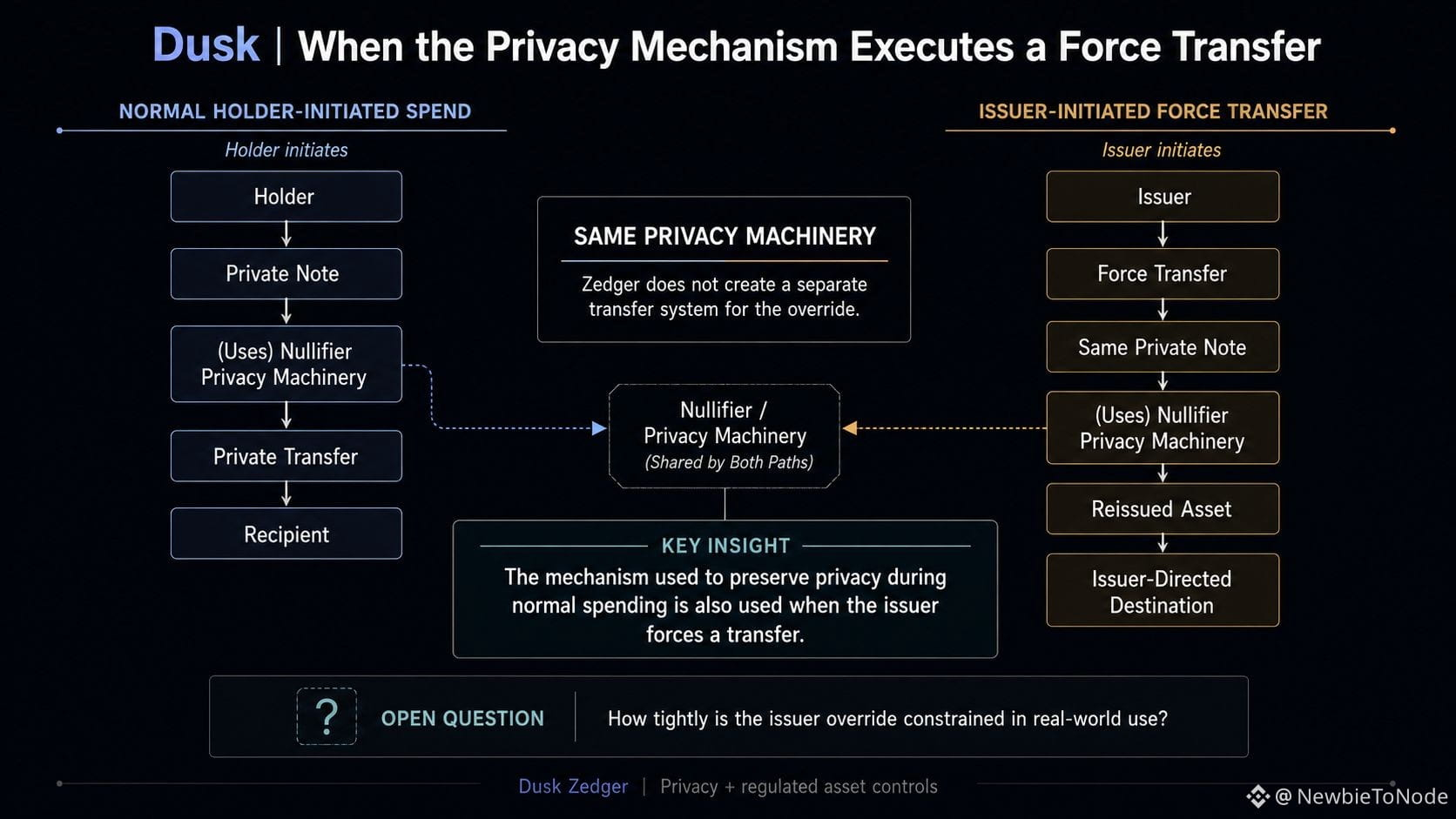
When that override fires, it doesn't bypass the privacy machinery. It uses it.
The holder's note gets nullified through the same mechanism used when a normal Phoenix note is spent. The asset can then be reissued to the destination specified by the issuer, with the transfer still handled through the protocol's proof-based machinery.
So the mechanism that normally lets a holder prove control without exposing unnecessary information is also involved in executing a transfer the holder didn't initiate.
That's the part I find interesting.
A tokenized bond isn't just a balance sitting in a wallet. It's a legal claim, and Zedger's contract already accounts for things like dividends, corporate actions and events triggered outside the chain. Those obligations don't disappear because the asset becomes tokenized.
Zedger's answer isn't to bolt on a completely separate transfer system.
It reuses the machinery already there.
What I can't tell from the whitepaper alone is how narrow that override stays once real issuers are using it. Who can trigger it. Under what conditions. Whether the boundary remains narrow as more asset types get added.
$DUSK only becomes more interesting to me here once that boundary has been tested against something other than the contract describing it.
#dusk
Force transfers. Issuer-initiated. Sitting inside Zedger's contract spec like it belongs there.
I stopped on that clause longer than it probably deserved.
Zedger is built for securities and real-world assets, where the holder normally controls their assets through their own keys. But the contract also gives the issuer a force-transfer capability.
Not a bug someone missed.
A designed capability, sitting alongside minting, burning and dividends.
Here's the part I hadn't traced yet.
When that override fires, it doesn't bypass the privacy machinery. It uses it.
The holder's note gets nullified through the same mechanism used when a normal Phoenix note is spent. The asset can then be reissued to the destination specified by the issuer, with the transfer still handled through the protocol's proof-based machinery.
So the mechanism that normally lets a holder prove control without exposing unnecessary information is also involved in executing a transfer the holder didn't initiate.
That's the part I find interesting.
A tokenized bond isn't just a balance sitting in a wallet. It's a legal claim, and Zedger's contract already accounts for things like dividends, corporate actions and events triggered outside the chain. Those obligations don't disappear because the asset becomes tokenized.
Zedger's answer isn't to bolt on a completely separate transfer system.
It reuses the machinery already there.
What I can't tell from the whitepaper alone is how narrow that override stays once real issuers are using it. Who can trigger it. Under what conditions. Whether the boundary remains narrow as more asset types get added.
$DUSK only becomes more interesting to me here once that boundary has been tested against something other than the contract describing it.
#dusk