Something I keep coming back to in @Dusk 's architecture is how deliberately it separates settlement from execution, instead of forcing one layer to do both jobs.
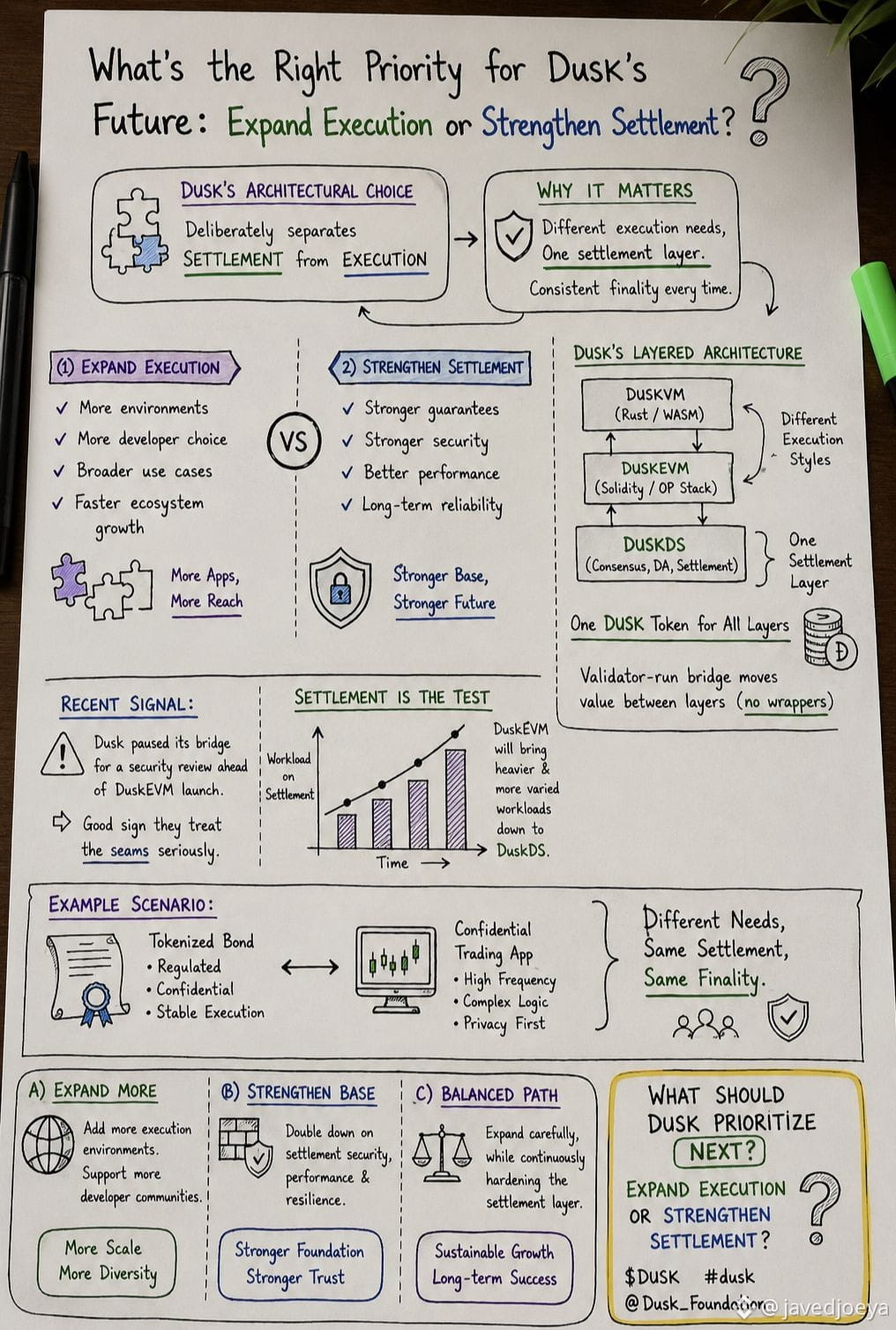
DuskDS sits at the bottom handling consensus, data availability and settlement. Above it, DuskVM runs native Rust/WASM contracts for privacy-focused applications, while DuskEVM gives Solidity developers a familiar path through OP Stack compatibility. Different execution styles, but everything posts back down to DuskDS and inherits the same finality.
For regulated finance, I think this split is the right call. A tokenized bond and a confidential trading app have very different execution needs, but both need settlement that behaves the same way every time. And since NPEX's licenses cover the full stack, an asset doesn't leave its regulatory perimeter just because it moves between environments. One DUSK token pays gas across all layers, with a validator-run bridge moving value between them instead of wrapped assets.
The part I find easy to underestimate is that adding execution environments is the simple half. Keeping them all anchored to one settlement and data layer without weakening it is the harder engineering problem — and the seams between layers are usually where modular designs get tested. Dusk pausing its bridge for a security review ahead of the DuskEVM launch was a good sign they treat those seams seriously.
What I want to see next is how DuskDS holds up once DuskEVM brings a heavier and more varied mix of workloads down to settlement.
Would you rather see #dusk expand to more execution environments, or keep hardening the connection between the layers it already has?
$DUSK #dusk @Dusk _Foundation.
DuskDS sits at the bottom handling consensus, data availability and settlement. Above it, DuskVM runs native Rust/WASM contracts for privacy-focused applications, while DuskEVM gives Solidity developers a familiar path through OP Stack compatibility. Different execution styles, but everything posts back down to DuskDS and inherits the same finality.
For regulated finance, I think this split is the right call. A tokenized bond and a confidential trading app have very different execution needs, but both need settlement that behaves the same way every time. And since NPEX's licenses cover the full stack, an asset doesn't leave its regulatory perimeter just because it moves between environments. One DUSK token pays gas across all layers, with a validator-run bridge moving value between them instead of wrapped assets.
The part I find easy to underestimate is that adding execution environments is the simple half. Keeping them all anchored to one settlement and data layer without weakening it is the harder engineering problem — and the seams between layers are usually where modular designs get tested. Dusk pausing its bridge for a security review ahead of the DuskEVM launch was a good sign they treat those seams seriously.
What I want to see next is how DuskDS holds up once DuskEVM brings a heavier and more varied mix of workloads down to settlement.
Would you rather see #dusk expand to more execution environments, or keep hardening the connection between the layers it already has?
$DUSK #dusk @Dusk _Foundation.