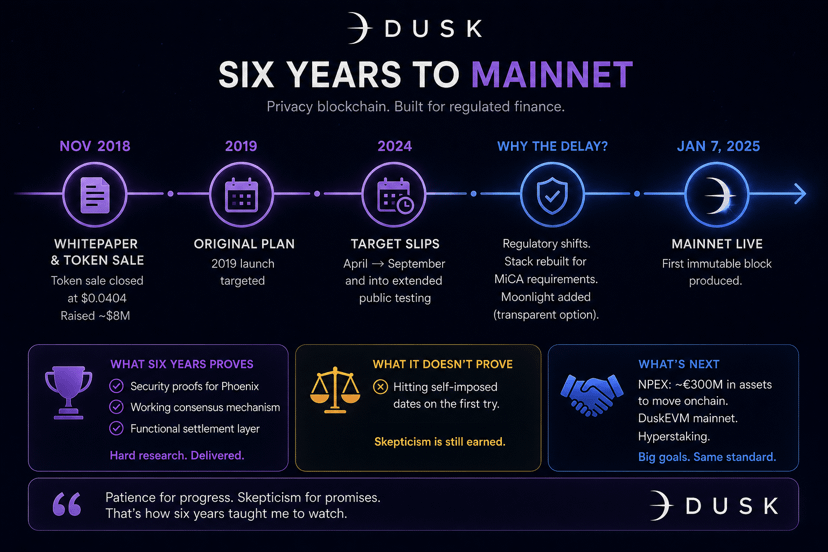
Six years. That is how long it took Dusk Network to go from a published whitepaper to a mainnet producing real, immutable blocks, and I keep returning to that number whenever someone claims blockchain infrastructure ships on schedule. The token sale closed in November 2018 at $0.0404 per token, raising roughly $8 million on the pitch of a privacy blockchain purpose built for regulated securities. The original public roadmap pointed toward a 2019 launch. That date passed quietly. A 2024 target then slipped from April to September, and again into an extended public testing phase that founder Emanuele Francioni attributed to additional testing before anything touched real value. The first immutable block finally landed on January 7, 2025.
I do not read the delay as dishonesty. Regulatory expectations genuinely shifted under the team's feet, and Francioni has explained that parts of the stack were rebuilt once MiCA's requirements became clearer, which is how Moonlight, a transparent transaction option sitting beside the private Phoenix model, ended up in the design at all. That is an engineering response to a real constraint, not an excuse invented after the fact.
What six years actually proves is narrower than either the hype or the criticism suggests. It shows Dusk Network can complete genuinely hard cryptographic research: security proofs for Phoenix, a working consensus mechanism, a functioning settlement layer, all delivered. It does not yet show the team can hit a self imposed date on the first attempt, which is exactly why I hold the newer numbers loosely too, including the ambition tied to NPEX, whose roughly 300 million euros in existing assets the partnership hopes to eventually move fully onchain through Dusk Network. Every date attached to that goal, or to DuskEVM's mainnet, or to Hyperstaking, deserves the same mix of patience and skepticism the original mainnet had to earn one missed quarter at a time.
@Dusk $DUSK #dusk
I do not read the delay as dishonesty. Regulatory expectations genuinely shifted under the team's feet, and Francioni has explained that parts of the stack were rebuilt once MiCA's requirements became clearer, which is how Moonlight, a transparent transaction option sitting beside the private Phoenix model, ended up in the design at all. That is an engineering response to a real constraint, not an excuse invented after the fact.
What six years actually proves is narrower than either the hype or the criticism suggests. It shows Dusk Network can complete genuinely hard cryptographic research: security proofs for Phoenix, a working consensus mechanism, a functioning settlement layer, all delivered. It does not yet show the team can hit a self imposed date on the first attempt, which is exactly why I hold the newer numbers loosely too, including the ambition tied to NPEX, whose roughly 300 million euros in existing assets the partnership hopes to eventually move fully onchain through Dusk Network. Every date attached to that goal, or to DuskEVM's mainnet, or to Hyperstaking, deserves the same mix of patience and skepticism the original mainnet had to earn one missed quarter at a time.
@Dusk $DUSK #dusk