
I went back through the Dusk technical documentation last night, and I found the consensus design more interesting than I expected.
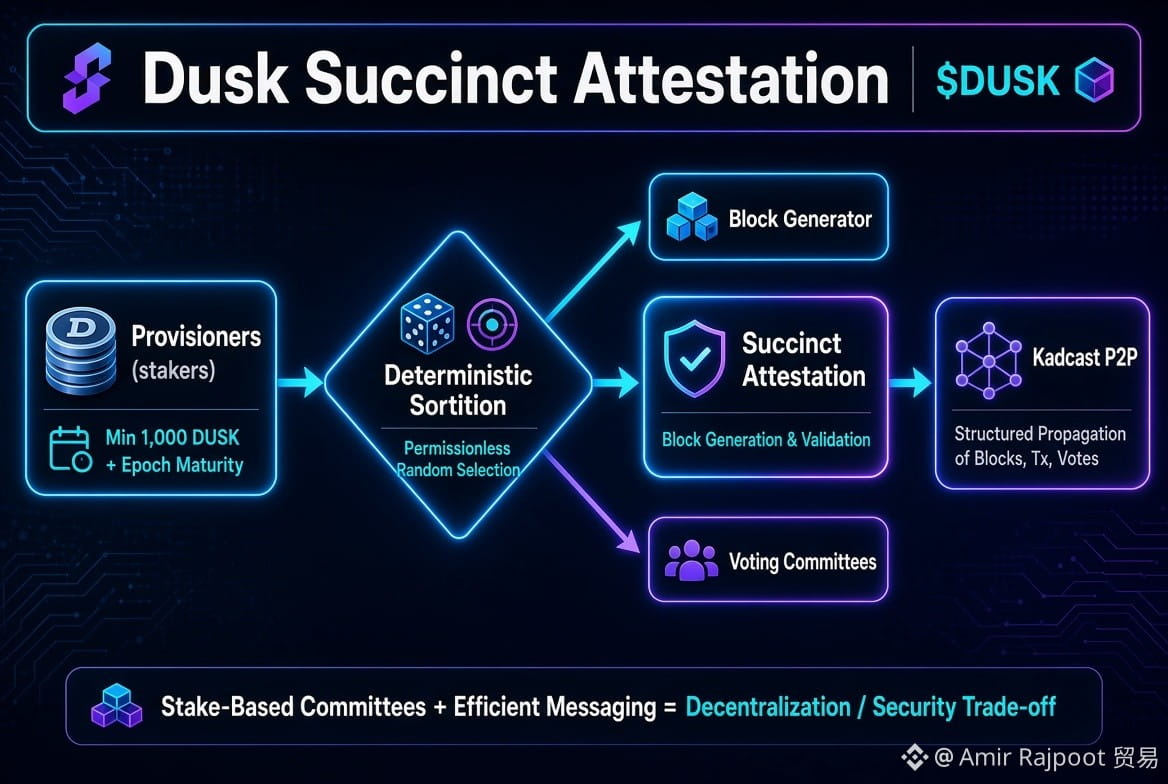
Dusk uses Succinct Attestation, a permissionless proof-of-stake system where stakers, called provisioners, help generate and validate blocks.
What caught my attention was deterministic sortition. Instead of having everyone compete to produce or vote on every block, the protocol randomly selects a block generator and voting committees from eligible provisioners.
That made me wonder about the balance between efficiency and decentralization. How unpredictable is the selection from an attacker’s perspective, and how difficult would it be to influence committee membership through stake concentration?
The staking rules also matter. The documentation says the minimum stake is currently 1,000 DUSK, while eligibility only begins after a maturity period tied to epochs. My interpretation is that this gives the system some protection against instantly entering consensus participation, but I’d like to understand the security assumptions more deeply.
Then there is Kadcast, the underlying P2P layer used to propagate blocks, transactions and votes. Its Kademlia-based structure is designed to reduce redundant communication while maintaining propagation.
So I’m left with one bigger question:
Does combining stake-based committee selection with structured message propagation create a good decentralization/security trade-off, or are there edge cases I’m overlooking?
@Dusk $DUSK #dusk
#dusk $DUSK @Dusk
Dusk uses Succinct Attestation, a permissionless proof-of-stake system where stakers, called provisioners, help generate and validate blocks.
What caught my attention was deterministic sortition. Instead of having everyone compete to produce or vote on every block, the protocol randomly selects a block generator and voting committees from eligible provisioners.
That made me wonder about the balance between efficiency and decentralization. How unpredictable is the selection from an attacker’s perspective, and how difficult would it be to influence committee membership through stake concentration?
The staking rules also matter. The documentation says the minimum stake is currently 1,000 DUSK, while eligibility only begins after a maturity period tied to epochs. My interpretation is that this gives the system some protection against instantly entering consensus participation, but I’d like to understand the security assumptions more deeply.
Then there is Kadcast, the underlying P2P layer used to propagate blocks, transactions and votes. Its Kademlia-based structure is designed to reduce redundant communication while maintaining propagation.
So I’m left with one bigger question:
Does combining stake-based committee selection with structured message propagation create a good decentralization/security trade-off, or are there edge cases I’m overlooking?
@Dusk $DUSK #dusk
#dusk $DUSK @Dusk