One phrase in Dusk Hyperlane's production sign-off stands out to me: "no admin recovery path."
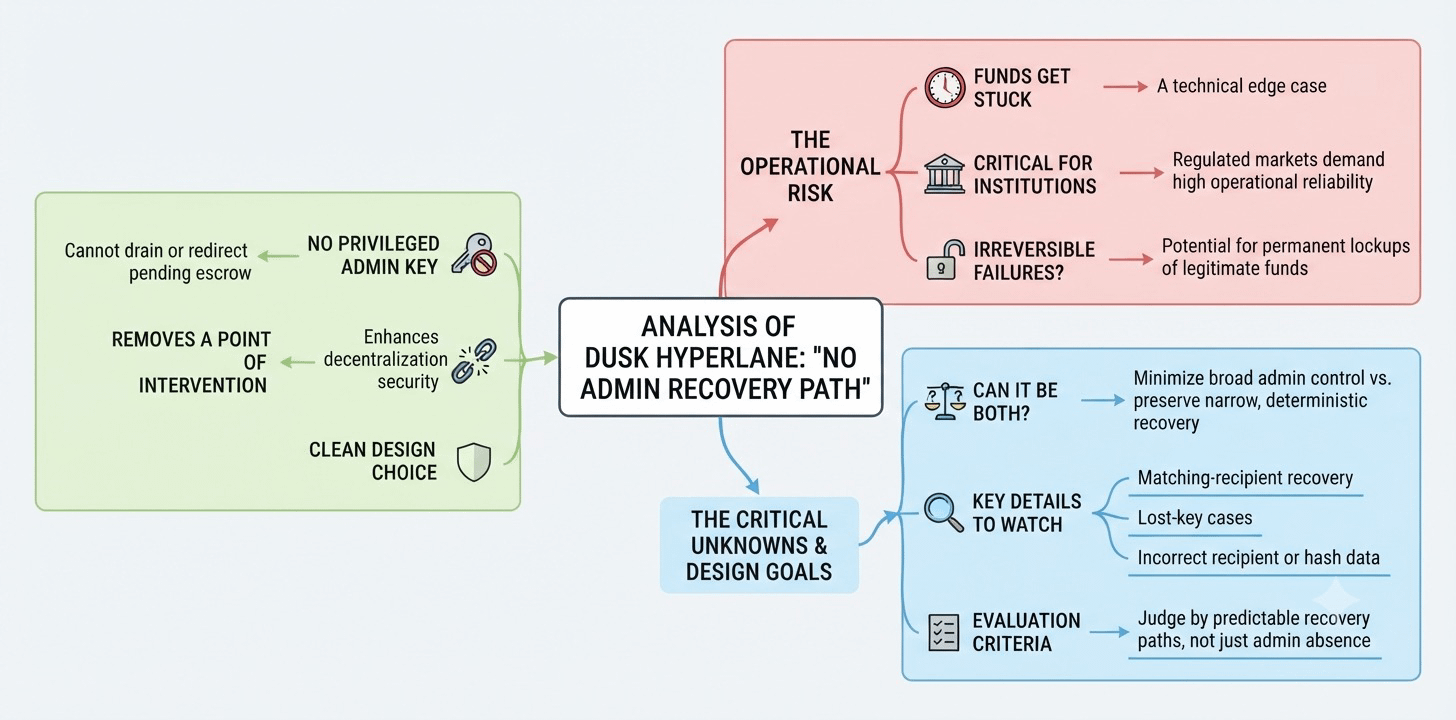
It sounds like a clean trust-minimization choice. If there is no privileged admin key that can drain or redirect pending escrow, one obvious source of intervention disappears.
But that also removes one of the obvious ways to intervene when legitimate funds get stuck. That matters as Dusk pushes to bring financial markets onchain with EU-licensed institutions, where a stuck transfer is not just a technical edge case but part of the operational reliability the infrastructure has to support.
What I don't know yet is whether Dusk Hyperlane can remove broad admin control while still preserving a narrow, deterministic way to recover from legitimate failures, or whether some mistakes simply become permanent lockups.
The details worth watching are fairly specific: matching-recipient recovery, lost-key cases, and incorrect recipient or hash data.
The absence of an admin escape hatch is useful evidence that privileged control has been reduced. It is weaker evidence of whether funds remain recoverable when something goes wrong.
I would judge the design less by whether an admin can intervene and more by whether legitimate recovery still has a predictable path without reopening broad discretionary control.
Removing a recovery authority can reduce one trust assumption while making another failure mode more irreversible.
The question is whether Dusk Hyperlane can minimize privileged recovery without turning recoverable mistakes into permanent state.
I am watching the pending-escrow recovery design, especially how Dusk handles lost keys and incorrect recipient data.
@Dusk $DUSK #dusk
It sounds like a clean trust-minimization choice. If there is no privileged admin key that can drain or redirect pending escrow, one obvious source of intervention disappears.
But that also removes one of the obvious ways to intervene when legitimate funds get stuck. That matters as Dusk pushes to bring financial markets onchain with EU-licensed institutions, where a stuck transfer is not just a technical edge case but part of the operational reliability the infrastructure has to support.
What I don't know yet is whether Dusk Hyperlane can remove broad admin control while still preserving a narrow, deterministic way to recover from legitimate failures, or whether some mistakes simply become permanent lockups.
The details worth watching are fairly specific: matching-recipient recovery, lost-key cases, and incorrect recipient or hash data.
The absence of an admin escape hatch is useful evidence that privileged control has been reduced. It is weaker evidence of whether funds remain recoverable when something goes wrong.
I would judge the design less by whether an admin can intervene and more by whether legitimate recovery still has a predictable path without reopening broad discretionary control.
Removing a recovery authority can reduce one trust assumption while making another failure mode more irreversible.
The question is whether Dusk Hyperlane can minimize privileged recovery without turning recoverable mistakes into permanent state.
I am watching the pending-escrow recovery design, especially how Dusk handles lost keys and incorrect recipient data.
@Dusk $DUSK #dusk