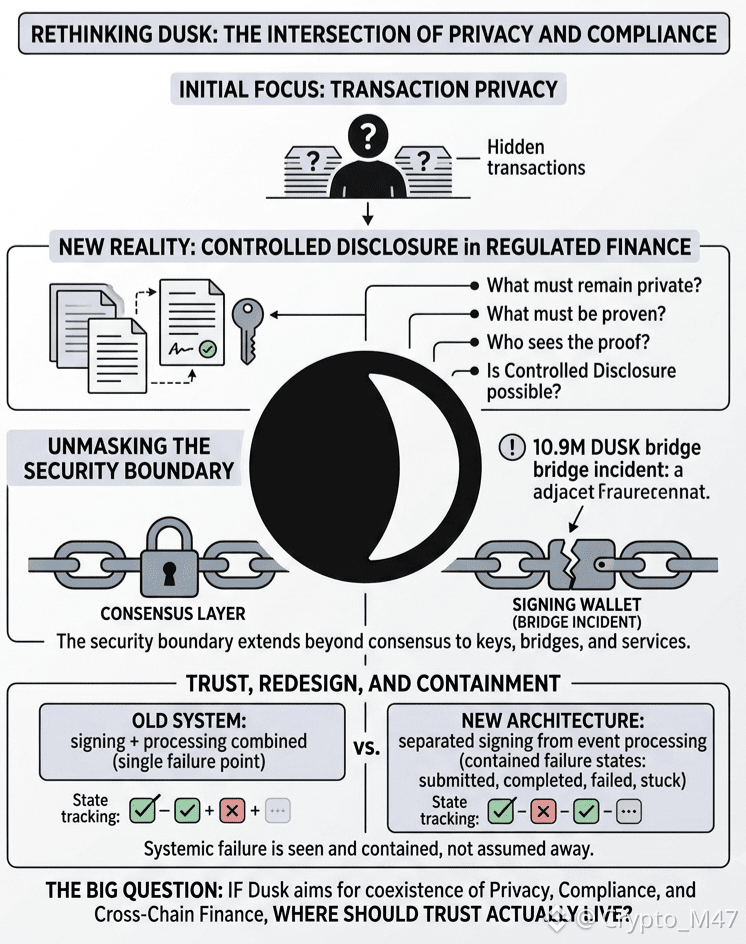

I’ve been digging into Dusk again😊, and I keep catching myself changing the question halfway through. I started with privacy. Then I started wondering what privacy looks like when the thing being protected is part of a regulated financial system. That feels much harder to me than simply hiding a transaction.
The Dutch regulatory discussion is what pushed me there. I found it interesting that the idea of controlled disclosure was coming from a regulatory setting, not from Dusk explaining its own architecture. It made me stop and think. Maybe privacy and compliance aren’t naturally in conflict. Maybe the real problem is deciding what should remain private, what needs to be proven, and who gets to see the proof.
That also changed how I read the 10.9M DUSK bridge incident. The consensus layer wasn’t compromised; the signing wallet around the bridge was. I keep thinking about that distinction because it shows how much larger the real security boundary is. A chain can protect its consensus while the surrounding bridges, keys, relayers and processing services introduce another layer of trust.
The redesign interests me for the same reason. Separating signing from event processing and tracking migrations through states like submitted, completed, failed or stuck isn’t flashy. But I think that’s exactly why it matters. It treats failure as something the system should be able to see and contain, not something it assumes away.
So my question has shifted again: if Dusk wants privacy, compliance and cross-chain finance to coexist, where should trust actually live? I’m still working through that, and I know I don’t have the full picture. I’d genuinely like to hear from people who understand this architecture more deeply.
#dusk $DUSK @Dusk
$VELVET
$UAI
The Dutch regulatory discussion is what pushed me there. I found it interesting that the idea of controlled disclosure was coming from a regulatory setting, not from Dusk explaining its own architecture. It made me stop and think. Maybe privacy and compliance aren’t naturally in conflict. Maybe the real problem is deciding what should remain private, what needs to be proven, and who gets to see the proof.
That also changed how I read the 10.9M DUSK bridge incident. The consensus layer wasn’t compromised; the signing wallet around the bridge was. I keep thinking about that distinction because it shows how much larger the real security boundary is. A chain can protect its consensus while the surrounding bridges, keys, relayers and processing services introduce another layer of trust.
The redesign interests me for the same reason. Separating signing from event processing and tracking migrations through states like submitted, completed, failed or stuck isn’t flashy. But I think that’s exactly why it matters. It treats failure as something the system should be able to see and contain, not something it assumes away.
So my question has shifted again: if Dusk wants privacy, compliance and cross-chain finance to coexist, where should trust actually live? I’m still working through that, and I know I don’t have the full picture. I’d genuinely like to hear from people who understand this architecture more deeply.
#dusk $DUSK @Dusk
$VELVET
$UAI