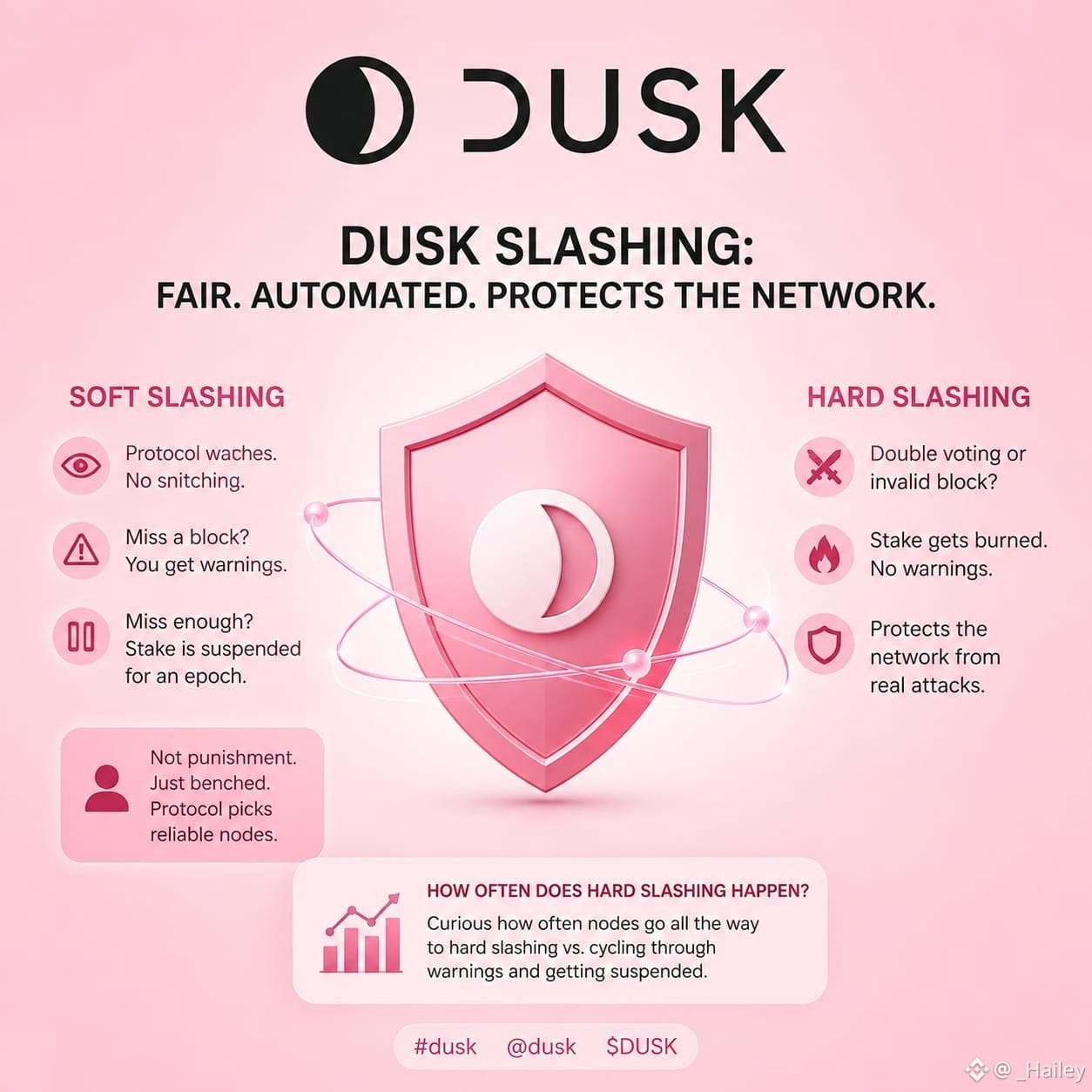
Been sitting with Dusk's slashing setup for a bit and its not quite what I expected going in. Theres no whistleblowwer thing happening, no one's out here snitching on provisioners.
The protocol just watches. If a node misses producing an block, that's a soft fault, and honestly the response is more
forgiving than I assumed, you get warnings first. Miss enough times and your stake gets suspnded for an epoch, not burned, just benched. Then there's hard slashing.
and this is where it stops being gentle. Double voting or pushing an invalid block actually burns a chunk of your stake, no warning stage at all. Which makes sense once you think.
about it, one of those is a node having a bad day, the other is behavior that looks like an actual attack. What I keep coming back to is that soft slashing doesnt really read as
punishment. Its more like the protocol quietly nudging unreliable nodes out of the selection pool so it keeps picking ones that are actually onlne.
Curious how often nodes go all the way to hard slashing versus just cycling through warnings and getting suspended.
#dusk @Dusk $DUSK
The protocol just watches. If a node misses producing an block, that's a soft fault, and honestly the response is more
forgiving than I assumed, you get warnings first. Miss enough times and your stake gets suspnded for an epoch, not burned, just benched. Then there's hard slashing.
and this is where it stops being gentle. Double voting or pushing an invalid block actually burns a chunk of your stake, no warning stage at all. Which makes sense once you think.
about it, one of those is a node having a bad day, the other is behavior that looks like an actual attack. What I keep coming back to is that soft slashing doesnt really read as
punishment. Its more like the protocol quietly nudging unreliable nodes out of the selection pool so it keeps picking ones that are actually onlne.
Curious how often nodes go all the way to hard slashing versus just cycling through warnings and getting suspended.
#dusk @Dusk $DUSK