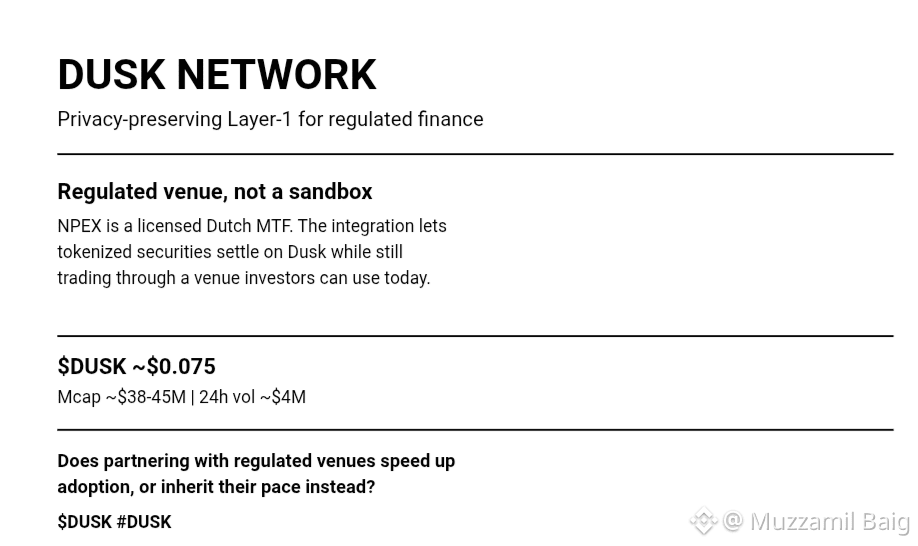
$DUSK is around $0.075 today, market cap roughly in the $38–45M range depending on the tracker, with about $4M in 24h volume.
Numbers aside, the more interesting thing this week was going through Dusk's NPEX partnership details instead of the price chart. Assumed it was another "we partnered with an exchange" press release, the kind every L1 puts out. It's not that. NPEX is a Dutch MTF — a regulated trading venue under EU law — and the integration lets tokenized securities settle on Dusk while still trading through a licensed venue investors can actually use today, not a sandbox.
That's a narrower thing than "RWA tokenization," which gets thrown around loosely right now. Most tokenization projects wrap an asset and hope a regulated venue picks it up later. Dusk built toward the venue relationship first.
The trade-off worth naming: settlement speed and privacy on-chain don't matter much if the regulated venue on the other end still runs on its own timeline and rules. Dusk's infrastructure can only move as fast as the slowest regulated counterparty it's plugged into.
@Dusk is betting that pairing with licensed venues early beats building infrastructure and waiting for regulators to catch up later.
Does partnering with regulated venues actually speed up institutional adoption, or does it just inherit their pace instead?
$DUSK #dusk
Numbers aside, the more interesting thing this week was going through Dusk's NPEX partnership details instead of the price chart. Assumed it was another "we partnered with an exchange" press release, the kind every L1 puts out. It's not that. NPEX is a Dutch MTF — a regulated trading venue under EU law — and the integration lets tokenized securities settle on Dusk while still trading through a licensed venue investors can actually use today, not a sandbox.
That's a narrower thing than "RWA tokenization," which gets thrown around loosely right now. Most tokenization projects wrap an asset and hope a regulated venue picks it up later. Dusk built toward the venue relationship first.
The trade-off worth naming: settlement speed and privacy on-chain don't matter much if the regulated venue on the other end still runs on its own timeline and rules. Dusk's infrastructure can only move as fast as the slowest regulated counterparty it's plugged into.
@Dusk is betting that pairing with licensed venues early beats building infrastructure and waiting for regulators to catch up later.
Does partnering with regulated venues actually speed up institutional adoption, or does it just inherit their pace instead?
$DUSK #dusk