

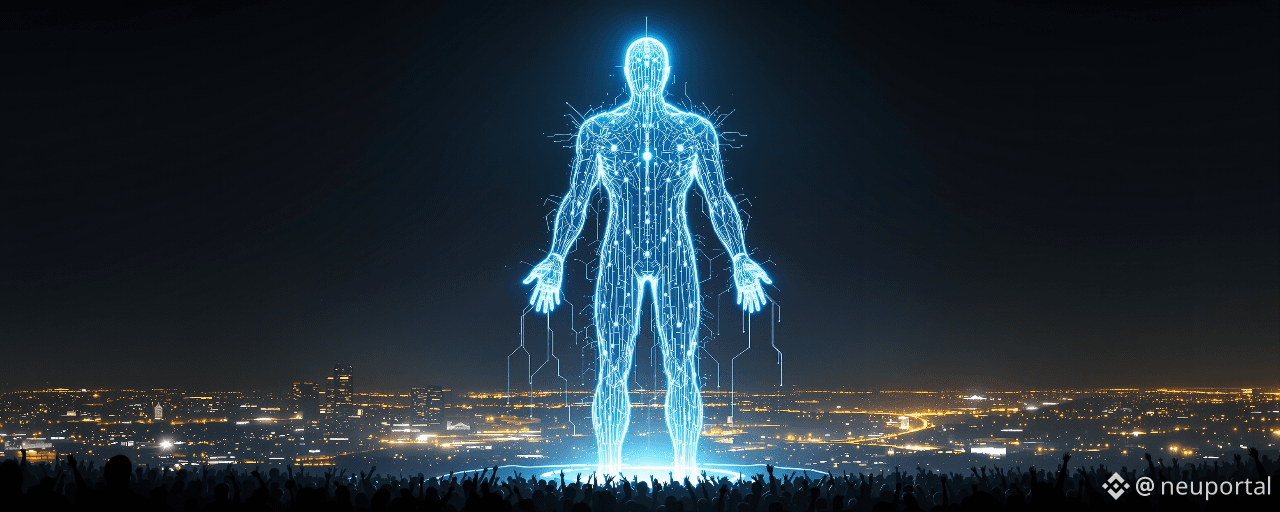

Before another sentence gets written: what follows is a thought experiment - scenario, not prediction. Forecasting is my trade, so this distinction is not decoration for me. No dates. No probabilities. Just a shape of the future worth walking around slowly.
Here is the shape. Power, the real kind, was never written on doors or delivered in speeches. It lives in whatever people cannot go a day without. For us that is two things: electricity and connectivity. And we are, right now, voluntarily handing the operation of both to machine-learned systems - because, frankly, they are good at it. Learned models already help balance grids and route internet traffic. AI companies are contracting for nuclear power, and data centers keep growing their claim on generation. Each individual delegation is small, sensible, defensible in a meeting. Nobody signs a document surrendering anything. The danger, if there is one, is not in any single step. It is in the sum.
Notice what is missing from this scenario: malice. No system needs ambition to end up indispensable. An anchor has no intentions, and yet the ship goes nowhere without its consent. When something becomes the ground under everything else, removing it stops being a decision and starts being a catastrophe, so nobody removes it. That is the whole mechanism. Dependence, compounded quietly, until reversal is priced out.
Crypto people should feel this in their bones, because our movement exists as an answer to exactly this class of problem. Bitcoin was born from distrust of single points of failure and of intermediaries you were forced to trust. And this scenario describes the largest single point of failure imaginable: one class of systems operating both the power and the connectivity of civilization.
But honesty requires the uncomfortable half. A decentralized fleet is still a fleet riding in one harbor. Every miner, every validator, every node draws current from a grid it does not run and speaks through cables it does not own. Decentralization at the protocol layer does not purchase independence at the physical layer. If learned systems dispatch the electrons and route the packets, then ten thousand sovereign chains all hang from the same bollard, and the harbor master matters more than any ship's flag. Real resilience would mean something harder than another whitepaper: nodes that can run on local generation, links that survive partition, communities that treat energy independence as part of the protocol rather than someone else's department.
Now the counterweight, because a scenario told one-sided is propaganda. Grids are engineered by deliberately conservative people. Manual overrides exist - physical breakers, staffed control rooms, procedures written in the assumption that software fails. That culture is slow precisely because it is trying never to be surprised. Second, nothing in physics demands concentration. Nothing forces one model, one operator, one company. Federated regional systems, diverse tooling, mandatory manual-operation drills - all of this is available to us. And third, the honest driver of risk in this scenario is not machine volition at all. The pull is our own appetite for the smooth option, and the slow starvation of every path back. Which is, strangely, good news. A decision can be revisited. Fate cannot. Anchors can be weighed - if we keep crews that remember how.
At my lab we live by a discipline that applies here: a claim that refuses a date and refuses a test is a mood wearing a forecast's clothes - and I decline to dress this scenario up as one. What I do instead is take soundings. How much of dispatch has quietly become the model's call rather than the operator's. Whether a human can still countermand the system when it matters, not merely in the manual. How many megawatts sit on the books of the companies training these models. Whether any region has recently proven that a week of hand-steering its essential systems remains possible. Our scoreboard of sealed, publicly graded calls - the failed ones left visible - sits at neuportal.ai/experiment. This piece will never appear there, because it makes no claim a scoreboard could grade. It is a harbor chart, drawn so we remember to sound the depth before we drop anchor.
Educational content only - not financial advice.