Why Dusk Still Holds My Attention
@Dusk #dusk $DUSK
I’ve seen plenty of crypto projects talk about bringing finance on-chain, only to end up as another public ledger. The problem is that real financial markets aren’t completely open. Putting every balance, position, client detail, or trading strategy in public isn’t always transparency; sometimes it is simply bad business. That’s where Dusk feels somewhat different to me.
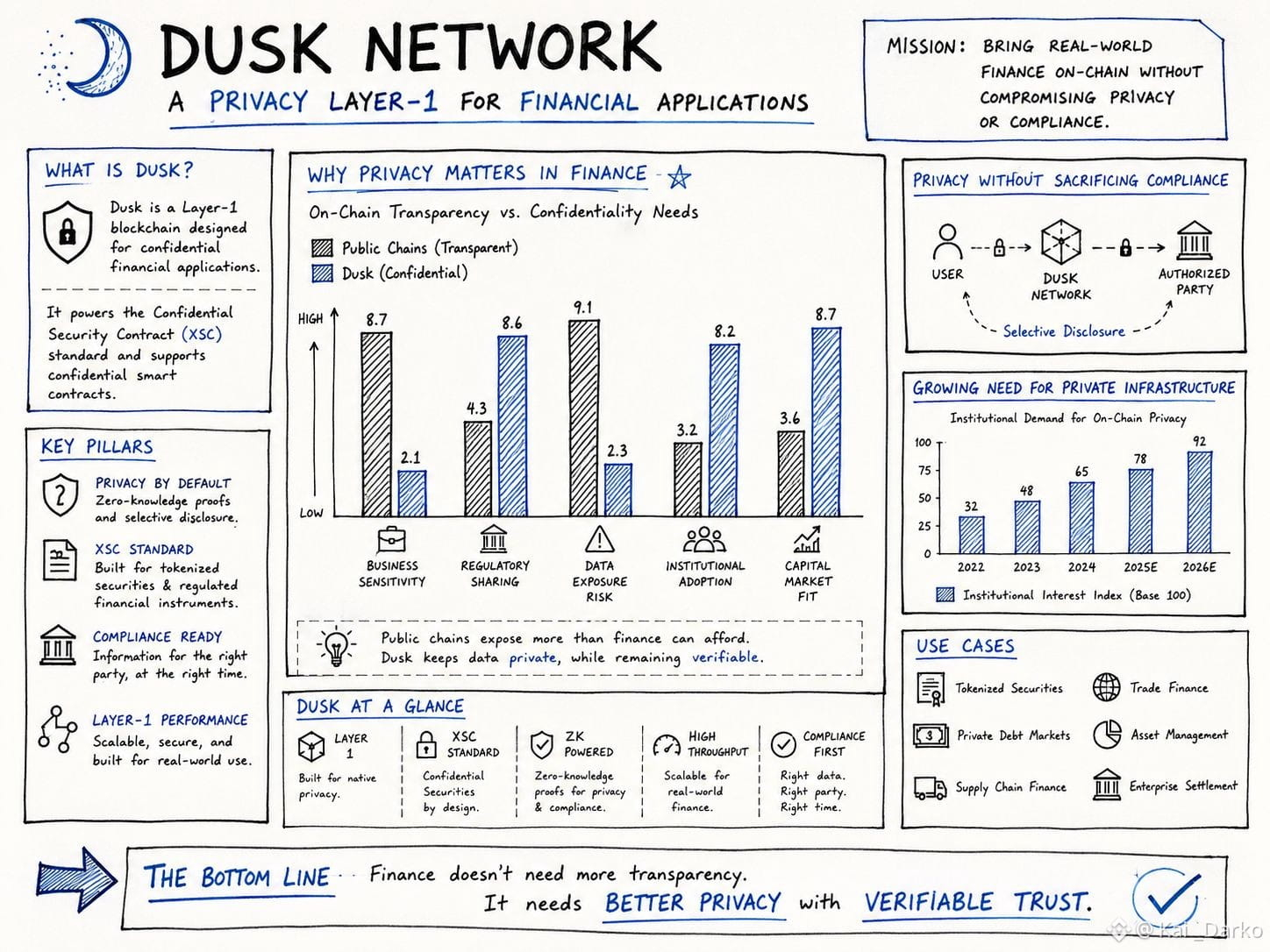
Dusk is building a Layer-1 around confidential smart contracts, zero-knowledge proofs, and selective disclosure. Its XSC standard is designed for tokenized securities, where transactions can remain verifiable without forcing sensitive information into public view.
I keep coming back to one point: crypto has treated transparency almost like a moral principle, but financial institutions may hesitate precisely because of that. Dusk’s approach isn’t total secrecy. It is closer to the idea that the right information should be available to the right party, while everything else can remain protected.
I’m not fully convinced yet. Zero-knowledge technology is powerful, but it also brings questions around complexity, performance, security, and whether institutions will actually use it at scale. And Dusk itself makes an important distinction: blockchain does not replace securities law. On-chain systems still have to operate within real-world regulations.
I’ve heard these promises before. What keeps me watching Dusk is the harder question underneath them: if finance really moves on-chain, does everything actually need to be public?
I’m not sure yet. But I think it’s the right question to be asking.
@Dusk #dusk $DUSK
@Dusk #dusk $DUSK
I’ve seen plenty of crypto projects talk about bringing finance on-chain, only to end up as another public ledger. The problem is that real financial markets aren’t completely open. Putting every balance, position, client detail, or trading strategy in public isn’t always transparency; sometimes it is simply bad business. That’s where Dusk feels somewhat different to me.
Dusk is building a Layer-1 around confidential smart contracts, zero-knowledge proofs, and selective disclosure. Its XSC standard is designed for tokenized securities, where transactions can remain verifiable without forcing sensitive information into public view.
I keep coming back to one point: crypto has treated transparency almost like a moral principle, but financial institutions may hesitate precisely because of that. Dusk’s approach isn’t total secrecy. It is closer to the idea that the right information should be available to the right party, while everything else can remain protected.
I’m not fully convinced yet. Zero-knowledge technology is powerful, but it also brings questions around complexity, performance, security, and whether institutions will actually use it at scale. And Dusk itself makes an important distinction: blockchain does not replace securities law. On-chain systems still have to operate within real-world regulations.
I’ve heard these promises before. What keeps me watching Dusk is the harder question underneath them: if finance really moves on-chain, does everything actually need to be public?
I’m not sure yet. But I think it’s the right question to be asking.
@Dusk #dusk $DUSK