#dusk $DUSK @Dusk
Why Dusk’s Architecture Is Becoming More Interesting
One thing I think gets overlooked in the Dusk conversation is how it is approaching developers.
The goal isn't simply to build another chain and ask everyone to learn a completely new stack.
@Dusk is creating a bridge between two worlds:
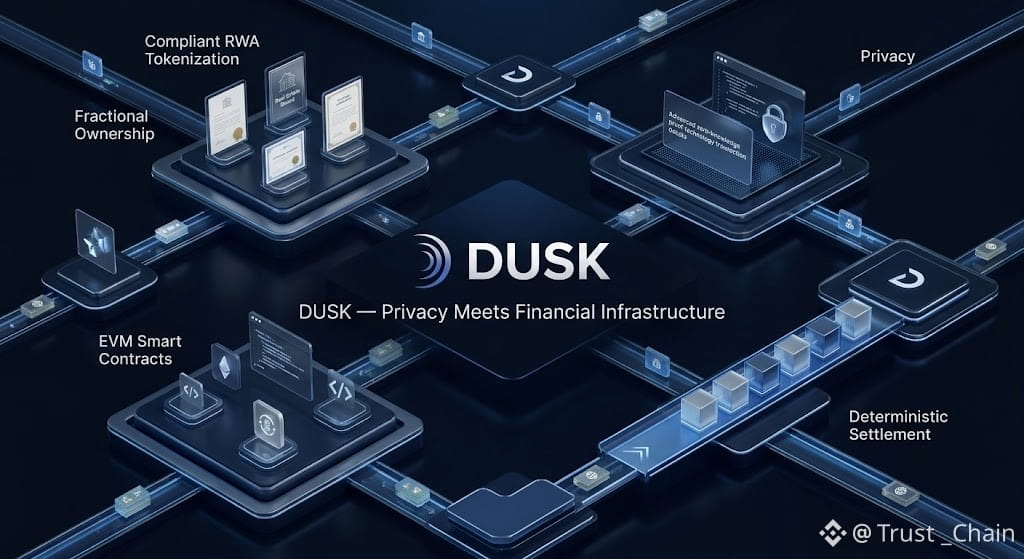
Native Dusk infrastructure gives applications access to the network’s privacy and settlement capabilities.
The EVM environment opens the door to developers already working with Solidity, Vyper and Ethereum-based tooling.
Then there is the confidential-computing layer being developed around EVM transactions, where cryptography can help keep sensitive financial information protected without making the entire system opaque.
That combination matters because institutional applications have very different requirements.
A tokenized security may need transparency for regulators, privacy for investors, programmable restrictions for issuers and predictable settlement for everyone involved.
One architecture rarely solves all of those requirements with a single switch.
Dusk's approach is more modular:
Build → control access → protect sensitive data → execute → settle.
That is a much more compelling way to look at $DUSK than simply calling it a “privacy chain.”
The real opportunity is whether this architecture can turn into infrastructure that financial institutions can actually use at scale.
And with DuskEVM development progressing, that experiment is getting much more interesting.
#dusk $DUSK
Why Dusk’s Architecture Is Becoming More Interesting
One thing I think gets overlooked in the Dusk conversation is how it is approaching developers.
The goal isn't simply to build another chain and ask everyone to learn a completely new stack.
@Dusk is creating a bridge between two worlds:
Native Dusk infrastructure gives applications access to the network’s privacy and settlement capabilities.
The EVM environment opens the door to developers already working with Solidity, Vyper and Ethereum-based tooling.
Then there is the confidential-computing layer being developed around EVM transactions, where cryptography can help keep sensitive financial information protected without making the entire system opaque.
That combination matters because institutional applications have very different requirements.
A tokenized security may need transparency for regulators, privacy for investors, programmable restrictions for issuers and predictable settlement for everyone involved.
One architecture rarely solves all of those requirements with a single switch.
Dusk's approach is more modular:
Build → control access → protect sensitive data → execute → settle.
That is a much more compelling way to look at $DUSK than simply calling it a “privacy chain.”
The real opportunity is whether this architecture can turn into infrastructure that financial institutions can actually use at scale.
And with DuskEVM development progressing, that experiment is getting much more interesting.
#dusk $DUSK